
You have read the tips before. Drink water first thing. Lay out your gym clothes the night before. Use a habit tracker. Find an accountability partner. But you still wondering how to build a habit that acctually sticks!
You tried some of them. Maybe most of them. And a few weeks in, you stopped anyway.
That is not a willpower problem. It is a sign that you were handed tactics with no system to hold them together. Tiny habits, habit stacking, rewards, tracking: each one works, but only when it is applied at the right moment, in the right order, for the right reason.
This guide pulls from the actual research behind habit formation, not the recycled version of it. It also does something most habit articles skip: it resolves the places where popular advice contradicts itself, like whether you should build one habit at a time or stack several together. By the end, you will have a system, not just a list.
TL;DR
- The four-step habit loop (cue, craving, response, reward) explains why habits form and why they collapse when one step is missing.
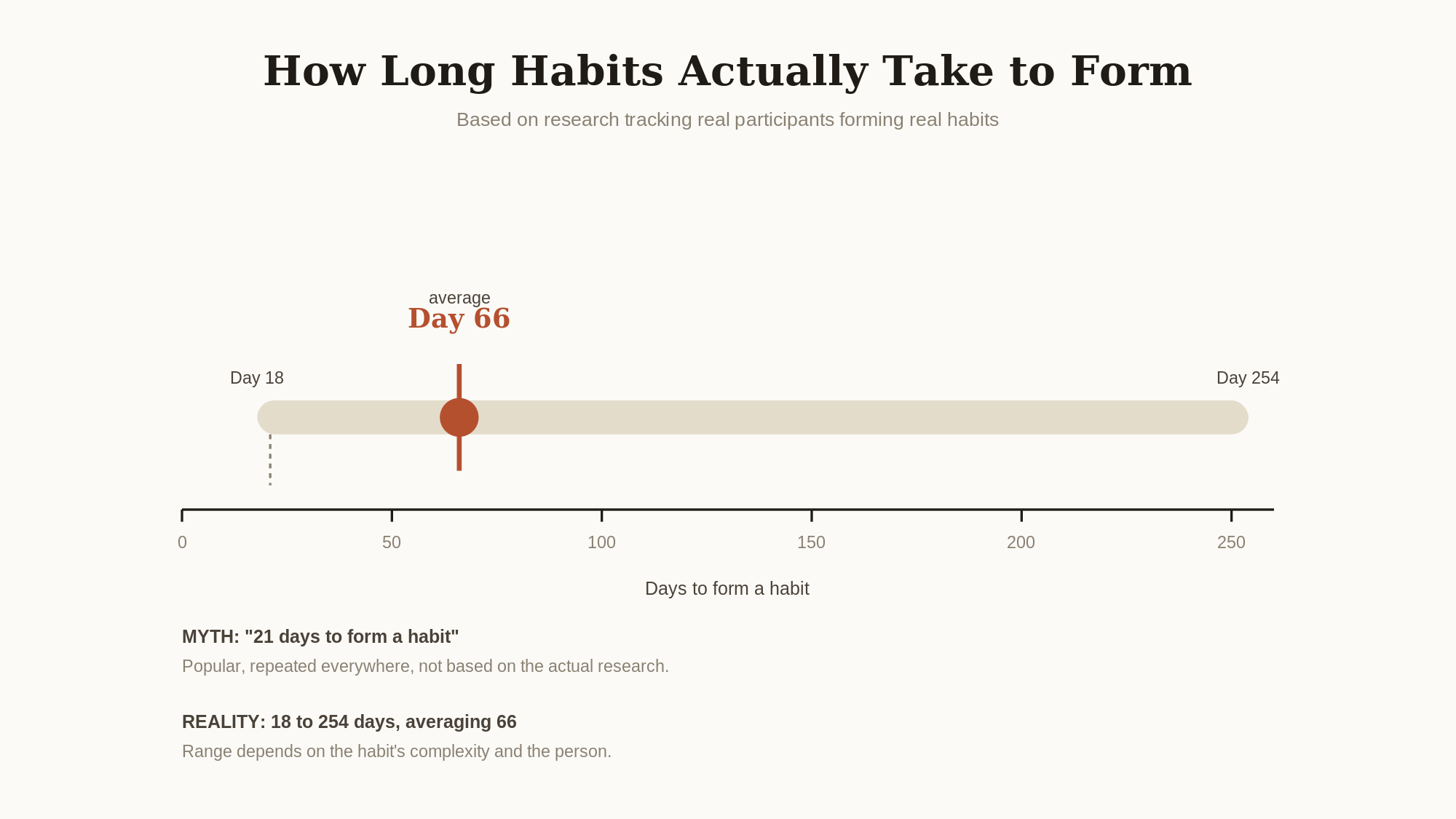
- The 21-day myth is wrong. Research on real people forming real habits found it takes anywhere from 18 to 254 days, with an average around 66.
- Tiny habits work because they lower the amount of motivation required, not because small actions are inherently good.
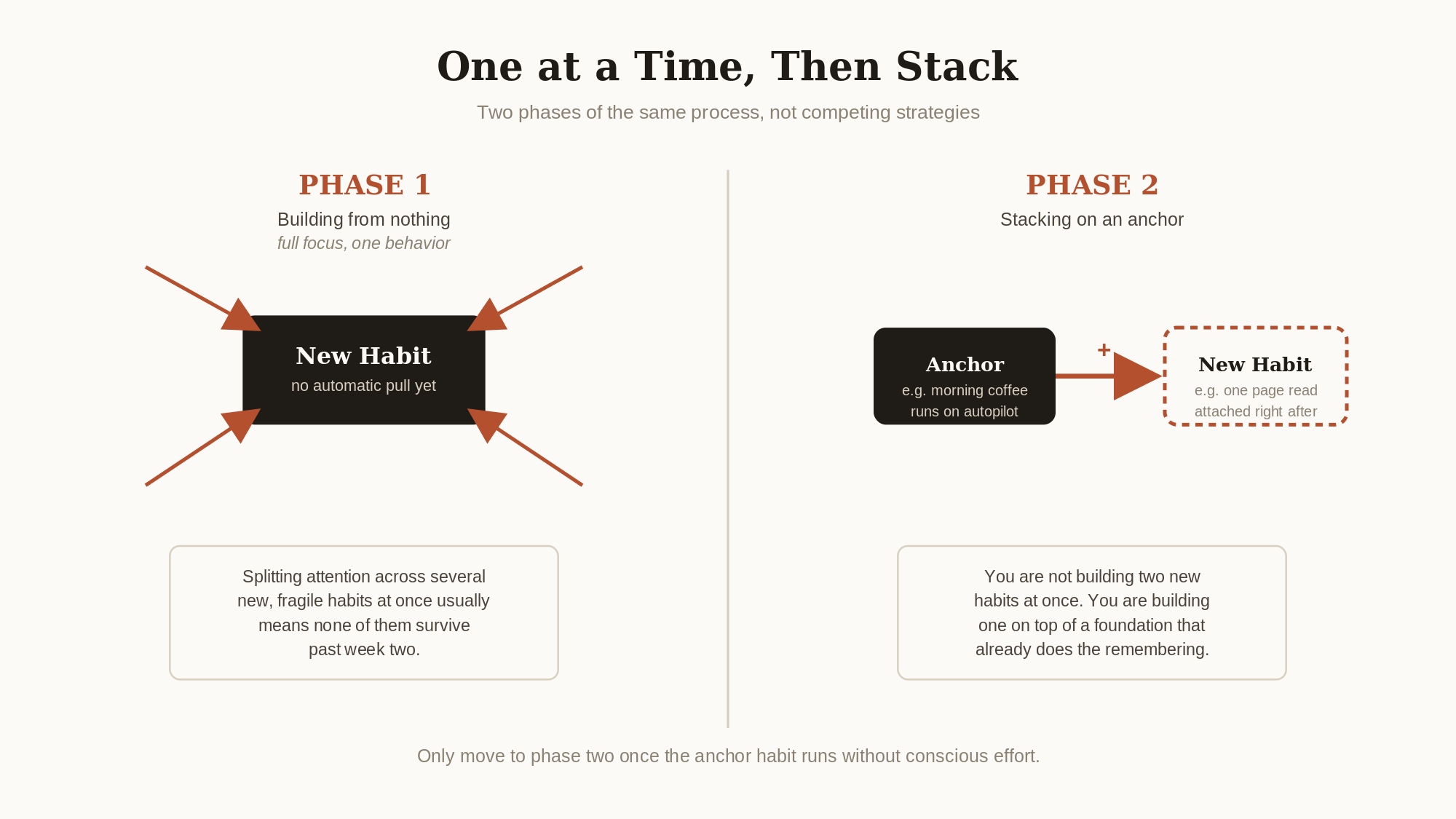
- Stacking several habits at once and building one habit at a time are not opposing strategies. They belong to different phases of the same process.
- Rewards only reinforce a habit when they happen immediately, connect to the action, and stay small.
- Identity-based habits (“I am someone who shows up”) outlast goal-based habits (“I want to lose 10 pounds”) because identity does not expire once a target is hit.
- Missing one day rarely kills a habit. Missing three weeks and not having a restart plan does.
Why Your Past Attempts Failed (And It Was Never About Willpower)
Every habit, good or bad, runs through the same four-step loop: a cue, a craving, a response, and a reward. This model was popularized by Charles Duhigg and later refined by James Clear, who described the process as cue, craving, response, and reward, arguing this four-step pattern is the backbone of every habit your brain repeats in the same order each time.
The cue is what tells your brain a reward is nearby. The craving is the desire that cue creates. The response is the actual behavior. The reward is what satisfies the craving and teaches your brain to repeat the loop next time.
Here is why this matters more than any single tip. If a habit is not sticking, the problem is not that you lack discipline. The problem is that one of these four steps is missing or broken. No cue means the habit never gets triggered. No craving means there is no motivation to act. Too much friction in the response means you will not do it even when you want to. A weak reward means your brain has no reason to repeat the behavior tomorrow.
Most people troubleshoot habits by blaming themselves. The more useful question is: which step in the loop is actually failing? Once you can answer that, you stop guessing and start fixing the actual weak point instead of just trying harder.
This reframe changes everything that follows in this guide. Every tactic below, tiny habits, stacking, rewards, tracking, is really just a tool for strengthening one of these four steps. Keep that connection in mind and the tactics stop feeling like a random grab bag.

How to Build a Habit: Forget the 21-Day Myth and Read the Research
Somewhere along the way, “21 days to form a habit” became common knowledge. It is repeated in fitness apps, corporate wellness programs, and most habit blogs. It is also not based on real evidence.
The number that actually comes from research is different, and more useful once you understand it. A 2010 study by Phillippa Lally and colleagues at University College London tracked 96 people forming real habits and found it took an average of 66 days for a behaviour to become automatic, with individuals ranging from 18 days to a predicted 254 days depending on the habit and the person.
That range matters more than the average. A habit like drinking a glass of water after waking up is simple, low friction, and can become automatic in a few weeks. A habit like a full workout routine involves more complexity, more decisions, and more resistance, so it can reasonably take months to feel automatic.
The mistake most people make is treating day 21 (or even day 66) as a deadline. When the habit still feels effortful past that point, they conclude something is wrong with them and quit. In reality, feeling effortful at day 40 is completely normal for anything beyond the simplest behaviors.
The practical takeaway is to stop counting days as a measure of success. Instead, watch for the moment the behavior stops requiring a mental negotiation with yourself. That moment is different for every habit, and it will not arrive on a fixed schedule. Expecting it too early is one of the most common reasons people abandon habits that were actually working.
Start Absurdly Small (Smaller Than Feels Useful)
Stanford behavior researcher BJ Fogg built an entire framework around one idea: most people fail at habits because they start too big, not because they lack motivation. His research group at Stanford recommends setting the bar low enough that you can be consistent with a habit every single day, since making a habit small enough lowers the amount of motivation required to complete it.
What this actually means: if you want to build a reading habit, the goal is not “read for 30 minutes a day.” The goal is “read one page.” If you want to build a flossing habit, the goal is not your whole mouth. It is one tooth.
This feels almost too easy to matter, which is exactly why most people skip it. But the mechanism is simple. A habit only needs to survive your worst day, the day you are tired, busy, or unmotivated. If the habit is small enough to do even then, it survives. If it requires real effort, your worst day is exactly when it breaks, and once a habit breaks on a bad day, restarting gets harder every time.
Here is how to apply it in practice.
- Cut your first instinct in half, then in half again. Whatever number feels reasonable to you right now is still too ambitious for week one. If your instinct says 20 minutes of exercise, start with a 5-minute version instead.
- Judge success by whether you showed up, not by output. One page read counts as a full success on day one, even if you wanted to read a chapter. The habit is what you are training, not the volume.
- Let yourself do more, but never require it. If you feel like reading three pages instead of one, go ahead. The moment doing more becomes an expectation, the habit turns back into an obligation.
The common mistake here is treating the tiny version as a warm-up before “the real habit” starts. It is not a warm-up. For the first few weeks, the tiny version is the entire habit. Trying to upgrade it too soon is the single fastest way to undo the progress you just made.
One Habit at a Time, or Stack Several? Resolving the Contradiction
If you search habit advice long enough, you will run into a direct contradiction. Some sources insist you should only work on one habit at a time, because splitting focus across several new behaviors makes all of them weaker. Other sources recommend stacking multiple small habits onto your morning routine at once, treating that as an efficient way to redesign your whole day.
Both pieces of advice are correct. They just apply to two different phases of habit building, and most articles never say which phase they are talking about.
Phase one: building a new habit from nothing. This is where the “one at a time” advice applies. Establishing a brand-new behavior, one with no existing cue and no automatic pull, takes real attention. Splitting that attention across three new, fragile habits at once usually means none of them survive past week two. This phase deserves your full focus on a single behavior until it stops requiring conscious effort.
Phase two: attaching new behaviors to a habit that is already automatic. Once a habit runs without thinking, for example your morning coffee, it becomes a stable anchor. At that point, you can attach a second small behavior right after it, a technique often called habit stacking, without diluting your focus. You are not building two new habits at once. You are building one new habit on top of a foundation that already does the remembering for you.
The practical rule is this: only stack a new habit onto an existing one once that existing habit runs on autopilot. If you are still consciously reminding yourself to do the anchor habit, it is not stable enough to build on yet, and adding something new to it will just make both behaviors weaker.
This is also why habit stacking works so well for people who already have a strong daily routine, and works poorly for people trying to build their entire routine from scratch in one attempt. If you have no anchor habits yet, phase one comes first. There is no shortcut around it.
Make the Cue Impossible to Miss
A habit cannot start if nothing reminds you to do it. This sounds obvious, but most people design their environment to make good cues invisible and bad cues unavoidable. Your phone sits on your nightstand and buzzes; your running shoes sit in the closet where you cannot see them.
The fix is not more motivation. It is environment design. Move the object connected to the habit into your direct line of sight, and remove the friction between noticing the cue and starting the response.
- Put the object where the habit should happen. If you want to meditate after waking up, put the cushion at the foot of your bed, not in a closet. If you want to drink more water, keep a full glass on your desk instead of relying on thirst to remind you.
- Use “if this, then that” planning. Psychologist Robert Cialdini’s research on implementation intentions shows that deciding your cue and action in advance, in an “if I brush my teeth, then I will floss” format, makes it significantly easier to follow through than relying on remembering in the moment.
- Reduce the number of steps between noticing the cue and starting. If your workout requires finding clean clothes, filling a water bottle, and locating headphones before you even leave the house, each of those steps is a chance to quit. Prep them the night before so the only decision left in the morning is to begin.
Common mistake to avoid: relying on a cue that lives inside your own memory, like “I’ll just remember to do it after lunch.” Memory is an unreliable cue precisely because it depends on you being in the right mental state to notice it. Physical, environmental cues do not have that weakness. They are there whether you are tired, distracted, or stressed.
Reward It Immediately, and Keep the Reward Small
Most people think about rewards backward. They picture a big prize waiting at the finish line: new clothes after losing weight, a vacation after finishing a big project. Research on habit formation says almost the opposite works better.
A reward’s job is not to motivate the behavior. It is to reinforce it after the fact. That distinction matters because it changes what a good reward actually looks like. Effective rewards share three traits: they happen immediately after the action, they are connected to the action itself, and they stay small.
Immediate matters because your brain’s reward systems respond within moments, not days. A reward that arrives a week later, like a cheat meal on Sunday for a week of clean eating, does very little to reinforce Monday’s individual choice. The two events are too far apart for your brain to link them.
Connected matters because the reward needs to require the habit to get it. If your reward for a workout is a nap, you could just take the nap and skip the workout entirely, and part of your brain knows that. A reward tied specifically to the action, like a coffee shop you only visit on your way home from the gym, keeps the connection intact.
Small matters more than it seems like it should. Research on motivation, going back to Self-Determination Theory from psychologists Deci and Ryan, shows that a large enough external reward for something you already enjoy doing can actually shift your motivation from internal to external, and you end up doing the behavior less, not more. Big rewards do not add fuel. They can quietly replace the fuel you already had.
Where this matters most: habits you are trying to enjoy for their own sake, like reading, journaling, or a creative practice. Over-rewarding these with something large risks turning an activity you liked into a transaction you are just doing for the prize.
Attach the Habit to Your Identity, Not Just the Outcome
Most habit advice focuses entirely on outcomes: lose the weight, write the book, save the money. Outcome-based motivation has one structural weakness. Once you hit the outcome, or once progress stalls and the outcome feels far away, the motivation to continue disappears with it.
Identity-based habits work differently, and almost no habit guide explains how to actually use this in practice, beyond a passing mention. The shift is small in wording but large in effect: instead of “I want to run a 5k,” the framing becomes “I am someone who runs.” Instead of “I’m trying to save money,” it becomes “I am someone who checks in on my finances.”
Here is why the wording shift changes behavior. An outcome can be finished. An identity cannot. Once you have run the 5k, the goal that was driving you is gone, and there is nothing pulling you toward the next run. But if running is part of how you see yourself, missing a run creates a small internal conflict, a sense of acting against your own identity, which is a stronger pull back toward the behavior than chasing a finished goal ever was.
To apply this, pick one identity statement connected to the habit you are building, and treat every small action as evidence for or against it. Each time you show up, even the tiny version, you are casting a vote for that identity. Each time you skip it, you are casting a vote against it. Neither vote is permanent, which is exactly the point.
Common mistake to avoid: using identity language as a source of shame instead of direction. “I am someone who runs” should motivate you to run today. It should not become “I am a failure because I skipped a run,” which turns identity from a compass into a weapon against yourself. One missed vote does not overturn an election. Keep the identity language focused forward, not backward.
Track It, But Don’t Worship the Streak
Tracking a habit, whether on paper, in an app, or with a simple checkmark on a calendar, has one of the most consistent effects in behavior research: people who track a behavior are more likely to keep doing it than people who do not. Writers, dieters, and people managing chronic conditions all show the same pattern, which is why behavioral scientists have repeatedly found that tracking behavior, whether it’s exercise, diet, studying, or managing an illness, makes people more likely to stick with it.
The reason tracking works is visibility. A habit you cannot see any evidence of is easy to quietly abandon. A habit with a visible record creates a small, immediate reward every time you mark it done, and a small, immediate discomfort every time you have to leave it blank.
That said, tracking has a failure mode worth naming directly: treating an unbroken streak as the entire point. When the streak becomes the goal, one missed day stops feeling like a normal part of building a habit and starts feeling like the whole system has failed. Some people quit entirely the moment their streak breaks, purely because the number reset to zero.
The healthier way to track is to record the habit for information, not for a perfect record. A simple log that shows four out of seven days is still useful information about what is working and what is not. A log you abandon the first time it is not perfect gives you nothing. Track to learn your own patterns, not to protect a number.
The Real Test: What to Do When You Fall Off for Weeks, Not Just a Day
Almost every habit guide covers the one missed day. The advice is consistent and correct: if you miss a day, do not miss the next one too. As Zen Habits founder Leo Babauta puts it, if you let yourself miss a day, be sure you do not let yourself miss a second one, because missing two days in a row is the moment that actually threatens the habit, not the single missed day itself.
But almost nobody covers the harder, more common situation: you did not just miss one day. You missed three weeks, because of illness, travel, a stressful month at work, or simply losing the thread. This is where most habit advice goes quiet, and it is exactly the moment people need a plan the most.
Here is what an actual restart looks like, based on the same principles covered above.
- Do not audit the failure before you restart. Spending a lot of time analyzing exactly why the last three weeks fell apart delays the one thing that actually matters, which is doing the habit again today. A brief, honest look is fine. An extended investigation is procrastination wearing a productive disguise.
- – Restart at the tiny version, not where you left off. If you were running 5 kilometers before the break, do not try to pick back up at 5 kilometers. Restart at the smallest version from phase one. The three-week gap reset your automaticity, even if it did not reset your fitness.
- – Rebuild the cue before you worry about consistency. A long break usually means your environmental cues disappeared too. The running shoes got put away. The journal got buried under other things. Fix the cue first; consistency will follow once the cue is back in place.
- – Expect the first week back to feel like week one, because it is. This is not a personal failure. It is simply how habits work after a real interruption. Treating it as a fresh start, rather than a disappointing relapse, removes most of the shame that keeps people from trying again at all.
This is really the difference between people who eventually build a lasting habit and people who do not. Almost everyone experiences a real break at some point, whether from a vacation, an illness, or a busy season. The people who succeed long term are not the ones who never break their streak. They are the ones who have an actual plan for restarting instead of treating the break as proof the habit was never going to work.
Bring Someone Else Into It
Habits built entirely alone are not inherently weaker, but they do lose one useful mechanism: social accountability. Telling another person about a habit, or better, doing it alongside them, adds a layer of consistency that willpower alone struggles to provide.
Fogg’s research group at Stanford frames this directly, noting that syncing your efforts with someone who shares the same goal, such as finding a friend to walk with, helps both people become more consistent with the habit. The mechanism is straightforward. Skipping a habit only you know about costs you nothing socially. Skipping a habit someone else is tracking with you costs you a small, real moment of accountability.
This does not require a formal system. It can be as simple as a daily text to a friend confirming the habit happened, or scheduling the activity itself with another person so cancelling requires actually telling them. The specific format matters less than the presence of another person who notices whether you followed through.
Where this matters most: habits that are easy to justify skipping when you are the only one who will know, like a workout, a writing session, or cutting back on a specific expense. Habits that are private by nature, like a personal reading practice, benefit less from this and may not need it at all.
A Simple System to Start Today
Everything above works best as a sequence, not a menu you pick items from at random. Here is the order that ties it together.
- Pick one habit and shrink it until it feels almost too easy. This is phase one. Do not add a second new habit yet, no matter how motivated you feel right now.
- 2. Attach it to a specific, physical cue you cannot miss. Place the object where the habit happens, and write out the exact “if this, then that” trigger in one sentence.
- 3. Reward yourself immediately, in a small way, connected to the action. Skip the big, delayed reward entirely for this habit.
- 4. Track it for information, not for a perfect streak. A simple daily mark is enough.
- 5. Only once the habit runs without conscious effort, stack the next small habit on top of it. This is the signal that phase one is complete and phase two can begin.
- 6. When (not if) a real break happens, restart at the tiny version and rebuild the cue before worrying about consistency.
None of these steps require more discipline than you already have. They require applying the right tactic at the right moment instead of every tactic at once, which is where most habit advice, however well-intentioned, quietly falls apart.
Frequently Asked Questions
How long does it actually take to build a habit?
There is no fixed number. Research tracking real habit formation found it took an average of 66 days, with a range from 18 to 254 days depending on the habit’s complexity and the person. Simple habits form faster than complex ones. Stop counting toward a deadline and instead watch for the point where the behavior stops requiring a mental negotiation with yourself.
What should I do if I miss a day?
Do the habit again the next day without treating the missed day as a failure. One missed day rarely breaks a habit on its own. What actually threatens the habit is missing two days in a row, since that second miss is where the behavior starts slipping out of your routine entirely.
Should I focus on one habit at a time, or build several at once?
Focus on one habit at a time until it runs without conscious effort. Only then should you stack a second small habit directly onto it. Trying to build several brand-new habits at the same time usually means none of them get enough attention to survive.
Do rewards help or hurt habit building?
The right kind of reward helps, but most people use the wrong kind. Effective rewards happen immediately after the action, connect directly to that action, and stay small. Large, delayed rewards, like a big treat at the end of the week, do little to reinforce the habit and can even reduce your motivation over time.
What is the difference between a habit and a routine?
A habit happens automatically, triggered by a cue, without requiring active decision-making. A routine is a sequence of actions you follow intentionally, but still have to consciously choose to start each time. Many routines eventually become habits once they run often enough to become automatic, but not every routine gets there.
Does willpower matter at all?
Willpower helps in the first days of a new habit, before any automaticity has formed. But relying on it long term is not a system, since motivation naturally rises and falls with mood, stress, and energy. The tactics in this guide, tiny habits, strong cues, immediate rewards, tracking, and a restart plan, are designed specifically to keep the habit going on the days your willpower is low.