You ask how to sell more courses and get two opposite answers. One person tells you to build an email list and nurture it. Another swears cold email landed them a five-figure client last month. Both sound convincing. Neither tells you which one fits where you are right now.
Here’s the short version. Email marketing means emailing people who signed up to hear from you. Cold email means emailing strangers you researched, usually to start a business conversation. Both live in the inbox. Everything else about them is different, from the tools to the laws to the results you can expect.
This guide breaks down what each one actually does, how they differ in practice, and which one deserves your attention first as a course creator.
TL;DR
- Email marketing goes to people who opted in: your subscribers, students, and leads. Its job is to build trust and sell your courses.
- Cold email goes to strangers you researched, almost always businesses. Its job is to start a conversation, never to close a sale.
- Start with email marketing. Students buy from teachers they trust, and a nurtured list builds that trust on autopilot.
- Add cold email only for specific jobs: corporate training deals, partnership pitches, or filling a coaching pipeline.
- Never run both from the same tool or the same domain. Cold email complaints will sink the deliverability of your student emails.
- The two work best as a relay. Cold email opens the door, and email marketing carries the relationship from there.
Email Marketing vs Cold Email: The Quick Answer
Email marketing covers every message you send to people who gave you permission: welcome sequences, newsletters, launch campaigns. Cold email covers outreach to people who have never heard of you, like an HR manager who might buy your course for their team.
Here’s the difference at a glance.
| Factor | Email Marketing | Cold Email |
|---|---|---|
| Who you email | Subscribers who opted in | Strangers you researched |
| Main goal | Build trust, sell courses | Get a reply, start a conversation |
| Format | Branded, designed emails | Short, plain-text notes |
| Volume | Your whole list at once | 20 to 30 sends per day |
| Tools | Email marketing platform | Dedicated cold outreach software |
| Legal basis | Consent | Varies by country, B2B is safer |
| Time to results | Compounds over months | Replies within days, deals take longer |
Now let’s walk through what actually falls into each category, and why each piece matters for your course business.
What Is Email Marketing?
Email marketing is the practice of emailing people who asked to hear from you. They grabbed your free checklist, joined your webinar, or enrolled in your course. That permission changes how every message lands. Your email arrives as a welcome follow-up, never an interruption.
It also happens to be the highest-return channel you’ll ever run. According to Litmus research, “email marketing has a 36:1 ROI,” meaning every dollar spent returns about 36 dollars on average (source). No ad platform comes close to that.
There’s a deeper reason course creators live and die by their list, though. It’s the only audience you own. Instagram can change its algorithm tomorrow and cut your reach in half. Your list stays yours, and every blog post and freebie you publish grows it a little more.
For a course business, email marketing breaks down into three core message types. Let’s go through each one.
Welcome Sequences
A welcome sequence is the short series of automated emails a new subscriber gets right after signing up. It introduces who you are, delivers the freebie they signed up for, and shows them how you teach. This is the highest-open-rate email you will ever send, because interest peaks at the moment of signup.
Three to five emails is plenty. Deliver the lead magnet, share your story, teach one quick win, and point to your best free content. By the end, a stranger has become someone who recognizes your name in their inbox.
Common mistake to avoid: Pitching your course in email one. A new subscriber barely knows you. Let the sequence build familiarity first, then introduce your paid offer near the end, once you’ve already delivered real value.
Newsletters
A newsletter is your regular email to the whole list, usually weekly. One lesson, one student win, or one answer to a question you keep hearing. Its job is simple. Keep the relationship warm between launches, so your sales emails never arrive out of nowhere.
Consistency matters more than polish here. Every email you send trains your audience to open the next one. A plain, useful weekly email beats a beautiful monthly one that people forget exists.
Where this matters most: The months before a launch. Creators who emailed weekly all along see far stronger launch results than creators who go quiet and only show up to sell.
Launch Emails
Launch emails are the campaign you send when enrollment opens. Announcement, objection handling, student proof, and a final deadline reminder. This is where the trust you built through welcome emails and newsletters converts into actual revenue.
A typical launch runs five to seven emails over a week or two. That number surprises new creators, but most sales come from the reminder and deadline emails, never the announcement. People need repetition before they act.
Common mistake to avoid: Launching to a list you never nurtured. If your first email in three months is a sales pitch, expect unsubscribes instead of enrollments. The newsletter earns you the right to launch.
If you don’t have a list yet, that’s the first fix. A content marketing strategy is usually the cheapest way to build one, because every post you publish can carry a signup offer.
What Is Cold Email?
Cold email is outreach to someone who has never heard of you. No signup, no prior contact. You found their address through research or a lead database, and you’re writing to start a conversation, usually about a business deal.
That word “conversation” carries all the weight. A cold email never asks for a sale. It asks for a reply, a short call, or permission to share more. Pitch your course price to a stranger in message one and you get deleted, or worse, reported as spam.
Expect small numbers, too. Backlinko analyzed 12 million outreach emails and found that “only 8.5% of outreach emails receive a response” (source). That sounds brutal until you remember one reply can be worth more than a hundred individual course sales.
One thing to settle before you send anything. The law treats cold email differently by region. In the US, CAN-SPAM allows it if you use accurate sender details, include a physical address, and honor opt-outs. In the EU, GDPR is far stricter, and cold emailing consumers can bring real fines. Stick to business contacts and you stay on the safer side everywhere.
For course creators, cold email earns its keep in exactly three situations.
Corporate Training Outreach
If your course teaches a workplace skill like Excel, leadership, or compliance, companies are realistic cold prospects. HR managers and team leads have training budgets, and a team license can be worth 50 individual enrollments in a single deal.
The email itself stays short. Name their company, state the problem your course solves for teams like theirs, and ask for a fifteen-minute call. That’s it. The call sells the deal, never the email.
Common mistake to avoid: Sending the same template to 200 companies. Corporate buyers can smell a mail merge instantly. Ten researched emails with a personal first line beat a hundred generic ones. Every time.
Partnership and Podcast Pitches
Podcast hosts, newsletter writers, and creators with adjacent audiences can put your course in front of thousands of ideal students overnight. A guest spot on the right podcast often outperforms months of your own content.
The pitch works when it centers on their audience, never on you. Show you actually know their show, propose a specific topic their listeners would care about, and make saying yes easy.
Where this matters most: The months before a launch. A podcast tour timed ahead of enrollment fills your list with warm leads right when you need them most.
Service and Coaching Leads
Many course creators also sell coaching, consulting, or done-for-you work. Cold email fills that pipeline faster than waiting for inbound interest, especially when your ideal client has a job title you can search for on LinkedIn.
Notice what’s missing from all three situations. Selling a consumer course to strangers. It rarely works, and in regions like the EU it often breaks the law. If your students are individuals, keep cold email out of your student acquisition plan entirely.
Email Marketing vs Cold Email: The Full Comparison
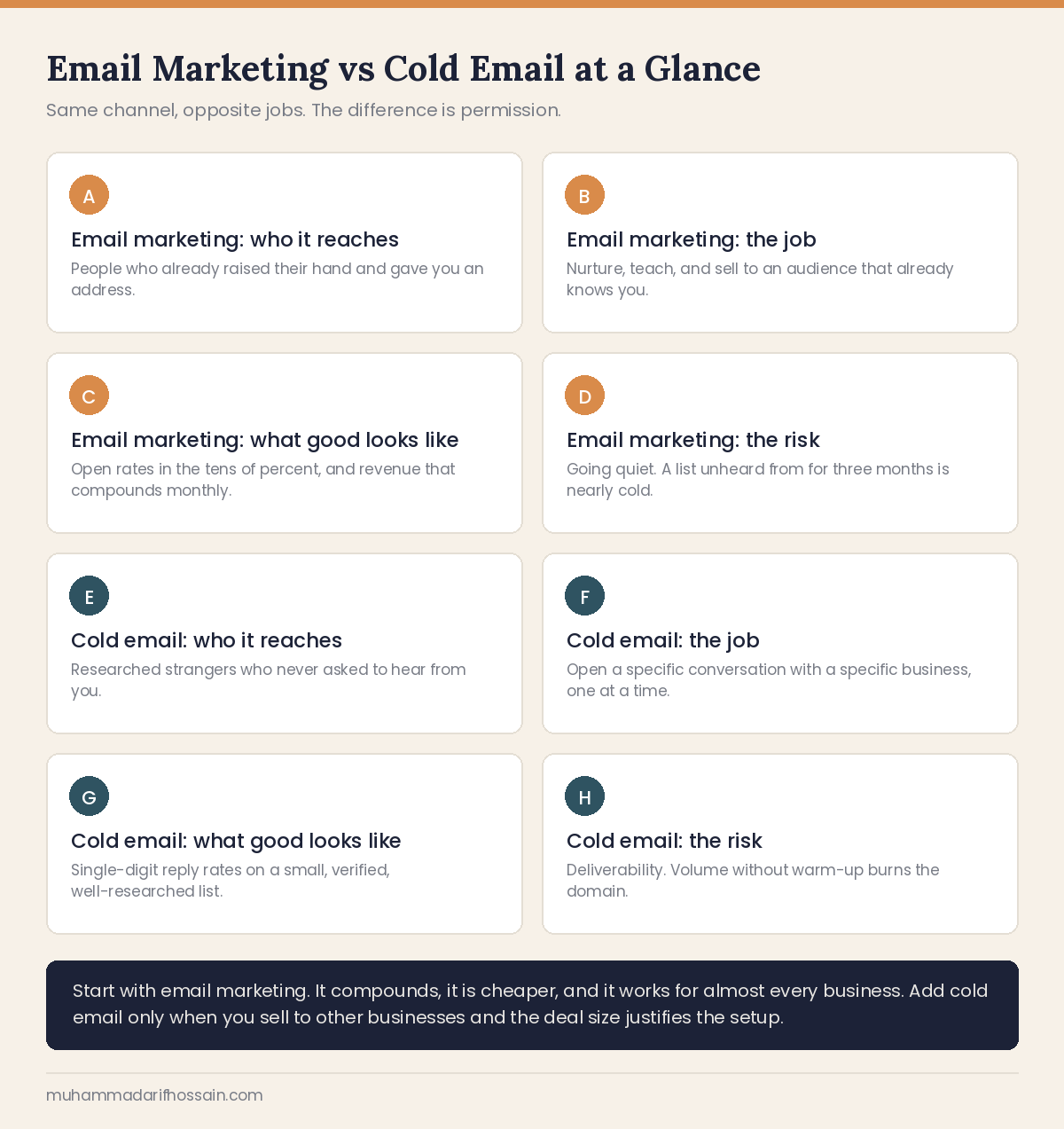
Here’s how the two channels stack up once you look past the definitions.
| Email Marketing | Cold Email | |
|---|---|---|
| Permission | Explicit opt-in | None, so providers watch you closely |
| Deliverability | Strong, if you email consistently | Fragile, one bad week hurts the domain |
| Cost to start | Free at small list sizes | Domain, inboxes, leads, verification tools |
| Setup time | One afternoon | About a month, including warmup |
| Risk of mistakes | A few unsubscribes | A burned domain, weeks of recovery |
| Best measured by | Opens, clicks, launch revenue | Positive replies, booked calls |
The permission gap drives everything in that table. Gmail knows your subscribers asked for your emails, so it puts them in the inbox. Gmail also knows when strangers ignore or report you, and it punishes the sending domain for it. Same sender, same words, completely different treatment.
Permission shapes the format too. Subscribers recognize your brand, so logos, buttons, and course thumbnails work fine. A designed template from a stranger screams mass mailing. Every good cold email looks like a plain note a real person typed, because that’s exactly what it should be.
Neither column is wrong. They’re built for different jobs, and the trouble only starts when you use one for the other’s job.
Which One Should You Start First?
If you’re starting from zero, email marketing comes first. It’s fully in your control, it costs almost nothing, and it builds the one asset every course business runs on: a list of people who trust you.
Think of it this way. Remember the last course you bought. Did a stranger’s email convince you? Almost certainly not. You followed that creator for weeks, read their emails, tried their free tips, and saw some results. Then you bought. Courses run on trust, and cold email can’t manufacture trust with a consumer. A nurture sequence can, and it does it on autopilot.
The economics point the same way. Email marketing needs a signup form and a welcome sequence, and plenty of platforms include that for free at small list sizes. Cold email needs a separate domain, lead databases, verification tools, and two to three weeks of inbox warmup before your first real send.
Mistakes are cheaper on the marketing side too. Mess up a newsletter and you lose a few subscribers. Mess up cold outreach and you can burn a domain for weeks. When you’re learning, pick the channel where errors don’t wreck anything.
One honest exception. If corporate training or B2B services are your main revenue plan, start cold email early, because your buyers are companies, not individual students. Even then, build your list alongside it. The list is what keeps selling when outreach slows down.
How Email Marketing and Cold Email Work Together
These two aren’t rival strategies. At their best, they run as a relay.
Say you cold email 40 HR managers about your team training. Three reply, and one books a call. During the call, she’s interested but can’t budget it until next quarter. So you point her to your free workshop, she opts in, and now she’s on your list. Your newsletter keeps teaching her for three months, and when the budget opens, you’re the obvious choice.
Cold email found her. Email marketing closed her. Neither channel could have done the whole job alone.
The handoff has one rule. The prospect must opt in themselves. When a cold reply shows interest, send your signup link and let them choose. Only then do they join your subscriber list. That keeps your marketing list fully permission-based, which protects the deliverability everything else depends on.
Common Email Marketing and Cold Email Mistakes to Avoid
Sending cold email through your marketing platform. Most email marketing platforms ban cold outreach in their terms of service. Get caught and your account gets suspended, along with the subscriber list inside it. Years of list building gone over one shortcut.
Running outreach from your main domain. Cold email attracts spam complaints by nature, and those complaints drag down inbox placement for your newsletters and launch emails too. Use a separate domain, like tryyourname.com, so a bad outreach week can never touch the domain your students hear from.
Importing scraped or purchased contacts into your list. Bought contacts never consented, they bounce at high rates, and they tank your sender reputation. Verified, opted-in subscribers are the only ones who belong on a marketing list.
Skipping authentication setup. SPF, DKIM, and DMARC are DNS records that prove your emails really come from you. Skip them and both channels suffer, because Gmail and Outlook now treat unauthenticated senders as spam by default.
Going quiet between launches. A list that hasn’t heard from you in three months is nearly as cold as a purchased one. Weekly contact is what keeps launch emails landing in the inbox instead of the promotions graveyard.
A Simple Starting Checklist
Not sure where to begin? Work through this order.
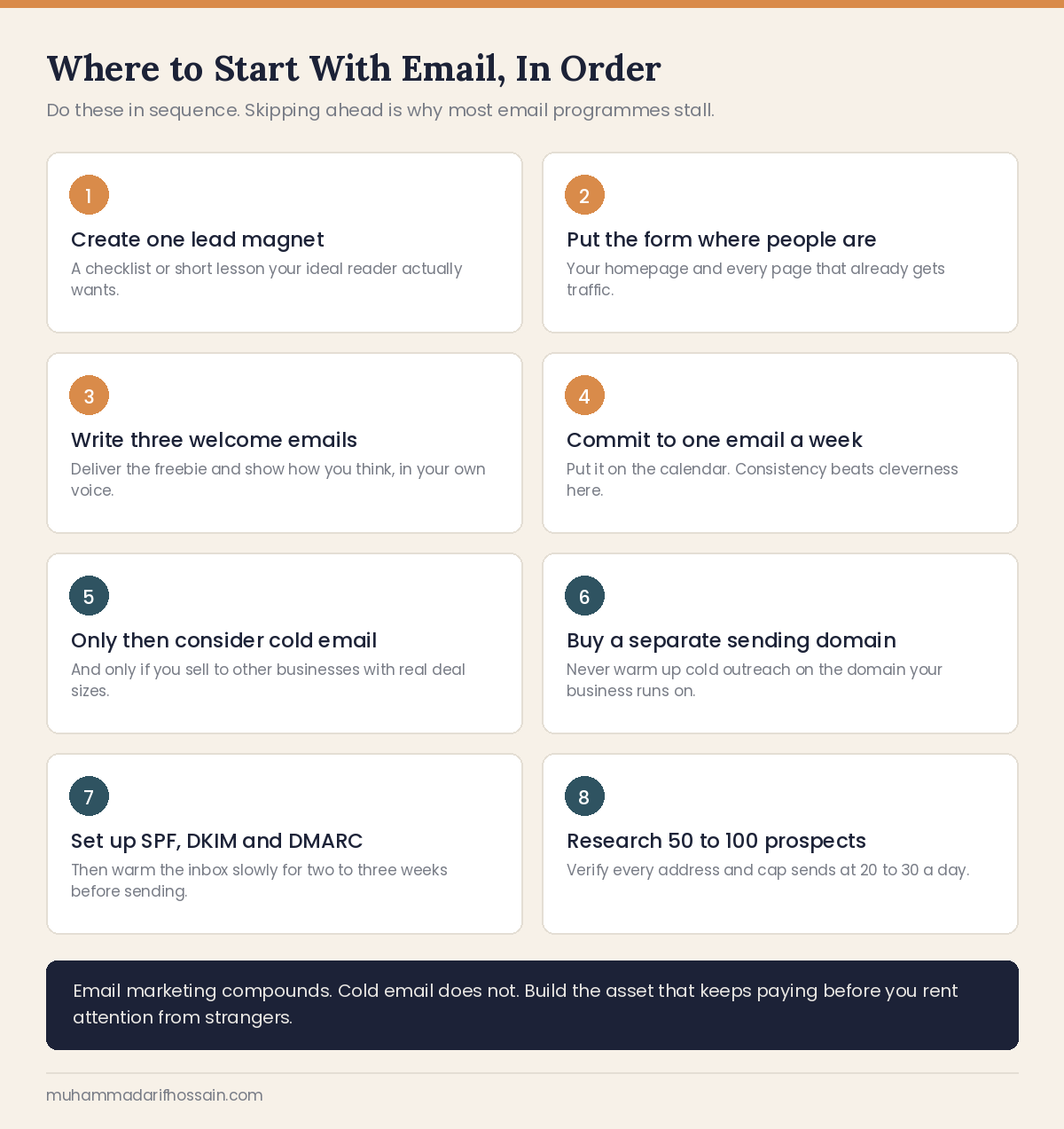
- Create one lead magnet your ideal student actually wants, like a checklist or a free mini lesson
- Add a signup form to your course site and homepage
- Write a three-email welcome sequence that delivers the freebie and shows how you teach
- Commit to one useful email per week, and put it on your calendar
- Pick a dedicated email platform and keep the signup form on a page you have already run through conversion rate optimization
- Only if you sell to businesses: buy a separate outreach domain, set up SPF, DKIM, and DMARC, and warm the inbox for two to three weeks
- Build a researched list of 50 to 100 business prospects, verify every address, and cap sends at 20 to 30 per day
Related Guides
- Cold Email Marketing in 2026: What Works and Mistakes to Avoid
- Content Marketing Strategy: 8 Steps That Actually Work
- Conversion Rate Optimization: 6 Steps and Mistakes to Avoid
- How to Write a Blog Post: 9 Steps and Mistakes to Avoid
- Copywriting Strategy: 6 Steps and Mistakes to Avoid
Not Sure Which Channel Your Business Needs?
Start the list this week, even with an imperfect freebie and a two-email sequence. Email marketing vs cold email stops being a debate once your list starts compounding, and cold email can wait for the day a corporate deal or a podcast tour makes the setup worth it.
If you want help deciding which channel actually fits your business, or you want a second pair of eyes on a sequence that isn’t converting, reach out here. I read and reply to every message myself.
Frequently Asked Questions
How many cold emails should I send per day?
You should send 20 to 30 cold emails per day from one fully warmed inbox. New inboxes need to start with a handful of daily sends and rise slowly, since providers flag sudden volume spikes. If you need more volume, add extra inboxes instead of pushing one harder.
Can I add someone who replied to my cold email to my newsletter?
You can add them to your newsletter only after they clearly agree to join. A reply shows interest in the conversation, never consent for ongoing marketing. Send them your signup link and let them opt in themselves, which keeps your list permission-based and your deliverability safe.
What is a good reply rate for cold email?
A good reply rate for cold email sits between 5 and 10 percent for well-researched campaigns. Generic blasts to purchased lists often fall under 1 percent, which is a targeting problem, so fix the list before blaming the copy. Judge campaigns on positive replies and booked calls, since “not interested” still counts as a reply.
How big should my email list be before I launch a course?
You can launch a course with 200 to 500 engaged subscribers. Engagement beats size, and a small list that opens and replies will outsell a big list that ignores you. Many creators even presell to a tiny list first to validate the course before building it.
Is cold email the same as spam?
Cold email is not the same as spam when it’s targeted, personal, and compliant. Spam is bulk, irrelevant, and ignores the law, while a legitimate cold email goes to a researched business contact, offers something relevant, and includes a clear way to opt out. The line is real, and mailbox providers judge you by which side you’re on.