Quick question. When your sales dip, what’s your instinct? If you’re like most people, it’s “let’s get more traffic.” More ads, more content, more cold outreach.
I get it. It feels like doing something. But here’s a number that might change your mind: the average website converts around 1.7% of its visitors. That means over 98 out of every 100 people who show up leave without buying, signing up, or doing anything at all. Getting a slice of that 98% to convert is usually way cheaper than chasing new visitors.
That’s what conversion rate optimization, or CRO, actually is. Not a trick. Not a hack. Just a process for getting more out of the traffic you already have. Let’s get into it.
TL;DR
- CRO means increasing the percentage of visitors who take a specific action, not increasing how many visitors show up in the first place.
- The average conversion rate sits around 1.7%, but “good” changes a lot depending on your industry, price point, and whether you’re B2B or B2C.
- B2B and SaaS usually convert lower than ecommerce, often somewhere around 2 to 4%, because more people are involved in the decision.
- CRO works best as a loop: set a goal, find where people drop off, ask them why, form a real hypothesis, test it, then repeat.
- A jump from 2% to 3% conversion can mean 50% more customers from the exact same traffic. No extra ad spend required.
- B2B and B2C need different tactics. A countdown timer that works on an impulse shopper does basically nothing for a buyer who still needs sign-off from four other people.
So What Is Conversion Rate Optimization, Really?
Here’s the plain version. CRO is the process of getting more of your existing visitors to do the thing you want them to do, whether that’s buying something, booking a demo, or signing up for your list.
The math behind it is simple. Take your number of conversions, divide it by your number of visitors, multiply by 100. Done. If 300 people hit your pricing page last month and 9 of them started a trial, you’re converting at 3%.
But here’s the mindset shift that actually matters. Most people default to asking “how do I get more people here?” CRO flips that question around. It asks “how do I get more value from the people already here?” Completely different problem. And usually, a much cheaper one to solve.
Why a Small Conversion Rate Lift Moves the Needle
Small conversion bumps do something traffic growth can’t. They apply to everyone, not just the new people you’d have to pay to bring in.
Let me show you what I mean. Say you get 100,000 visitors a month, convert 2% of them, and your average sale is $50. That’s $100,000 a month. Now bump that conversion rate up to 2.5%, without touching your ad budget at all. You’re suddenly at $125,000 a month. That’s 25% more revenue from a change most visitors wouldn’t even notice happened.
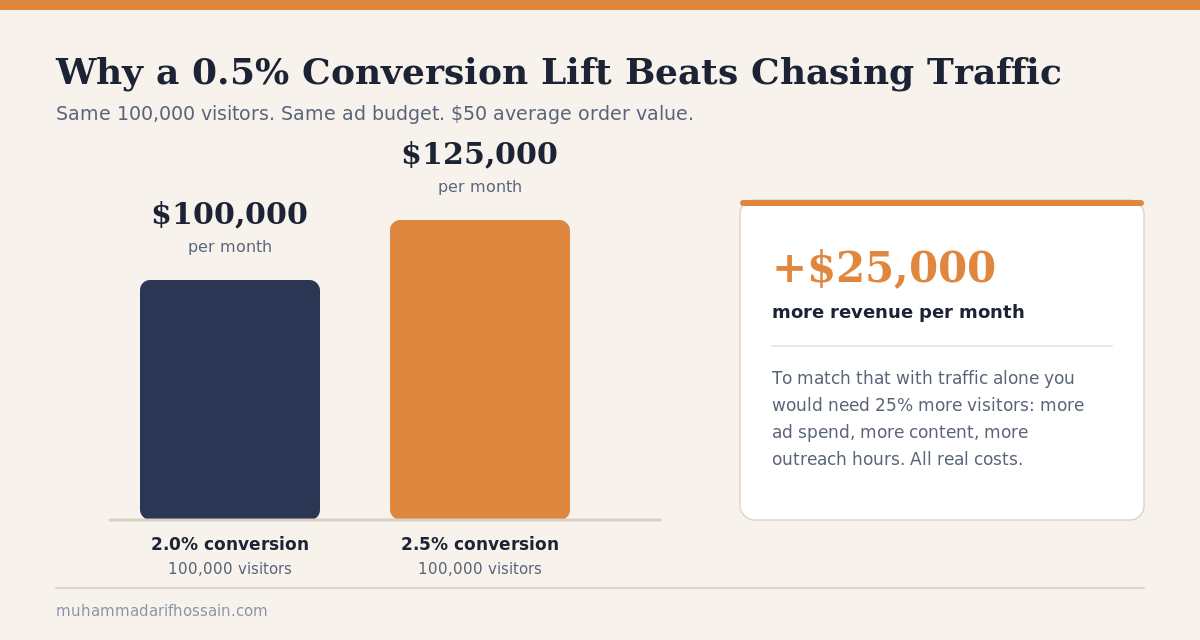
Now compare that to the traffic route. To hit that same $25,000 bump by growing traffic instead, you’d probably need 25% more visitors. That means more ad spend, more content, more outreach hours. All real costs. All real time.
This is exactly why CRO tends to be one of the best-returning things you can spend effort on. You’re not manufacturing new demand out of thin air. You’re just catching more of the demand that’s already knocking on your door.
What Actually Counts as a Good Conversion Rate
I wish I could hand you one clean number and say “hit this and you’re golden.” I can’t, because it doesn’t exist. Your industry, your price point, your traffic source, all of it changes what “good” looks like.
The overall average across every industry sits around 1.7%. But that number is hiding a lot of variance underneath it.
| Industry | Typical Conversion Rate |
|---|---|
| Skincare | ~2.7% |
| Food & beverage | ~2.2% to 7.1% (varies by source) |
| General apparel | ~1.9% |
| Health & beauty | ~1.5% |
| Electronics & accessories | ~1.5% |
| Home furniture | ~0.7% |
| Luxury apparel | ~0.4% |
B2B and SaaS play by different rules entirely. Across a big sample of landing pages built specifically to convert, the overall median lands around 6.6%, but SaaS specifically tends to sit closer to 3.8%. And even that’s only for pages designed for one job, not your average website traffic. A B2B tool with a five-figure annual contract is going to convert nothing like a $15-a-month app, even though both get filed under “SaaS.”
So here’s my honest advice. Don’t grab a number from some other industry and treat it like a target. Compare yourself to your own past numbers first. Use industry data as a rough gut check, not a scoreboard.
The Conversion Rate Optimization Process, Step by Step
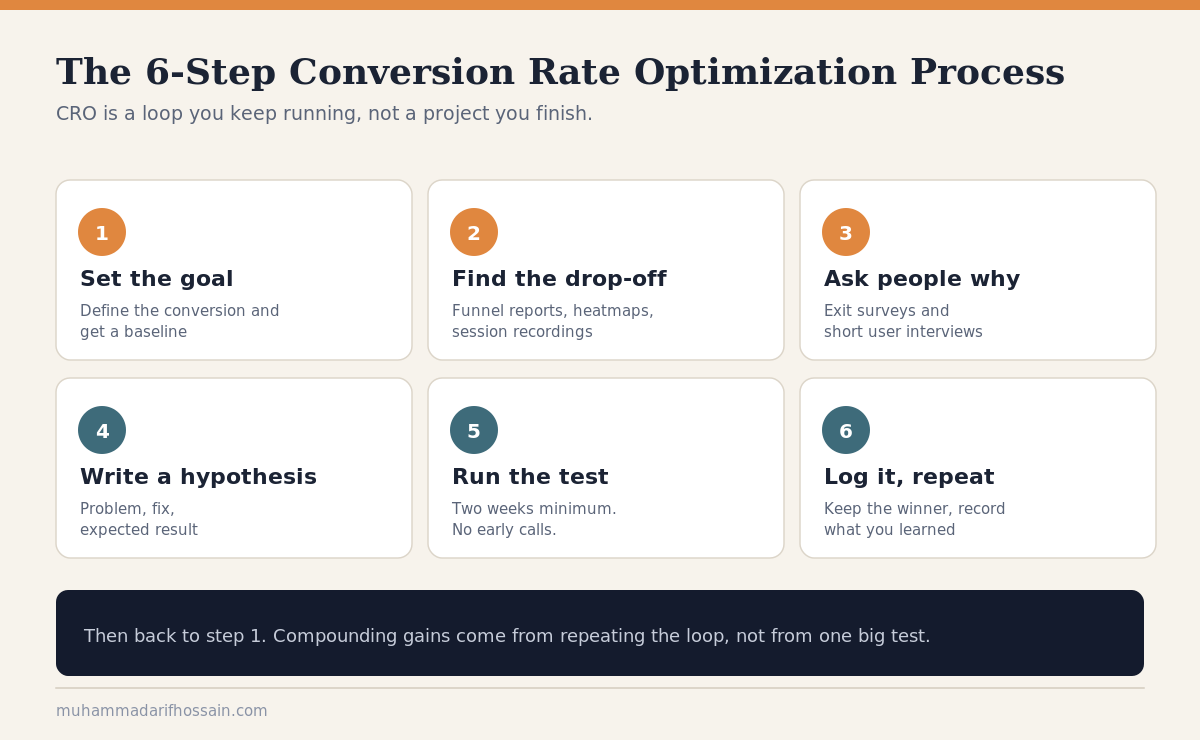
CRO works best as a habit, not a one-time fire drill. Here’s the loop that actually holds up.
Step 1: Get Clear on Your Goal and Your Baseline
Before you touch anything, decide what “conversion” even means for the page you’re working on. A homepage conversion looks different from a pricing page conversion, which looks different again from a blog post conversion.
Set that up as a tracked event in Google Analytics, then just wait. Let the data build for a while before you touch a thing. Without a real baseline, you have no way to know later whether your change actually worked or you’re just seeing normal noise.
Step 2: Figure Out Where People Are Actually Bailing
You can’t patch a leak you haven’t found yet. Pull up your funnel or path reports and see exactly where people exit before finishing what you wanted them to do.
Watch your bounce rate, your form or cart abandonment, time on page, and scroll depth. A high bounce rate usually means what people found didn’t match what they expected. A high form abandonment usually means you’re asking for too much, too soon.
And honestly? Heatmaps and session recordings will show you things a spreadsheet never will. Watching a real person hesitate, scroll back up, and then leave tells you something no percentage can.
Step 3: Just Ask People What Happened
Numbers show you what happened. They almost never tell you why. This step closes that gap.
An exit-intent survey, a quick feedback form, even a handful of short user interviews, all of it works. Ask things like: what stopped you from finishing this today? Was anything confusing? Was there something you were looking for that you couldn’t find?
You don’t need a hundred responses. Even ten honest answers will usually surface a pattern you never would’ve guessed sitting behind your screen.
Step 4: Write a Hypothesis You Can Actually Test
This is the step almost everyone skips, and it’s exactly why so many “we tried CRO and it did nothing” stories exist. Changing something because it feels right is a guess. A hypothesis is a guess you can actually check.
A good one has three parts: the problem, the fix, and the expected result. Something like: “People are dropping off at checkout because it forces account creation. Adding guest checkout should reduce that and lift purchases by around 2%.”
That structure forces you to be specific enough to actually know, afterward, whether you were right or just lucky.
Step 5: Run the Test the Right Way
A/B testing means showing your current version and your new version to different chunks of traffic at the same time, then comparing what happened.
Let it run long enough to mean something. For most sites, that’s a couple of weeks minimum. I know it’s tempting to peek after three good days and call it a win. Don’t. That’s how you end up trusting a result that flips the other way a week later.
Step 6: Write It Down and Do It Again
Once the test wraps, keep the winner and move to your next hypothesis. Log everything, what you tried, why, and what happened. This sounds boring. It’s actually one of the most valuable habits you can build, because it stops you from retesting the same idea two years from now and losing all that knowledge the moment someone leaves the team.
CRO isn’t a project you finish. It’s a loop you keep running. The businesses seeing real compounding gains aren’t the ones who did one big push. They’re the ones who never really stopped.
Where to Focus Your Conversion Rate Optimization First
Not every page deserves equal attention. These are the spots that tend to pay off the fastest.
Your homepage. This is often someone’s first real impression of you, so clarity beats cleverness every time. People should know what you do and what to do next within a few seconds, not after hunting around.
Landing pages. A page built for one offer and one audience will always beat a homepage trying to speak to everyone at once. If different traffic sources all land on the same generic page, you’re leaving conversions sitting on the table.
Your pricing page. High stakes, since anyone who gets here already showed real intent. Simplify the layout. Be upfront about pricing ranges even if the exact number needs a call. Put trust signals like testimonials right near the decision point, not buried three scrolls down.
Forms. Every extra field is a small tax on your conversion rate. Look at each one and ask honestly: do I need this right now, or can it wait? One company simplified their homepage and switched to a multi-step form and saw a 500% jump in conversions. That’s how much friction a form can quietly create without you noticing.
Your CTA buttons. “Submit” does almost no work for you. “Get Your Free Quote” does a lot more. And here’s something interesting: simple text links inside a blog post have been shown to outperform banner-style CTAs at the bottom by a wide margin. People have gotten really good at ignoring anything that looks like an ad.
Social proof placement. Testimonials and trust badges work hardest right next to the actual decision, not tucked away on a separate reviews page nobody’s going to visit.
Why B2B and B2C Need Different Conversion Rate Playbooks
A lot of CRO advice out there comes from ecommerce, and it just doesn’t translate cleanly to B2B or SaaS. The underlying ideas, like clarity, trust, less friction, those hold up everywhere. The specific tactics often don’t.
The real difference comes down to three things: how many people are involved, how long the decision takes, and how big the purchase is. A B2C shopper buying a $40 item is one person making a fast, sometimes impulsive call. A B2B buyer evaluating software is often one voice among several, and that whole group might take weeks or months to actually decide.
That’s exactly why urgency tricks that crush it in ecommerce, countdown timers, “only 3 left,” flash discounts, tend to fall completely flat in B2B. Telling someone a discount expires in 48 hours means nothing if they still need budget approval from finance and a sign-off from legal before they can act on it anyway.
For B2B and SaaS, these tend to matter more:
- Get people to a first win fast. Reduce the time it takes someone to experience real value in a trial or onboarding, so they’re not just staring at an empty dashboard wondering what to do.
- Swap static demo request forms for an embedded calendar. Let people book time directly instead of filling out a form and waiting around for a follow-up email.
- Build content for more than just the person who lands first. A technical evaluator and a budget-holder need to hear completely different things before they’ll say yes.
- Show your pricing, or at least a range. Even if the final number needs a conversation, buyers comparing vendors will quietly disqualify themselves early if your pricing feels hidden on purpose. Honestly, that’s often better for both sides than a long, low-intent sales call.
Mistakes That Quietly Sink Conversion Rate Optimization
Expecting one test to fix a downward trend. If your conversion rate’s been sliding for months, one winning test usually won’t flip that trajectory overnight. CRO builds real, compounding gains. It rarely delivers one dramatic turnaround.
Testing without a real hypothesis. Changing a button color because it “felt off” isn’t a strategy. Even if it wins, you won’t understand why well enough to use that insight anywhere else.
Calling a test too early. A test that looks like a clear winner after three days can just as easily flip by day ten. Patience isn’t optional here.
Skipping the human side entirely. Numbers show you where people are leaving. They rarely tell you why. Skip the feedback step and you’re testing your best guess instead of something grounded in reality.
Copy-pasting B2C tactics onto a B2B audience. Urgency language built for a single impulsive buyer can feel out of place, even a little untrustworthy, to someone managing a slow, multi-approval purchase.
Related Guides
- On-Page vs Off-Page SEO: The Difference and Which Comes First
- Cold Email Marketing: What Actually Works in 2026
- Content Marketing Strategy: 8 Steps That Actually Work
- Business Growth Strategy: 4 Types and How to Pick the Right One
Need Help Setting This Up?
Getting CRO right takes more than swapping a button color and crossing your fingers. It takes a real process: the right data, honest hypotheses, and the patience to actually let tests finish.
I work on marketing systems for SaaS and WordPress products every day, conversion work included. If you want help figuring out where your funnel’s actually leaking, or just want a process that holds up over time, reach out here. I read and reply to every message myself.
Frequently Asked Questions
What is a good conversion rate for a website?
A good conversion rate depends heavily on your industry, traffic source, and business model, so there’s no single number to chase. The overall average sits around 1.7%, while B2B and SaaS landing pages usually run higher, often 3 to 7%, since that traffic tends to be more targeted to begin with.
How do you calculate conversion rate?
You calculate conversion rate by dividing your number of conversions by your number of visitors, then multiplying by 100. So 30 conversions out of 1,000 visitors works out to a 3% conversion rate.
How long should an A/B test run before I trust the results?
An A/B test should run at least two weeks for most sites to reach real statistical significance, longer if your traffic is lower. Calling a test early because the first few days look good is one of the fastest ways to end up trusting a result that reverses itself later.
Is CRO different for B2B companies compared to ecommerce?
Yes, CRO is different for B2B compared to ecommerce, mainly because B2B purchases usually involve more decision-makers, longer sales cycles, and bigger price tags. Urgency tricks like countdown timers that work great on a single impulsive shopper often do almost nothing for a buyer who still needs approval from several other people first.
How much traffic do I need before I can start doing CRO?
You can start CRO at pretty much any traffic level, though formal A/B testing needs a meaningful volume of visitors to reach significance in a reasonable time. If your traffic’s on the lower side, you can still get real value from qualitative methods, like user feedback and session recordings, instead of waiting until you have enough volume for a proper split test.
Why did my conversion rate improve in testing but revenue didn’t really change?
Your conversion rate can go up in testing while revenue barely moves if the new conversions are lower quality or smaller than your average sale. That’s exactly why it’s worth tracking revenue per visitor alongside your raw conversion percentage, not the percentage on its own.