
Ask ten founders what their growth strategy is, and most will describe a set of tactics: run more ads, hire a few salespeople, launch a new product line. None of that is a strategy. It is a wish list with a deadline attached.
A real business growth strategy answers a narrower question first: given where your business actually stands right now, which specific type of growth is worth pursuing, and what has to be true for it to work. Only after that question is answered do tactics like marketing and hiring have anywhere to attach.
This matters more than it sounds like it should. McKinsey’s research on company growth found that about a quarter of companies do not grow at all, and that between 2010 and 2019 only one in eight achieved more than 10 percent revenue growth a year. The gap between wanting growth and achieving it is rarely a tactics problem. It is a business growth strategy problem, and specifically, a problem of picking the wrong type of growth for the stage the business is actually in.
This guide connects the pieces most articles leave separate: which strategy type fits which stage, why one specific strategy quietly outperforms the others most of the time, and how to keep a strategy from collapsing the moment execution starts.
TL;DR
- A business growth strategy is a decision about which specific type of growth to pursue, not a list of marketing and sales tactics.
- Which strategy fits depends heavily on your business stage: early, expansion, or mature, since a move that works in one stage can actively hurt you in another.
- Across industries, roughly 80% of sustainable growth comes from a company’s core business, not from new markets or new products, which contradicts the instinct to chase the newest opportunity first.
- Internal growth strategies (using what you already have) and external growth strategies (using other companies’ resources) solve different problems and carry very different risk profiles.
- Strategies fail in execution more often than they fail on paper, usually from spreading resources across too many priorities instead of committing to one.
What a Business Growth Strategy Actually Is
A business growth strategy is a structured decision about how your business will increase its value and market position over time, and specifically which type of growth it will pursue to get there. It is the answer to one question: will we grow by selling more to who we already have, by building something new, by entering new territory, or by combining with someone else’s business.
This is a narrower definition than most people use, and the narrowness is the point. “Grow the business” is a goal, not a strategy. A strategy commits to a specific path and, just as importantly, rules out the other paths for now. A company trying to pursue market penetration, new product development, and geographic expansion all in the same year is not running three strategies. It is running none of them well.
The reason this distinction matters shows up directly in the data. Companies that treat growth as a deliberate, resourced choice consistently outperform peers who simply hope for growth while the actual budget still supports last year’s plan. McKinsey’s analysis found that growth leaders generate around 80 percent more shareholder value than their peers over a ten year period, and that gap does not come from working harder. It comes from choosing a specific direction and actually funding it.
At Harvard Business School, this gets framed through a value lens rather than a tactics lens. Every business growth strategy, whatever type it is, ultimately has to widen the gap between what customers are willing to pay and what it costs you to deliver, since the size of that gap is what determines how much value your business is actually creating as it grows. A strategy that adds revenue without widening that gap is not really growth. It is just more expensive complexity.
Common mistake to avoid: treating a growth strategy as a document you write once and file away. A real strategy changes the following month’s resource allocation, the next hiring decision, and which projects get killed. If nothing concrete changes after the strategy is written, it was not actually a strategy.
Before choosing which type of growth to pursue, the more useful first question is not “what do we want” but “what stage are we actually in.” That single filter eliminates most of the wrong options before you ever get to picking between them.
Start Here: What Stage Is Your Business Actually In?
The single biggest reason growth strategies fail is not a bad strategy on paper. It is a good strategy for the wrong stage, applied to a business that has not yet earned the right to use it.
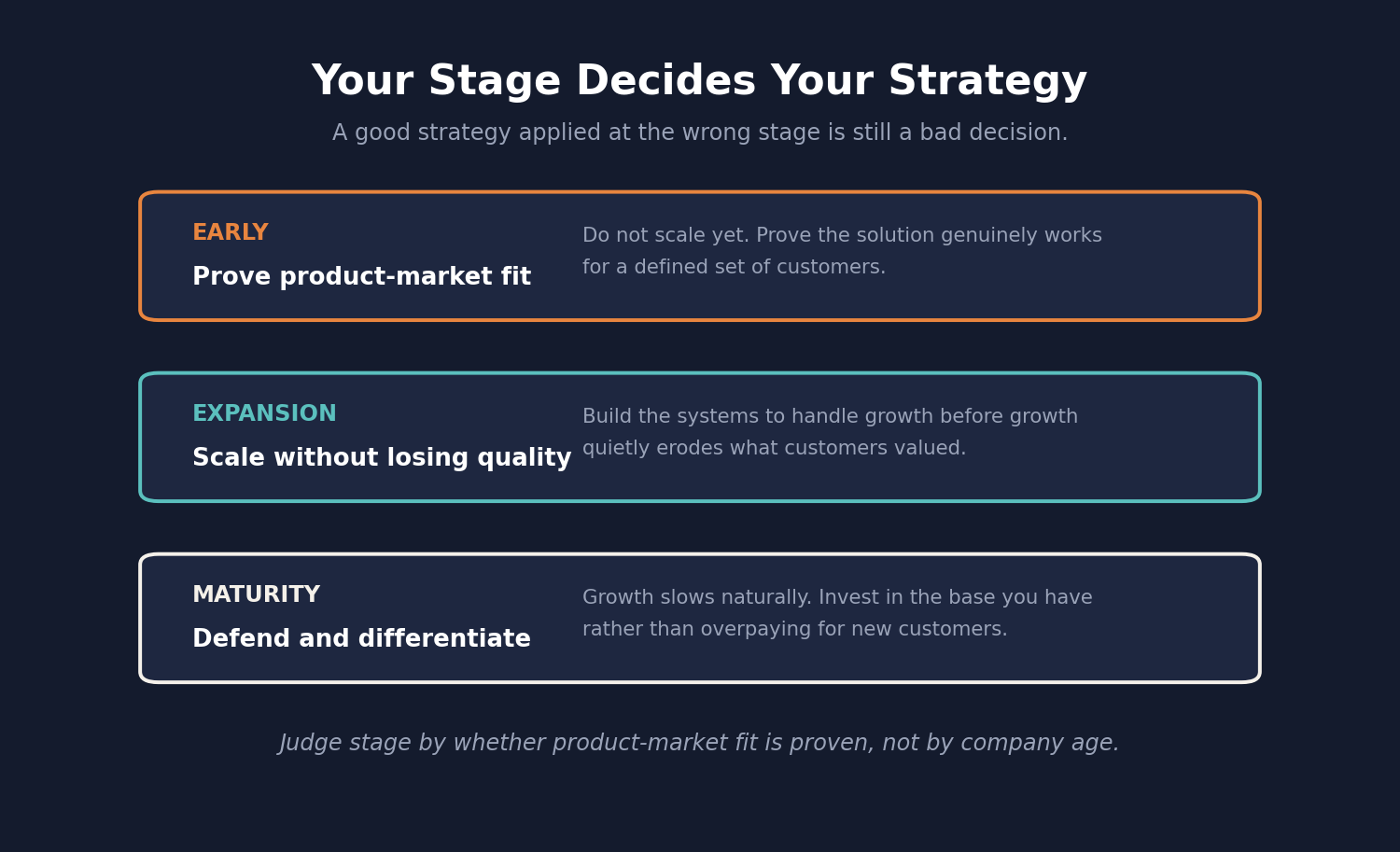
Businesses move through three broad stages, and each one calls for a different growth approach. In the early stage, the priority is finding real product-market fit and proving the solution genuinely works for a defined set of customers, not scaling anything yet. A company here that jumps straight to geographic expansion or a second product line is usually running from an unsolved problem in the first one, not solving it.
The expansion stage shifts the priority to scaling operations while protecting the quality and differentiation that made the business work in the first place, since growth introduces complexity that can quietly erode what customers originally valued. This is where most companies either build the systems and processes to handle scale, or grow revenue while quality slips just enough that retention starts leaking out the back door.
By the maturity stage, growth naturally slows and competition intensifies, so the priority shifts to defending market position and finding genuinely differentiated ways to create value, rather than expecting the same growth rate the business had in its first few years. A mature company still chasing early-stage growth tactics is usually the one that ends up overpaying for a shrinking pool of new customers instead of investing in the much larger base it already has.
Where this matters most: deciding between internal growth and any move into new markets or products. A business still working out product-market fit has no business chasing market development or diversification yet. Those strategies assume a stable core to expand from, and an early-stage business does not have one.
Common mistake to avoid: assuming stage is about company age or size. A ten-year-old company that just entered a genuinely new market segment is, for that segment, back in the early stage, whether the rest of the business is mature or not. Judge stage by whether product-market fit is proven for the specific thing you are trying to grow, not by how long the company has existed.
The Core Growth Strategy Types (And When Each One Actually Fits)
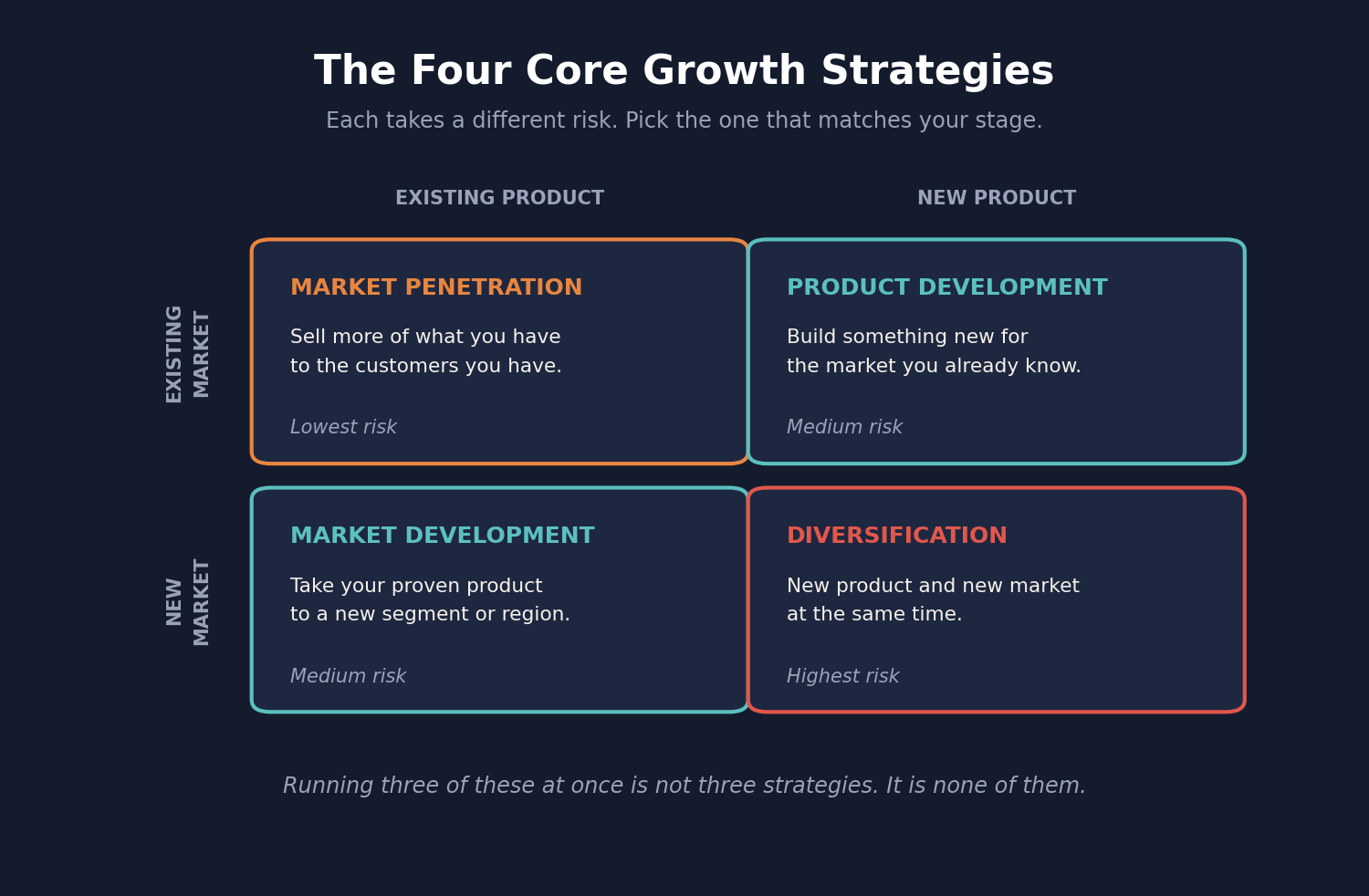
Most growth strategy content lists the same handful of options, often pulled from the Ansoff matrix that Igor Ansoff published in Harvard Business Review in 1957, without explaining which one fits which situation. Each business growth strategy solves a different problem, and picking the wrong one for your stage is the most common reason a technically sound plan still fails.
Market Penetration: Sell More to Who You Already Have
This is the strategy of growing by selling more of your existing products to your existing market, rather than building anything new or going anywhere new. It covers bundling products together, running targeted discounts and promotions, and using personalised recommendations to get existing customers buying more often or in larger amounts.
This is almost always the right starting point, and the reason is not caution for its own sake. It is the lowest-risk, fastest-feedback strategy available, because you are testing offers against a market you already understand instead of guessing at a market you do not.
When this fits: any business that has not yet maximised how much of its existing customer base’s spending it captures. If you have not seriously tried bundling, tiered pricing, or a structured referral program, market penetration still has real room to run before anything more ambitious makes sense.
Common mistake to avoid: abandoning market penetration too early because it feels unambitious compared to launching something new. A company that has genuinely saturated this option is rare. Most companies move on from it because it is less exciting, not because it stopped working.
Product Development: Build New Things for the Market You Know
This strategy uses your understanding of your existing customers to develop and produce new products that better serve their needs, increasing how much each customer spends without needing to find new customers at all.
The advantage here is that you are only taking one risk at a time: the product is new, but the market is not. You already know what this audience wants, how they buy, and what they complain about, which removes most of the guesswork that makes new product launches fail elsewhere.
When this fits: businesses with a stable core and clear signal from existing customers about an unmet adjacent need, the kind that shows up repeatedly in support tickets, sales conversations, or churn interviews. Product development done well is really just listening carefully and building the obvious answer.
Common mistake to avoid: building the product leadership wants instead of the product the data points to. The safest version of this strategy stays disciplined about starting from evidence of demand, not internal enthusiasm for an idea.
Market Development: Take What You Have to New Customers
Market development flips the previous strategy around, using your existing, proven products to reach entirely new customer segments or geographic markets, widening your reach without needing to build anything new.
The risk profile here is the mirror image of product development. The product risk is low, since it already works. The market risk is high, since you are now guessing at a buyer you have not sold to before, in a context you may not fully understand.
When this fits: businesses whose core product has clearly proven demand in one segment or region and has structural reasons to believe a second segment or region would respond similarly. A useful test is whether a new segment mirrors your existing one in the ways that actually matter, meaning the problem it faces, not just superficial demographics.
Common mistake to avoid: entering a new market based on its size alone. A large but poorly understood market is not an opportunity. It is a fast way to spend a real budget generating a plausible-looking failure.
Diversification: New Products, New Markets
Diversification pursues both new products and new markets at the same time, which the Ansoff matrix identifies as the highest-risk of the four core strategies, since it requires proving two unknowns simultaneously instead of one.
This strategy is not wrong, but it is frequently chosen for the wrong reason: excitement about a new opportunity rather than genuine strategic need. It deserves to be treated as what it actually is, a bet that carries meaningfully more risk than the other three, and sized accordingly.
When this fits: mature businesses with a genuinely stable core, real financial cushion to absorb a failed bet, and a specific strategic reason to diversify, such as a regulatory shift or a structural threat to the existing core. It is rarely the right first move for a growing business still building its foundation.
Common mistake to avoid: pursuing diversification while the core business still has real, unclaimed room to grow. This is the single most common strategic error, and it deserves its own explanation.
Why 80% of Your Growth Should Still Come From Your Core
Here is a finding worth sitting with before choosing any of the strategies above: across industries and company sizes, roughly 80 percent of a company’s growth comes from maximising the value of its existing core business, not from new markets, new products, or acquisitions.
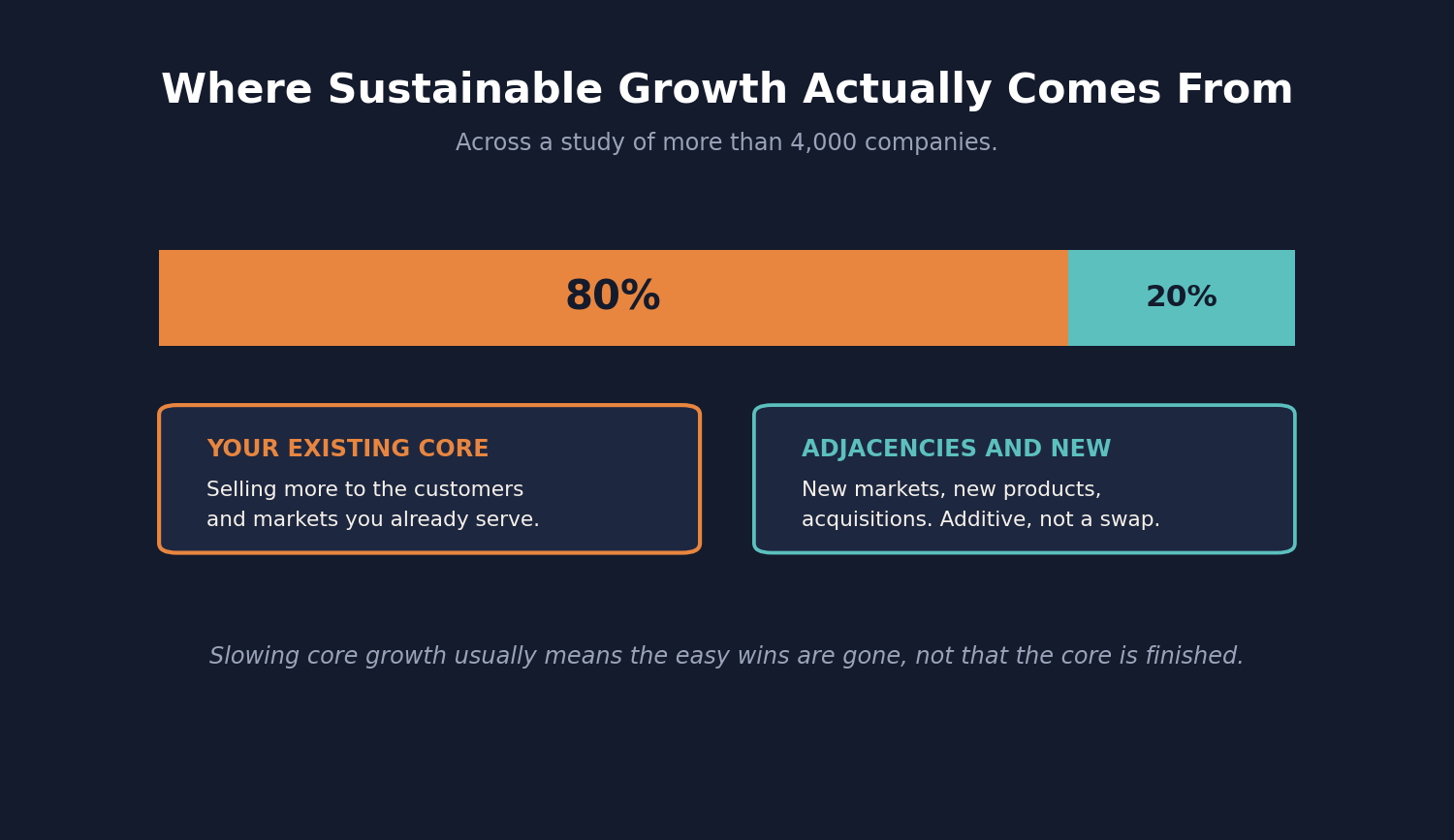
This runs directly against instinct. New markets and new products feel like where the real growth lives, since they represent territory not yet captured. But the data says otherwise, consistently, across a study spanning more than 4,000 companies. The core is not the boring, exhausted option. It is where most of the actual growth comes from, even for companies that are also successfully expanding elsewhere.
This does not mean new markets and new products do not matter. The other roughly 20 percent of growth, the harder-to-reach kind that separates true outperformers from average growers, does come from moving into adjacencies and building genuinely new businesses beyond the core. But that 20 percent is additive. It works because the 80 percent core foundation is already solid, not as a replacement for it.
Here is the practical test this creates: before investing serious resources into market development, product development, or diversification, ask honestly whether your core business has actually stopped producing return on additional investment. Most businesses that skip straight to expansion have not actually tested this. They have simply gotten bored with the core, or assumed it was tapped out without verifying it.
Where this matters most: budget allocation conversations, specifically the moment someone proposes a new market or product initiative. The right response is not automatic approval or automatic rejection. It is a specific question: what evidence do we have that our core is genuinely maxed out, not just familiar?
Common mistake to avoid: confusing slower core growth with exhausted core growth. A core business growing at 5% instead of last year’s 15% has usually just moved past its easiest wins, not run out of room. Slowing growth in the core is a signal to get more sophisticated about penetration and product development, not necessarily a signal to abandon it for something new.
This reframe changes how the strategy types above should actually be sequenced for most businesses: market penetration and product development first, market development and diversification only once there is real evidence the core has genuinely stopped paying back new investment.
Internal Growth vs. External Growth: Build It or Buy It
Every growth strategy type covered so far assumes you are growing using your own resources. That is not the only option, and knowing when to look outside your own walls is its own decision, separate from which strategy type you have chosen.
Internal growth strategies use only the existing resources, people, and capabilities already inside your business, giving you full control but requiring you to build every capability yourself, on your own timeline. This includes everything covered above, plus vertical strategies like bringing supply or distribution in-house instead of outsourcing them.
External growth strategies instead draw on the resources and capabilities of other businesses, through acquisitions, mergers, strategic partnerships, or franchising, generally reaching results faster than building the same capability from scratch would take. The tradeoff is real: less control, more coordination overhead, and a genuine risk that the partnership or acquisition never integrates the way it looked on paper.
- Choose internal growth when you have the time to build the capability properly, want full control over quality and brand experience, and the capability in question is close to your existing core competence.
- Choose external growth when speed genuinely matters more than control, when the capability you need is far outside what your team currently knows how to do well, or when a specific partner already has exactly the customer relationship or distribution channel you would otherwise need years to build.
- Choose a partnership over a full acquisition when you need access to a capability but do not need to own it outright, since strategic partnerships let both businesses keep growing independently while sharing a specific point of customer value, without the cost and integration risk of a full merger.
Common mistake to avoid: defaulting to acquisition because it sounds more decisive than partnership. Most of the value of external growth can be captured through a well-structured partnership at a fraction of the cost and integration risk of buying a company outright. Acquisition earns its place when ownership itself, not just access, is the actual requirement.
The build-versus-buy decision is not a one-time choice for the whole company. Many growing businesses run internal strategies for their core while using partnerships or acquisitions for specific capabilities, like distribution in a new region, that would take years to build alone.
Turning Strategy Into Execution: OKRs, Resource Allocation, and Killing the Hobbies
A correctly chosen strategy still fails constantly, and it fails for a boring, entirely predictable reason: it never gets translated into what specific people stop and start doing on a Monday morning.
The first execution failure is vague goals. A strategy that says “grow revenue” gives nobody a clear signal about whether this week’s work is actually working. The fix is setting specific objectives and key results tied directly to the chosen strategy, rather than chasing whatever metric happens to be trending in the industry that quarter. If the strategy is market penetration, the key result should be about existing-customer spend, not follower count.
The second, more damaging execution failure is resource allocation that never actually changes. Leaders at companies that consistently outgrow their peers describe the discipline directly: growth requires actively choosing where capital and talent go instead of simply taking last year’s budget and adjusting it by a few percent, and it requires eliminating the projects, sometimes described bluntly as “the hobbies,” that are not tied to the chosen growth path.
This is uncomfortable in practice, because the hobbies are usually someone’s pet project, staffed by people who are otherwise doing fine work. The discipline that separates growth outperformers is treating a failed or deprioritised initiative as information, not as a verdict on the people who ran it. A project not working out should not automatically mean the talented person who ran it has to leave, since that talent is often exactly what the next growth initiative needs.
Where this matters most: the quarterly or annual planning cycle, specifically the moment budgets get set. If the new plan’s spending looks nearly identical to last year’s, with a few line items nudged slightly, the strategy has not actually been adopted yet, regardless of what the strategy document says.
Common mistake to avoid: treating execution discipline as a one-time reallocation. Growth outperformance research found this pattern to be persistent rather than a single dramatic reset, with the highest-performing companies revisiting resource allocation regularly rather than locking in a budget once a year and defending it out of habit.
Strategy and execution are not two separate phases. A strategy that has not visibly changed this quarter’s resource allocation and this month’s OKRs is still just a document, no matter how sound the thinking behind it was.
Match Your Functional Levers to Your Strategy
Marketing, sales, finance, and hiring are not growth strategies by themselves. They are the levers you pull to execute whichever strategy you have already chosen, and pulling the wrong lever for your strategy wastes real effort even when each function individually does good work.
If your chosen strategy is market penetration, the functional priority is deepening existing relationships: referral programs, upselling and cross-selling training for your sales team, and loyalty programs that reward repeat purchases, rather than broad top-of-funnel marketing aimed at people who have never heard of you. A market-penetration strategy funded mostly through cold outbound acquisition spend is fighting itself.
If your chosen strategy is market development, the functional priority flips toward new-audience marketing and, often, new distribution partnerships, since reaching a new geography or customer segment usually requires different channels and messaging than the ones that already work for your existing audience. Sales scripts and marketing content built for your original market rarely transfer cleanly.
If your chosen strategy is product development, the functional priority shifts toward customer research and feedback infrastructure, since the entire strategy depends on genuinely understanding the unmet need before building anything. Marketing and sales matter here too, but only after product validation, not before it.
This is also where a content marketing strategy earns or wastes its budget, since content built for a new audience looks very different from content built to deepen an existing one.
Common mistake to avoid: running every functional lever at once regardless of strategy, on the theory that more activity across every channel must help. In practice, this usually means marketing is fighting for a new audience while sales is trained to upsell an existing one, and neither effort compounds because they are quietly pointed in different directions.
Before approving next quarter’s marketing plan, sales training, or hiring requests, run each one through a single filter: does this specific activity serve the growth strategy we actually chose, or is it just generally good practice that happens to feel productive. Good practice that serves the wrong strategy is still a distraction.
Common Ways Growth Strategies Quietly Fail
Growth strategies rarely fail with an obvious, dramatic collapse. They fail slowly, through a small set of recurring patterns that are worth naming directly so you can catch them early.
- Scaling faster than the foundation can hold. Rapid growth without matching operational capacity strains infrastructure, employees, and cash flow simultaneously, and the strain often shows up as declining service quality well before it shows up in the revenue numbers.
- Prioritising scale over the value gap. A strategy can technically hit its growth number while quietly expanding too quickly and reducing the quality or differentiation that made the product worth buying in the first place, which shows up later as retention problems that erase the growth on paper.
- Ignoring what customers are actually trying to accomplish. Strategies built on internal assumptions instead of a clear understanding of customer needs consistently miss opportunities and end up misaligned with what the market actually wants.
- Chasing growth strategies simultaneously instead of sequentially. A business running market penetration, market development, and a product launch all in the same two quarters is usually diluting all three, not accelerating any of them.
- Failing to revisit the strategy as the business changes stage. A strategy that fit the early stage perfectly can actively work against a business that has since moved into expansion, since the two stages call for different priorities entirely.
Reviewing this list honestly once a quarter catches more failing strategies early than any single metric will, because most of these patterns show up in behaviour and resource allocation long before they show up in the numbers.
The Metrics That Actually Tell You If It Is Working
A strategy is not real until it is measured, and measuring the wrong things gives false confidence that everything is fine right up until it clearly is not.
Track revenue growth to confirm the top-line direction is actually correct, customer acquisition rate to see whether new customers are arriving at the pace your strategy assumed, conversion rate to catch weak points in the sales process before they compound, and customer lifetime value to understand whether the customers you are acquiring are actually worth acquiring. These four, tracked together rather than in isolation, catch most of the failure patterns above before they become expensive.
Match the primary metric to the strategy you chose, not to whichever number is easiest to report. A market penetration strategy should be judged primarily on existing-customer revenue and referral volume. A market development strategy should be judged on new-segment acquisition cost and early retention in that segment specifically, not blended in with your existing customer base’s numbers.
Common mistake to avoid: reviewing metrics only when something already feels wrong. A monthly or quarterly review, on a fixed schedule regardless of how things feel, catches a negative trend while it is still a minor correction instead of a crisis requiring a much larger fix.
The point of measurement is not to generate a report. It is to know, with real evidence rather than a feeling, whether to keep funding the current strategy, adjust it, or admit it was the wrong choice for this stage and revisit the decision this guide opened with.
Related Guides
- How to Build a Content Calendar: 10 Steps and Mistakes to Avoid
- Content Marketing Strategy: 8 Steps That Actually Work
- How to Become a Digital Marketer: An Honest Roadmap for 2026
Frequently Asked Questions
What is the difference between a growth strategy and a marketing strategy?
A growth strategy decides which type of growth to pursue, such as selling more to existing customers, entering new markets, or building new products. A marketing strategy is one of the functional tools used to execute whichever growth strategy has already been chosen. Marketing without a growth strategy behind it tends to generate activity without a clear direction for that activity to serve.
What is the fastest way to grow a small business?
For most small businesses, market penetration, meaning selling more to the customers you already have through bundling, referrals, and better retention, is the fastest and lowest-risk path, since it does not require building anything new or finding an unproven audience. It is not the most exciting option, but it is usually the most underused one relative to how much room it actually has left.
Should a growing business focus on new customers or existing customers?
Existing customers should usually come first, since research on growth outperformers shows the large majority of sustainable growth comes from a company’s core business rather than new markets or products. New customer acquisition still matters, but it works best layered on top of a core business that is already being fully monetised, not as a substitute for that work.
How do I know if my business is ready to enter a new market?
Readiness generally requires a stable, proven core with clear evidence that additional investment in it is producing diminishing returns, plus a specific reason to believe the new market responds to your product in a genuinely similar way to your existing market. Entering a new market mainly because it is large, without either of those conditions in place, is a common and expensive mistake.
How often should a business growth strategy be reviewed?
A growth strategy’s underlying direction should be revisited whenever the business meaningfully changes stage, such as moving from early-stage product-market fit into expansion. The execution layer, including OKRs and resource allocation, deserves a much tighter review, typically quarterly, so a strategy that is quietly not working gets caught and corrected before an entire year has been spent on it.