
Most businesses that “do content marketing” are really just publishing things. A blog post here, a LinkedIn post there, maybe a newsletter that goes out when someone remembers to write it. None of it is connected to a goal, an audience, or a plan.
That is not a content marketing strategy. It is a content habit, and habits without direction rarely produce results worth the time invested.
A real content marketing strategy answers three questions before a single word gets written: why you are creating content, who it is for, and how it moves that person closer to a decision. Everything else, the calendar, the formats, the channels, is just execution once those three answers are clear.
This guide walks through the full process, step by step, and also fixes the part most guides skip: how to turn a scattered list of topic ideas into an actual system, and what a real one-page strategy looks like once you strip away the theory.
TL;DR
- A content marketing strategy is your “why.” A content plan is the tactical “how.” Most businesses confuse the two and end up with a calendar instead of a strategy.
- Businesses with a documented content marketing strategy consistently report feeling more effective and less challenged at content marketing than those working from memory.
- Content only works when it is mapped to a stage of the buyer’s journey, awareness, evaluation, or conversion, since a blog post and a comparison page do very different jobs.
- A pile of unrelated topic ideas is not a strategy. Topic clusters, groups of content connected around one core subject, are what actually build search authority and reader trust.
- Choosing content formats should depend on what your audience already consumes and what you can produce consistently, not on what looks impressive.
- Most content marketing strategies fail from a lack of distribution, not a lack of content. Publishing is not the same as promoting.
What Is a Content Marketing Strategy? (And Why It’s Not the Same as a Content Plan)
People use “content strategy,” “content marketing strategy,” and “content plan” as if they mean the same thing. They do not, and mixing them up is one of the fastest ways to end up with a calendar full of topics and no actual direction.
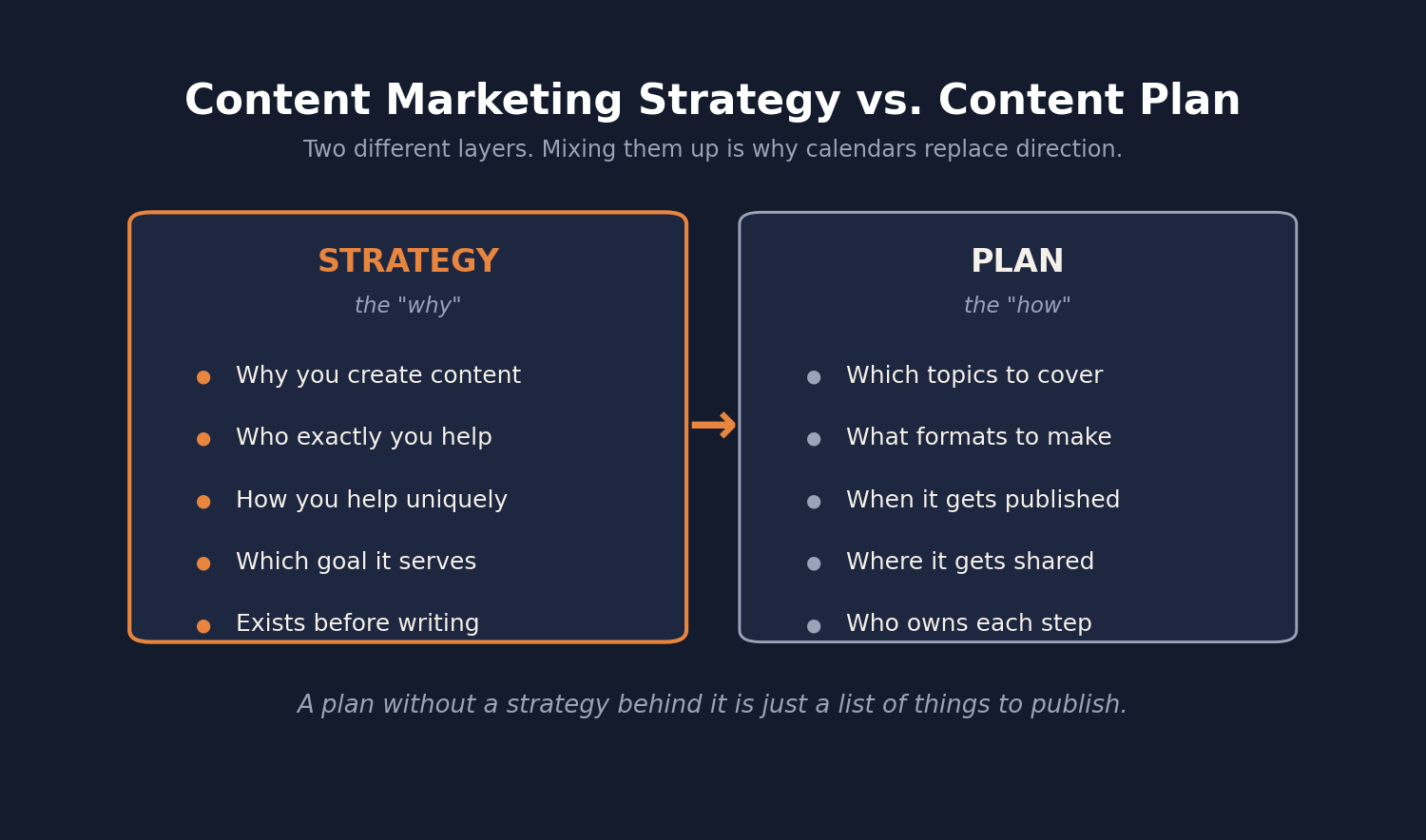
A content marketing strategy is your reasoning. It explains why you are creating content, who you are helping, and how you will help them in a way no one else can. This is the layer that should exist before anything gets written, filmed, or scheduled.
A content plan is different. It is tactical, not strategic. It documents the specifics of how you will execute your strategy, including which topics you will cover, what content you will create, and when and how you will share it. A content plan without a strategy behind it is just a list of things to publish.
Here is why the distinction actually matters in practice. A business without a documented strategy tends to generate content ideas reactively, whatever feels timely or whatever a competitor just published. A business with a strategy generates content deliberately, testing each idea against the same question: does this help our specific audience make a specific decision?
Skipping the strategy layer does not save time. It just moves the wasted effort later, into content that gets published but never ranks, never converts, and never gets revisited because nobody can explain what job it was supposed to do.
Why a Documented Content Marketing Strategy Outperforms Winging It
A strategy that only exists as a vague sense of direction in someone’s head is not really a strategy. It cannot be reviewed, defended in a budget meeting, or handed to a new hire.
The data backs this up directly. Content Marketing Institute’s annual B2B research consistently finds that businesses with a documented content marketing strategy are more likely to rate themselves effective, report fewer challenges across the board, and justify spending a higher share of the marketing budget on content. Writing the strategy down is not paperwork. It is the difference between a program you can improve and one you can only hope is working.
Documentation also solves a problem that shows up the moment more than one person touches the content. Without a shared reference, every contributor makes their own judgment call about tone, topic priority, and what counts as success. With one, everyone is optimizing toward the same target.
There is also a compounding argument for why the strategy layer pays off over time. Unlike paid traffic, which stops the moment you stop paying, a piece of well-targeted content keeps generating leads over and over, every month, long after it was written. That compounding effect only shows up when content is built around a real strategy. Random, disconnected posts do not compound. They just accumulate.
This is really the core case for slowing down before you start publishing. A day spent defining goals, audience, and topic direction saves months of publishing content that never adds up to anything bigger than itself.
Step 1: Set Content Marketing Goals Tied to Real Business Outcomes
Content marketing without a specific goal behind it tends to default to a vanity metric, usually traffic or follower count, because those are the easiest numbers to point to. The problem is that traffic alone does not pay anyone’s salary.
Every real content marketing goal should trace back to something the business already cares about. That might be building brand awareness, increasing trust and authority, educating customers to improve their experience, or generating leads, sales, and revenue. Pick the outcome that matters most right now, not the one that sounds most impressive.
Once the outcome is chosen, it needs a measurable target attached to it, not just a direction. “Increase leads” is not a goal. “Generate 50 marketing-qualified leads per month from organic search by Q3” is a goal, because it can be tracked, missed, or hit.
Common mistake to avoid: setting three or four goals at once because they all sound valuable. Brand awareness, lead generation, and customer retention pull content in different directions, toward different topics, formats, and channels. Pick one primary goal and let everything else in the strategy support it, rather than compete with it.
Where this matters most: early-stage content programs. A business six months into content marketing has almost no room for a scattered goal set. A mature program with a dedicated team can eventually run parallel tracks, but even then, each track should have its own clear owner and its own single primary goal.
Once the goal is locked, identify two or three key performance indicators that will tell you whether the strategy is working, and check them on a fixed schedule. A goal nobody measures is just an intention, and intentions do not survive a busy quarter.
Step 2: Build Audience Personas From Evidence, Not Assumptions
A content marketing strategy built around a vague idea of “our customers” will produce vague content. The fix is not more creativity. It is more specificity about exactly who the content needs to reach.
Start with the basic profile: the demographic details, the behavior patterns, and the motivations behind their buying decisions. Age and job title matter less than what problem keeps this person up at night and what they have already tried that did not work.
Copyblogger’s framing is useful here because it forces specificity instead of vibes. Before writing anything, define the title and position of the person who buys, the type of company or context they operate in, the pain point that brings them to you, and their existing knowledge level on the subject. That last point matters more than most strategies give it credit for. Content written for a beginner and content written for an expert should almost never look the same, even when covering the identical topic.
The instinct to skip this step and “just start writing” is understandable, but it produces a specific failure pattern. Content that tries to speak to everyone ends up resonating with no one, because the language, examples, and depth level are all compromises.
If real research is available, use it instead of guessing. Audience data on where a group discovers new brands, what they say they want from a brand, and which platforms they actually spend time on can reveal a starting point for your content strategy that internal assumptions rarely surface on their own. Even a handful of customer interviews will outperform pure guesswork.
Once the persona exists, it becomes a filter. Every future topic idea gets tested against it: would this specific person, with this specific problem, actually stop scrolling to read this? If the honest answer is no, the topic needs to change or get cut.
Step 3: Map Content to the Buyer’s Journey (TOFU, MOFU, BOFU)
A single blog post cannot do every job. It cannot make a cold stranger aware of a problem, convince a lead you’re the right choice, and close a sale, all at once. Trying to make one piece of content do everything is why so much content quietly underperforms.

The fix is mapping content to the three stages every prospect moves through. Awareness is where the prospect first realizes there is a problem and that a solution exists. Evaluation is where they compare the available choices, including doing nothing. Conversion is the moment of purchase itself. Each stage needs a different kind of content, doing a different job.
Top-of-funnel content should entertain, educate, or inspire, with a low barrier to entry, since a cold prospect has little motivation to hand over contact information or money at this stage. Blog posts, social content, and simple educational videos live here. Their only job is making the reader problem-aware and solution-aware.
Middle-of-funnel content has a different target. Here the goal is converting an aware prospect into an actual lead, usually through something valuable enough to justify an email address: a case study, a checklist, a webinar, or another useful resource offered in exchange for contact information.
Bottom-of-funnel content closes the loop. At this stage, the prospect needs the specific information required to choose, which usually means demos, customer stories, and comparison sheets that directly address the last remaining objections before a purchase decision.
Common mistake to avoid: publishing almost exclusively top-of-funnel content, which is what most content marketing programs default to. It is the easiest content to write and the easiest to justify, but a strategy that never builds middle and bottom-of-funnel content is leaving leads stuck exactly where they entered the funnel, aware but unconvinced.
Before writing your next ten pieces of content, sort them by funnel stage. If the list is entirely top-of-funnel, that gap is costing you conversions the strategy was supposed to produce in the first place.
Step 4: Build Topic Clusters Instead of a Random List of Ideas
Almost every content marketing strategy starts the same way: someone opens a spreadsheet and starts listing topic ideas as they occur to them. A few months in, the list is long, but the topics do not belong together. One is about pricing, the next about a completely different feature, the one after that a general industry trend.
This is the difference between collecting ideas and actually building a strategy. As one content strategist put it after making this exact mistake, writers collect ideas, but strategists connect them, because individually, scattered ideas might not be bad, but together they don’t tell a story.

Clusters also give your internal linking somewhere sensible to point. For a worked example of earning and placing links around a core topic, see the link building strategy I actually use.
A topic cluster fixes this by organizing content around one core subject instead of a random list. A single pillar page covers a broad topic at a high level, and a group of related, narrower articles link back to it, each covering one specific angle in depth. Together, they signal to both readers and search engines that you have real depth on the subject, not just one scattered post about it.
Here is how to build one in practice. Pick a core topic your audience actually searches for and that connects directly to what you sell. List every sub-question a genuinely curious reader would ask about that topic. Each sub-question becomes a supporting article, and the core topic becomes the pillar page they all link back to.
Where this matters most: businesses relying on organic search for a meaningful share of their traffic. Search engines reward topical depth over scattered breadth, and a reader who lands on one article in a well-built cluster is far more likely to click through to another, because the next logical question already has an answer waiting.
Common mistake to avoid: building a cluster around a topic that is popular but disconnected from what you actually sell. A cluster needs to be both something your audience searches for and something that leads naturally toward your product or service. A cluster that gets traffic but never connects to a buying decision is a content marketing strategy in name only.
Once even one cluster exists, use it as the template for every future topic decision. Before adding a new topic to the calendar, ask which existing cluster it belongs to. If it does not fit anywhere, that is a signal to either start a new cluster deliberately or reconsider whether the topic belongs in the strategy at all.
Step 5: Choose Content Formats and Channels That Match Your Audience and Your Capacity
Most content marketing strategies default to blogging because it is the most familiar format, and blogging remains a strong foundation for a reason: it drives organic search traffic and produces compounding returns over time. But defaulting to one format without checking whether it fits the audience is a missed opportunity.
Every major format comes with real trade-offs worth knowing before committing to it. Long-form written content, like blog posts and guides, is excellent for organic search traffic and works well for any product that requires some education before the customer is ready to purchase. Social content builds awareness quickly and personally, but is not evergreen, and winning requires publishing a high volume of quality content consistently.
Video builds trust fast because a viewer can see and hear a real person, though the person on camera can become the face of the brand, which becomes a risk if that person eventually leaves. Podcasts build unusually loyal audiences since listeners can consume them passively while doing something else, but like video, the audience is often tied closely to the specific host. Email remains one of the strongest formats because it is the only platform you fully own, immune to a platform algorithm change or a lost ranking.
The right format decision comes down to two practical questions, not personal preference. First, what type of content does your specific audience already enjoy consuming, since some audiences gravitate toward certain platforms far more than others. Second, and just as important, what can you actually produce on a consistent basis, because the real key to winning at content marketing is consistency, which makes a format you can sustain more valuable than one that merely looks impressive.
Common mistake to avoid: chasing a format because a competitor uses it well. A competitor’s polished video series says nothing about whether your team has the resources or interest to sustain the same format for the next two years. Pick the format your team will still be producing consistently six months from now, not the one that looks best in a single example.
Channel choice follows the same logic as format choice. A channel is only worth the investment if your specific audience actually spends meaningful time there, which is why persona research from Step 2 should directly inform this decision rather than defaulting to whichever platform is trending industry-wide.
Most strategies eventually use a mix of formats rather than just one, but the sequence matters. Master one format and channel combination before adding a second. Spreading thin resources across five channels from day one usually produces five mediocre presences instead of one strong one.
Step 6: Build a Content Calendar and a Workflow That Survives Busy Weeks
A content marketing strategy with no calendar behind it eventually becomes inconsistent, and inconsistency is one of the most common reasons good strategies quietly fail. The formula behind a working content program is straightforward: pick a topic, create it well, and publish it consistently, since most content marketing efforts fail not from a lack of ideas but from giving up or publishing too irregularly.
A calendar needs more than dates on a spreadsheet to actually function. Include the topic and its target keyword, the format and channel, who owns each stage of production, the milestones like draft and edit dates, and which audience segment or cluster it belongs to. A simple spreadsheet works for a solo creator. A shared project management tool becomes necessary the moment more than one person contributes.
Here is why the workflow matters as much as the calendar itself. A calendar tells you what to publish and when. A workflow tells you who does what, in what order, so a piece of content does not stall halfway through production because nobody was clearly responsible for the next step.
Common mistake to avoid: building an ambitious calendar that assumes every week will go exactly as planned. Busy weeks happen. A calendar with no buffer collapses the first time someone is out sick or a launch pulls the team’s attention elsewhere. Build in slack, and treat a slightly lighter but consistent publishing schedule as more valuable than an ambitious one that quietly stops after two months.
The point of a calendar is never to hit an arbitrary volume target. It exists to protect the one thing that actually compounds: showing up reliably enough that your audience learns to expect you.
Step 7: Distribute and Promote Every Piece of Content on Purpose
Publishing content and distributing content are not the same activity, and treating them as one is probably the single most common reason a content marketing strategy underperforms. Writing something excellent and hitting publish is only half the job.
Two habits explain why distribution gets skipped so often. Some teams assume that publishing consistent, well-optimized content on a regular schedule does most of the distribution work automatically through search rankings. Others are staffed mostly with writers and designers who are more interested in creating something well-crafted than in actively marketing it afterward. Both instincts are understandable, and both leave real reach on the table.
A working distribution plan uses several channels deliberately rather than hoping one channel does all the work. Search remains foundational, since ranking depends on writers and SEO specialists working closely together on the right keywords, at the right level of competitiveness for your domain. Social platforms extend reach further, and search engines increasingly treat social engagement as a signal of a post’s relevance. Email turns one piece of content into a direct message to people who already opted in to hear from you, which makes it one of the highest-converting channels available.
Where this matters most: any piece of content tied to a specific business goal, like a comparison page or a case study meant to move a lead toward a decision. Content like this should never rely purely on search traffic arriving naturally. Email it to your list, share it directly with sales, and consider a small paid budget to accelerate its reach.
Repurposing is the most efficient distribution tactic most strategies underuse. A single long-form piece of content can become social posts, an email, and a short video, multiplying the return on the original time invested without multiplying the production workload.
Before calling any piece of content finished, write down the specific channels it will go out through and who is responsible for each one. If that list is empty, the content is not actually done. It is just written.
Step 8: Measure the Metrics That Actually Predict Growth
Content marketing is a long-term investment, and the mistake most strategies make with measurement is expecting short-term proof of a long-term mechanism. Watching daily traffic for signs a strategy is failing is like weighing yourself every hour after starting a diet.
Pick two or three metrics that map directly back to the goal set in Step 1, rather than tracking everything available. A brand awareness goal should watch traffic, social mentions, and branded search volume. A lead generation goal should watch leads generated per content asset, not just overall site traffic. Trying to optimize for every metric at once usually means optimizing for none of them well.
Measure by content type, not just in aggregate. A blog should be measured on traffic and subscribers early on, folding in a lead generation goal once traffic has grown at a predictable rate. Gated assets should be measured on leads generated per offer. Social media should be measured on the reach and growth of your following on each specific platform that matters.
Reporting on a fixed schedule matters more than reporting frequently. A monthly review is usually enough to catch a negative trend before it becomes a crisis, and it creates a habit of actually using the data instead of collecting it and moving on.
Common mistake to avoid: abandoning a topic or format after one underperforming piece of content. One data point is noise. A pattern across several pieces over a few months is a signal worth acting on. Give a new topic or format a fair, defined trial period before declaring it does not work.
The entire point of measurement is repeatable improvement. Use it to double down on what is already working and retire what consistently is not, rather than treating every report as a pass or fail grade on the whole strategy.
The One-Page Content Marketing Strategy You Can Write Today
Everything above can feel like a lot to hold at once, so here is the condensed version. A real content marketing strategy fits on one page, and if it does not, it usually means the thinking behind it is not clear yet.

- Goal: the one business outcome this content program exists to support, with a measurable target attached.
- Audience: who exactly this is for, including their specific problem and their existing knowledge level on the topic.
- Funnel coverage: what you will create for awareness, evaluation, and conversion, so no single stage gets ignored.
- Core topic clusters: two or three subjects you will build real depth around, each with a pillar page and supporting articles.
- Format and channel: the one or two formats you can produce consistently, and the channels your audience actually uses.
- Cadence: how often you will realistically publish, built with enough slack to survive a busy month.
- Distribution plan: the specific channels every piece of content will go out through beyond just being published.
- Metrics: the two or three numbers that will tell you, on a fixed schedule, whether this is working.
If you can fill in all eight lines honestly, you have a real strategy. If several lines are still blank or vague, that is exactly where to focus before creating another piece of content.
Content Marketing Mistakes That Quietly Sink Good Strategies
Most content marketing strategies do not fail loudly. They fail slowly, through small habits that compound over months until the whole program feels like it is not working, without any single moment where it clearly broke.
- Treating the content plan as the strategy. A calendar full of topics with no goal, audience, or funnel logic behind it is a to-do list, not a strategy. It will keep you busy without necessarily moving anything forward.
- Chasing every format at once. Splitting limited time and budget across blog, video, podcast, and social simultaneously usually produces five mediocre efforts instead of one that actually works.
- Skipping distribution. Publishing without a deliberate promotion plan behind each piece leaves most of a strategy’s potential reach unclaimed.
- Measuring vanity metrics instead of the goal. Traffic and follower counts feel good to report, but they only matter if they are actually connected to the outcome the strategy exists to support.
- Abandoning a format or topic too soon. Content marketing compounds over months, not days. Judging a new format after two weeks almost always ends the experiment before it had a real chance to work.
Reviewing this list every quarter, honestly, catches more strategy failures early than any single metric will.
Related Guides
- How to Build a Content Calendar: 10 Steps and Mistakes to Avoid
- Link Building Strategy: 57 Links, No Budget, and Traps to Avoid
- How to Become a Digital Marketer: An Honest Roadmap for 2026
Frequently Asked Questions
What is the difference between a content strategy and a content marketing strategy?
A content marketing strategy focuses specifically on using content to achieve a marketing outcome, like leads, awareness, or sales. A content strategy is broader, covering the creation, publication, and governance of all the content a business manages, whether or not it is tied to a marketing goal. Most small businesses only need the content marketing version. Larger organizations managing content across many departments usually need both.
How long does content marketing take to show results?
Content marketing typically takes three to six months to show meaningful traction, and often longer for competitive topics, because organic search rankings and audience trust both build gradually rather than instantly. Businesses expecting the same speed as a paid ad campaign are usually the ones who abandon a working strategy too early. Judge progress by whether the trend is improving month over month, not by any single week’s numbers.
How much should a small business budget for content marketing?
Budgets for content marketing vary widely, but many small businesses spend somewhere between $1,000 and $5,000 per month once they move past a purely DIY approach, depending on how much is produced in-house versus outsourced. Start with whatever supports one format and one channel done consistently, rather than spreading a small budget across several channels at once. Consistency on one channel outperforms a thin presence on five.
Do I need a content marketing strategy if I’m a solo creator or a small business?
Yes, and arguably a documented strategy matters more at a small scale, not less. A large team can survive some wasted effort because output is high. A solo creator or small team has far less room to spend months on content that never connects to a real goal or audience. The one-page strategy above takes under an hour to draft and prevents most of that wasted effort.
What content format should I start with if I can only manage one?
Start with the format your specific audience already prefers to consume and that you can realistically sustain for at least six months without burning out. For most businesses selling to other businesses, long-form written content remains the strongest starting point because it drives organic search traffic and compounds over time. For consumer brands with a highly visual product, short-form video or social content is often a stronger first move.
How is AI changing content marketing strategy?
AI is changing content marketing strategy mainly through discovery, since more searches now surface an AI-generated summary before a list of links, which makes getting cited inside that summary a new goal alongside ranking in traditional search results. The core strategy fundamentals have not changed: a clear audience, real depth on a topic, and genuine usefulness still matter more than any single optimization tactic. Treat AI visibility as an additional distribution channel to plan for, not a replacement for the strategy work covered in this guide.