
A link building strategy is not too hard and not too easy. If you know the tactics, it is easy. If you do not, every email you send disappears into silence and you start thinking the whole thing is broken.
I know the tactics. I’ve read the same guides everyone has, guest posting, broken links, HARO, all of it. Reading them isn’t the hard part. The hard part is doing this alone, for one small WordPress product, with no team, no agency budget, and a genuinely short list of sites that are even worth reaching out to.
That gap is where most link building strategy advice falls apart. It’s written for a niche with hundreds of relevant sites and a team big enough to run five tactics at once. I’ve placed over 57 real links working with none of that, no PBNs, nothing paid, and I’ve also turned down offers dressed up as partnerships that were actually just paid links with better manners.
This is the link building strategy that came out of that, not another list of tactics you have already read, but what actually works when it is one person doing this alongside everything else.
TL;DR
- Placed 57+ real links for Klasio, no PBNs, nothing paid
- Turned down “partnership” emails that were actually paid links with a nicer template
- Vetted 16 candidate sites before finding 3 worth actually pursuing
- Most real conversations started in Slack, WhatsApp, or Reddit communities, not cold email
- Still mid-negotiation on one link exchange months later, no clean ending yet
- Used a full product portfolio, not just one domain, as leverage in swaps
- No outreach team, no agency, no budget, just one person doing this alongside everything else
Why Most Link Building Strategy Guides Do Not Work for a Small Product
Most link building guides assume a niche with hundreds of relevant sites to choose from. Fitness, finance, travel, SaaS in general, there’s always another blog, another directory, another site willing to talk. Klasio doesn’t have that luxury. It’s a course and coaching platform in a specific corner of WordPress, which means the actual list of sites worth reaching out to is short, and most of them already know each other.
That changes the math completely. A generic guide will tell you to send fifty outreach emails and expect two or three replies. When your realistic pool is closer to twenty sites total, burning through them with a templated pitch means you don’t get a second shot once they’ve filed you under “spam” or “no.”
It also means the tactics that scale well for a big niche, guest posting at volume, broken link building across hundreds of pages, don’t translate down. There simply aren’t hundreds of pages to check for broken links in this space. What’s left is a smaller, slower, more relationship-based version of the same idea, which almost nobody writes about because it doesn’t produce a punchy 170-tactic list.
How I Actually Vet a Site Before Reaching Out
Before any outreach email goes out, I go through a candidate list one by one. Sixteen sites went through this process the last time I built one out, and only three of them made it past the first filter: Paradiso Solutions, GS Plugins, and Acquaint Softtech.
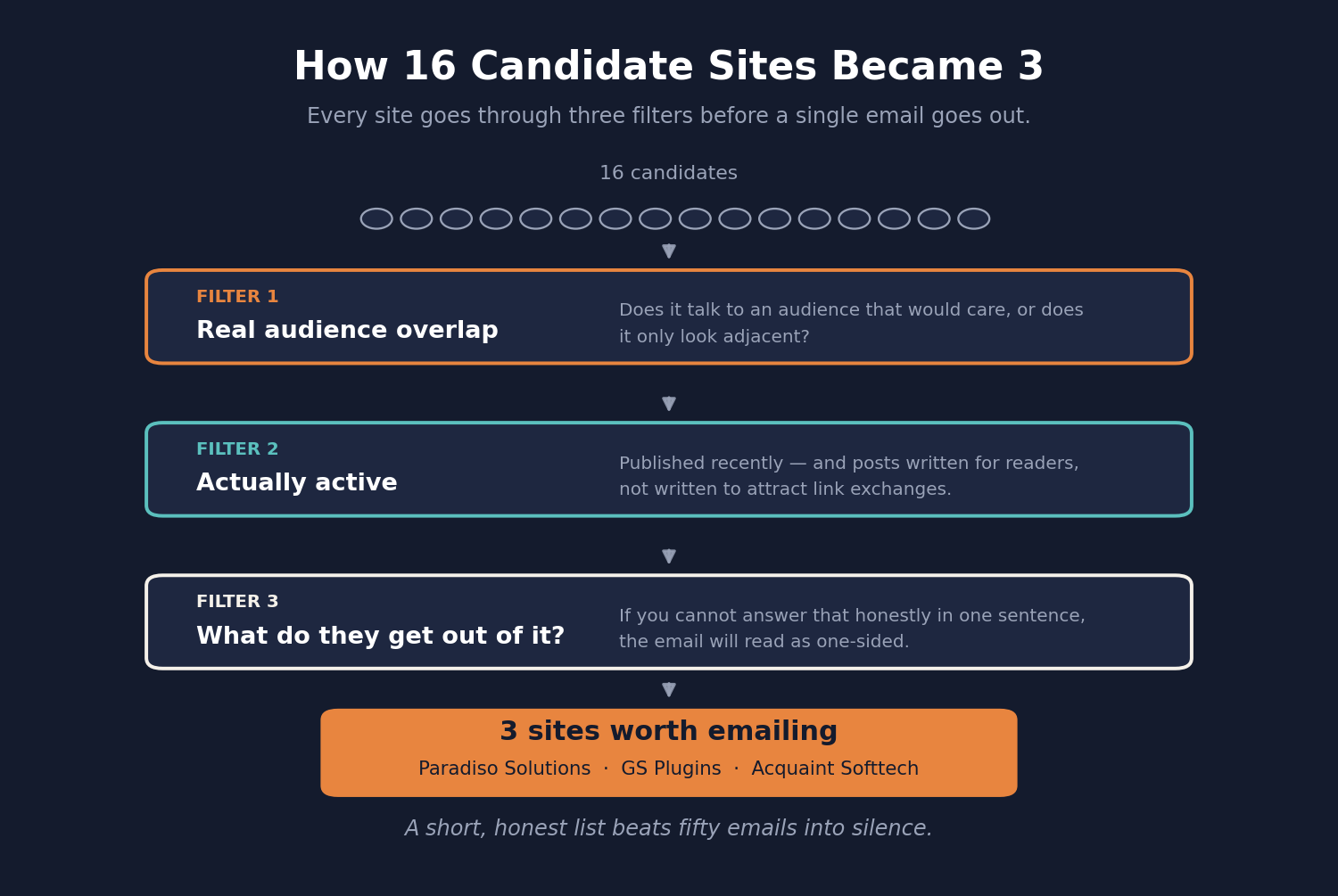
The filter itself is simple, even if it takes time. Does the site actually talk to an audience that would care about a course platform, or does it just look adjacent on the surface. A WordPress development shop and a WordPress course platform sound related, but if their readers are developers hiring for custom builds, a link exchange with us does nothing for either side. Relevance has to hold up past the first glance.
I also check whether the site is actually active, not just technically live. A domain with a decent-looking blog that hasn’t published anything in eight months isn’t worth the email. Neither is a site where every single post reads like it was written to attract link exchanges rather than readers, since that’s usually the first sign of a link farm dressed up as a normal blog.
The last filter is the one most guides skip entirely: what does this site actually get out of linking to us. If I can’t answer that honestly, in one sentence, the outreach email is going to read as one-sided no matter how it’s worded, and one-sided asks are the ones that go straight to silence.
That relevance test is the same one a content marketing strategy applies to topics: if you cannot name who it serves and why, it does not belong on the list.
Red Flags: The Link-Selling Agencies I Learned to Avoid
Not every outreach email is what it claims to be. A handful of names came up during vetting that looked like normal partnership offers on the surface, Midsbyte and SirLinksAlot among them, and turned out to be link-selling operations wearing a partnership costume.

The tell is usually in how fast they move. A real site owner interested in an actual exchange asks questions first, wants to know what Klasio is, checks whether the fit makes sense. A link seller skips straight to price, sometimes disguised as a “management fee” or “placement cost,” sometimes just stated outright. If money comes up before relevance does, that’s the answer right there.
The other tell is the site itself. Link-selling operations often run a network of blogs that all look similar, generic design, generic categories, posts that read like they exist purely to host outbound links. A quick check of a few other articles on the same site usually makes this obvious within a couple of minutes.
None of this means every fast-moving or slightly generic-looking site is a scam. But when both signs show up together, price mentioned early and a site that reads like filler, it’s not worth the risk. A link from a site like that doesn’t just fail to help, it can actively work against you if Google flags the network later. It is worth knowing where the actual line sits: Google’s spam policies treat buying or selling links that pass ranking signals as a link spam violation, which is exactly what these agencies are quietly selling.
Negotiating a Fair Link Exchange (Not Just Asking)
Most link building advice assumes a one-way ask, you want something, they have it, you request it politely and hope. A link exchange is a different conversation entirely, because both sides need to walk away feeling like they got something worth giving up a link for.
One exchange I’ve been working through, with an email marketing tool in a related space, started simply enough. Their audience overlaps with ours more than most candidates do, so the fit made sense from the first message. What didn’t go simply was agreeing on where each link would actually live. They wanted a link from a high-traffic page on our side. I wanted the same from theirs. Neither of us was wrong to ask, but neither of us could just say yes without it costing us something real.
Months later, this one still isn’t fully resolved. We’ve gone back and forth on which pages, which anchor text, whether it’s a straight one-for-one or something slightly uneven given the traffic gap between our sites. No guide mentions this part, the negotiation can just stall, politely, indefinitely, with neither side willing to call it off but neither side rushing to close it either.
What I’ve learned from it is that a fair exchange isn’t a template you send once. It’s closer to negotiating any other business terms, slower than outreach, more personal, and sometimes it just doesn’t resolve on a timeline you control.
Which Channels You Should Use to Get Links Quickly
Cold email isn’t the only channel, and for a lot of these conversations, it isn’t even the first one. Slack communities built around SEO or WordPress tend to be where the actual relationship starts, since people there are already primed to talk shop instead of guessing whether your email is spam.

WhatsApp groups work differently, more personal, usually smaller, and better once a conversation has already started somewhere else. I’ve moved a few negotiations there once email started feeling too slow for back-and-forth details like anchor text or page placement.
Reddit is the one place I use more for listening than talking. Communities like r/SEO or niche WordPress subreddits surface who’s actively working on link building right now, which is a better signal than a cold list, since someone posting about outreach today is someone actually doing outreach today.
Facebook groups skew a bit more agency-heavy in my experience, more people offering services than genuinely looking to swap. Still worth being in one or two relevant ones, since the useful conversations are just spread out more thinly than in Slack.
None of these replace email once terms actually need to be agreed on in writing. But almost every real exchange I’ve landed started with a conversation somewhere else first, not a cold email out of nowhere.
Using a Product Portfolio as Leverage
Most link building advice assumes you’re trading from one site, one domain, one thing to offer in return. Working inside weDevs, I’ve never actually had that constraint, since Klasio sits alongside a full portfolio of other products: weMail, HappyAddons, WP ERP, Appsero, WP Hive, weDocs, FlyWP.
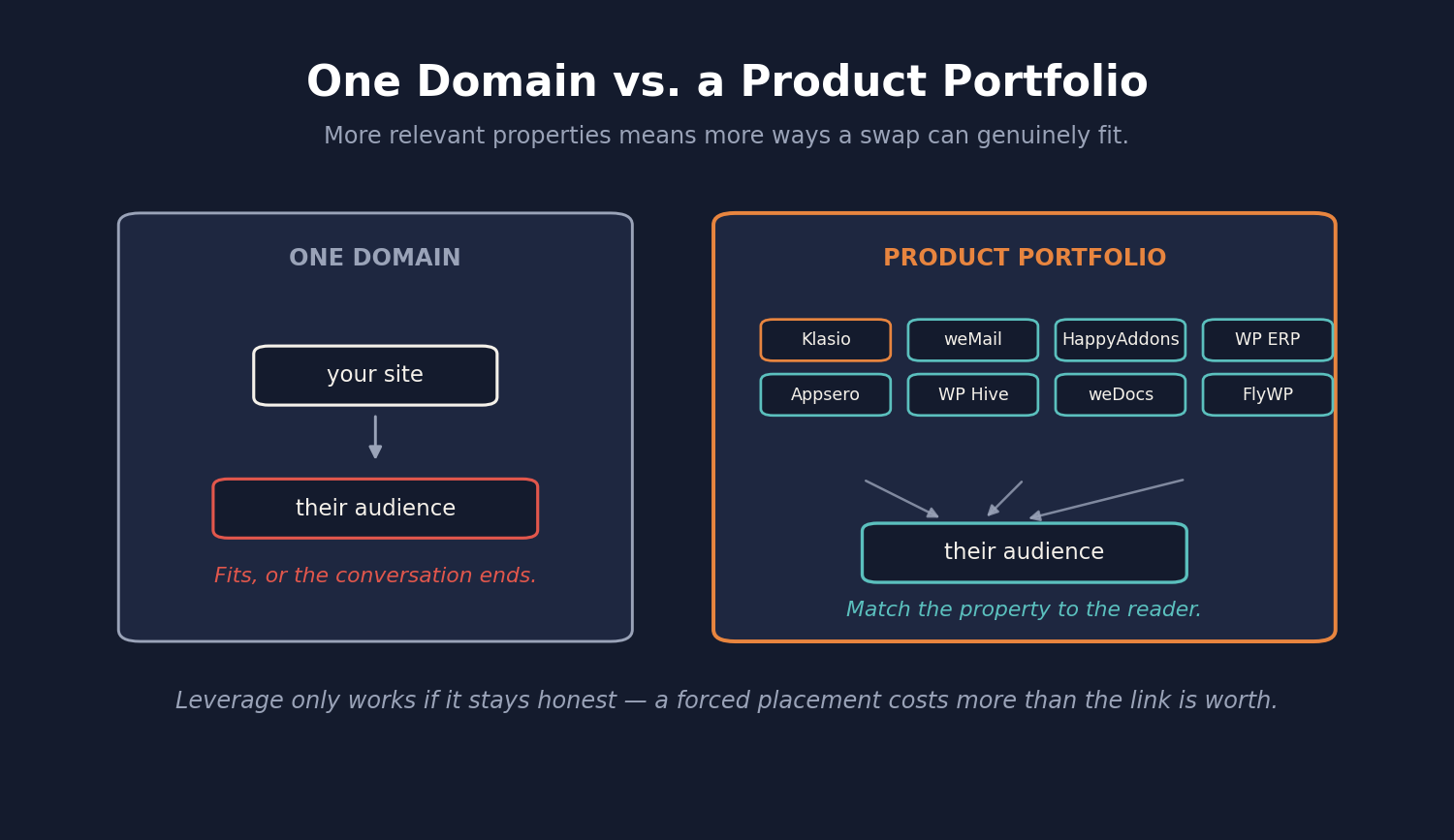
That changes what a swap can look like. If a site’s audience isn’t a great fit for Klasio specifically but lines up well with weMail’s audience instead, the conversation doesn’t have to end there. I can offer a relevant link from a different property in the portfolio, one that actually serves their readers better than a forced Klasio placement would.
This also means I’m not stuck negotiating from a position of “take this one link or nothing.” Having several relevant products to place a link from gives more room to find the option that genuinely fits both sides, rather than talking someone into a placement that doesn’t really serve their audience.
The trade-off is that this only works if the portfolio is used honestly. Offering a link from an unrelated product just to close a deal faster is the same mistake as a forced placement, it just moves the problem instead of solving it. The advantage is real, but only when each link still ends up somewhere it actually belongs.
What I Would Tell Someone Starting a Link Building Strategy With No Team and No Budget
Skip the fifty-email approach. If your realistic list of relevant sites is short, twenty or thirty total, treat every single email like it’s one of your only shots, because it functionally is. A generic template burns through a small list fast, and there’s no second list waiting behind it.
Check price signals before anything else. If a “partnership” conversation moves toward cost within the first two messages, that’s your answer, no matter how the email is worded. Save the time you’d spend negotiating and move to the next candidate.
Don’t force a fit that isn’t there. A site that looks adjacent to your product on the surface isn’t automatically worth an email. If you can’t say in one sentence why their specific audience would care about a link to you, that email is going to read as one-sided, and one-sided asks are the ones that get ignored.
Expect exchanges to take longer than outreach. A straightforward ask gets a yes or no fairly quickly. A negotiated swap can stretch for months without a clean resolution, and that’s normal, not a sign you’re doing it wrong.
If you have more than one product or property to work with, use that as real flexibility, not a shortcut. A link placed where it genuinely fits will do more for you long term than a faster placement that doesn’t quite belong.
And links are only one channel. If organic search is meant to carry a real share of your traffic, the content marketing strategy behind the pages you are linking to matters just as much as the links themselves.
A One Page Link Building Strategy Checklist
If you take nothing else from this, take the checklist. A link building strategy that survives a busy month is one you can run in an hour a week without deciding anything from scratch.
- Pull five candidate sites that genuinely overlap your topic, not just your traffic band.
- Vet each one against the red flags above before you write a single word of outreach.
- Send three personalised emails, not thirty templated ones.
- Follow up once, after four working days, then let it go.
- Log every reply, so next quarter your link building strategy starts with warm contacts instead of a blank sheet.
Run that loop weekly. The whole point of writing the link building strategy down is that on the weeks you have no energy to think, you do not have to. You just work the list, and the links accumulate anyway.
One more thing that took me too long to learn: track outcomes, not effort. It is easy to feel productive because you sent twenty emails this month, and easy to miss that nineteen of them went to sites that were never going to link to a product like yours. The number worth watching is placements per ten vetted sites, because that single ratio tells you whether the problem is your list or your pitch.
If the ratio is poor and the sites were genuinely relevant, your email is the problem, so rewrite the first two lines and try again. If the ratio is poor and the sites were a stretch, your vetting is the problem, and no amount of clever copy will fix it. Almost every stalled campaign I have seen is one of those two, and telling them apart takes about ten minutes with a spreadsheet.
One more thing that took me too long to learn: track outcomes, not effort. It is easy to feel productive because you sent twenty emails this month, and easy to miss that nineteen of them went to sites that were never going to link to a product like yours. The number worth watching is placements per ten vetted sites, because that single ratio tells you whether the problem is your list or your pitch.
If the ratio is poor and the sites were genuinely relevant, your email is the problem, so rewrite the first two lines and try again. If the ratio is poor and the sites were a stretch, your vetting is the problem, and no amount of clever copy will fix it. Almost every stalled campaign I have seen is one of those two, and telling them apart takes about ten minutes with a spreadsheet.
Frequently Asked Questions About Link Building Strategy
What is the best link building strategy?
The best link building strategy is one built around genuine relevance and fair exchange rather than volume. For a small or niche site, that usually means fewer, better-vetted outreach targets instead of mass templated emails sent to hundreds of loosely related sites.
How many backlinks do I need to rank?
How many backlinks you need to rank depends entirely on your competition for that keyword, not a fixed number. A handful of relevant, high-quality links can outperform hundreds of weak ones, so the target is fit and authority, not a count.
Is guest posting still effective for link building?
Guest posting is still effective for link building, but only on sites with real editorial standards and an audience that overlaps with yours. Guest posts on sites that accept nearly anything carry little to no value and can even signal a low-quality link profile.
How long does link building take to show results?
Link building takes weeks to months to show results, not days. Outreach-based links tend to show impact faster once placed, while content-driven links, the kind other sites cite naturally, often keep compounding for years after the first one lands.