Most guides on how to become a digital marketer read the same way. Learn SEO, learn paid ads, get a certificate, build a resume, apply for jobs. None of that advice is wrong. It is also missing the one thing that would actually change how you spend the next twelve months.
Here is that thing: the market hiring digital marketers in 2026 is not the same market these guides were written for. Entry-level hiring has genuinely tightened, largely because AI now handles many of the small, repetitive tasks junior marketers used to learn on. That does not mean the career is closing. It means the path in looks different than it did three years ago, and pretending otherwise wastes the exact time you cannot get back.
Every guide on how to become a digital marketer covers the fundamentals, and so does this one. But it also covers what most of them leave out: the honest 2026 hiring picture, a practice method that builds proof instead of just knowledge, and a way to choose a specialization based on where actual demand is heading rather than a guess.
TL;DR: How to Become a Digital Marketer in 2026
- Digital marketing is the practice of promoting products and services through channels like search, social, and email, using data to target and measure results in ways traditional marketing never could.
- Entry-level hiring in marketing has tightened noticeably in 2026, since AI now handles many of the repetitive tasks junior marketers historically learned on. Overall marketing hiring is still growing. It is just growing for experienced people first.
- The fastest way to build real proof of skill is not another certificate. It is a personal project, a website, a newsletter, a small business you volunteer to help, where you can point to results, not just coursework.
- Learning marketing psychology and the customer journey before touching any tool prevents the single most common beginner mistake: running ads or posting content with no strategy behind it.
- AI should be treated as an amplifier for your judgment, not a replacement for learning the fundamentals it is built on top of.
What Digital Marketing Actually Is
Digital marketing is the practice of promoting products and services through digital channels, search engines, social media, email, and mobile apps, instead of static channels like print, billboards, or television. The core difference is not really where the ads live. It is that digital marketing is measurable and targetable in ways traditional marketing never was.
A billboard cannot tell you who looked at it or whether it led to a sale. A digital ad can tell you exactly who clicked, what they did next, and whether it turned into revenue, in something close to real time. That single difference is why digital marketing has become the default rather than a supplement to traditional advertising.
Nearly every digital marketing effort moves a potential customer through the same four stages, regardless of which channel is doing the work. Awareness casts a wide net to capture attention when someone does not know your brand yet. Consideration builds trust once they are aware, through content, reviews, and education. Conversion removes friction at the moment they are ready to buy. Loyalty turns a one-time buyer into a repeat customer who refers others.
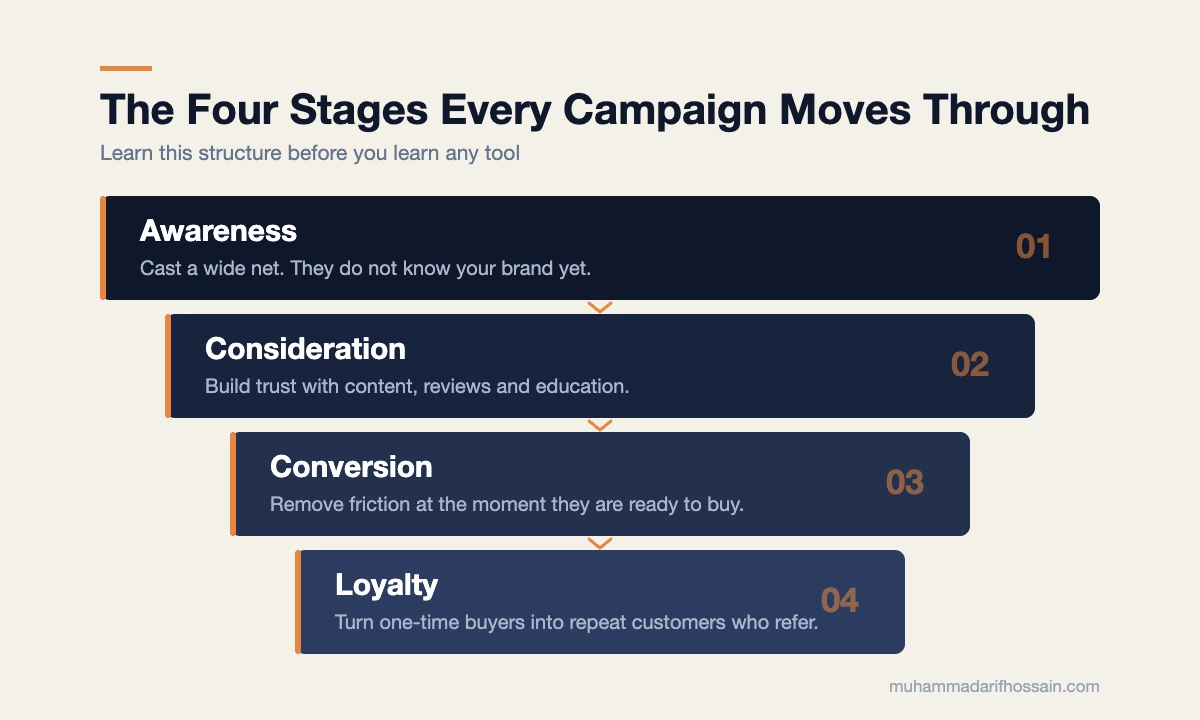
This funnel matters more than any individual tool or platform, because it is the thing that tells you which tactic to use and when. A blog post and a retargeting ad are not interchangeable. One is built for a stranger who has never heard of you. The other is built for someone who already has your product in a cart and just needs a reason to finish checking out.
Common mistake to avoid: learning tools before learning this structure. Someone who knows how to run a Facebook ad but does not know which funnel stage that ad is supposed to serve will burn budget testing the wrong message on the wrong audience, over and over, without understanding why it is not converting.
Everything that follows in this guide, the skills, the specializations, the portfolio, exists to serve this basic structure: get someone’s attention, earn their trust, remove their friction, and keep them coming back. It also sits underneath every business growth strategy worth the name, since marketing is the functional layer that executes whichever growth path a company has chosen.
The Honest Reality of the 2026 Job Market
Before spending months working out how to become a digital marketer, it is worth knowing exactly what kind of market you are learning for, because it has shifted meaningfully in the last two years, and most beginner guides have not caught up.
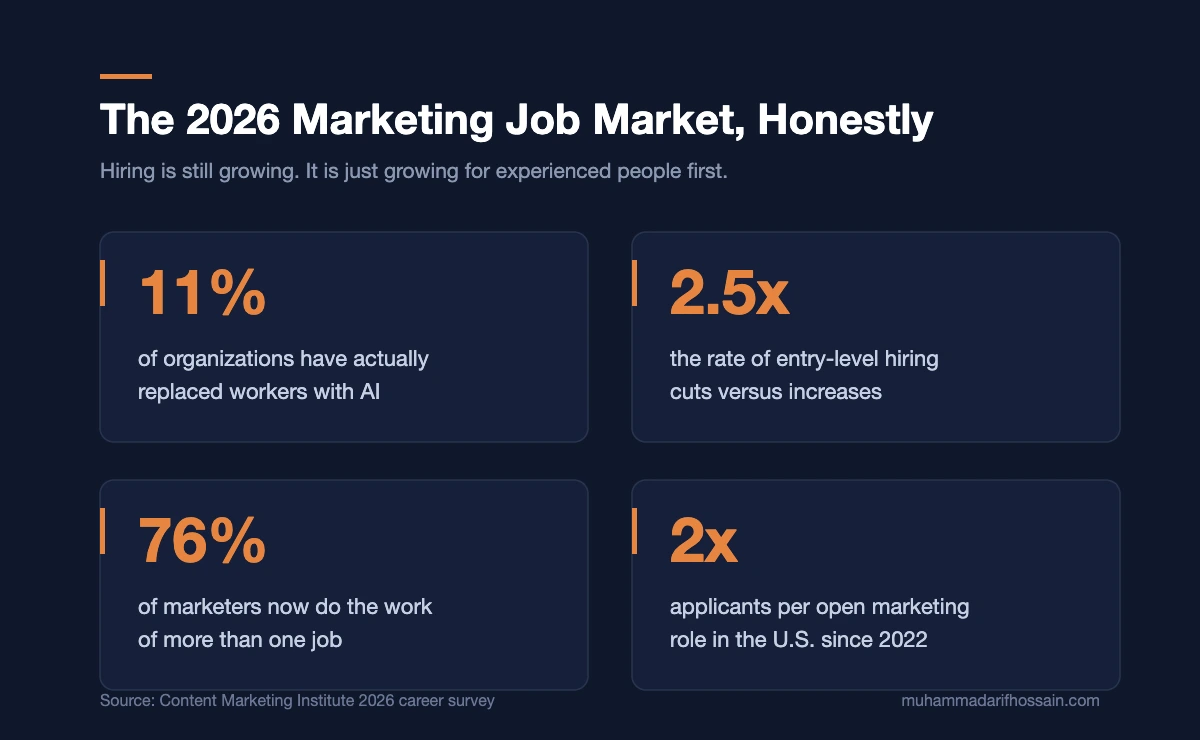
The headline data looks contradictory at first. Research from the Content Marketing Institute‘s 2026 career survey found that only 11 percent of organizations have actually replaced workers with AI, and overall marketing hiring is expanding, yet entry-level hiring reductions are happening at nearly two and a half times the rate of entry-level hiring increases. Put simply: companies want more marketers. They are just far less interested in inexperienced ones than they were three years ago.
The reason is not mysterious once you see it. AI has taken over exactly the tasks that used to be how junior marketers learned the craft: manual reporting, basic content formatting, A/B test variations, and scheduled posting are increasingly automated, while brand storytelling, customer psychology, and funnel design still require a human. The rungs at the bottom of the ladder did not disappear from the job. They disappeared from being a paid, junior-level task someone gets hired to do.
This is not the same as AI eliminating the career. The same research found 76 percent of marketers are now doing the work of more than one job, and half have taken on new responsibilities with no promotion or pay increase attached, a pattern researchers have started calling a “ghost workforce,” where fewer people are quietly absorbing more work rather than being visibly replaced. Demand for marketing work has not dropped. Demand for marketers who can only do the small, mechanical parts of the job has.
The practical result is a widening gap between candidates. Roles that combine marketing knowledge with genuine AI fluency, titles like AI Marketing Strategist, Performance Marketing Engineer, and SEO and AI Analyst, are seeing the strongest hiring demand, and salary differences between AI-fluent marketers and those without those skills are already visible even at the entry level. This is also making the hiring process itself more competitive: the number of applicants per open marketing role in the U.S. has roughly doubled since 2022, and most recruiters are now using AI themselves to pre-screen candidates before a human ever reads the application.
Where this matters most: deciding how you spend your first three months learning. A certificate alone increasingly proves you completed a course, not that you can do the parts of the job that still require a human. The practical response to a tighter entry-level market is not giving up on the field. It is entering it with more proof of actual capability than the market expected two years ago.
Common mistake to avoid: treating this data as a reason to avoid digital marketing entirely. Overall hiring in the field is still growing, and the roles being cut are specifically the ones AI can now do adequately on its own. The honest response is not pessimism. It is skipping straight past the entry-level path this guide’s older competitors describe, toward one built on visible, provable work from day one.
Employed or Freelance? Choosing Your Starting Path
Most guides to this career assume one path or the other, employment at a company or freelancing for clients, without acknowledging that the right starting point genuinely depends on your situation, not just your preference.
Freelancing offers real, specific advantages worth naming honestly. It comes with the ability to work from anywhere, choose which clients and industries you work with, and access to markets and companies well beyond your immediate area, all of which can mean higher rates than an equivalent local job would pay. It also comes with real costs that beginner guides sometimes undersell: you are running an actual business, invoicing, taxes, and client-hunting on top of the billable work itself, and your income will fluctuate with how many projects you currently have.
The income data reflects that variability directly. Freelance digital marketers in the U.S. report annual revenue anywhere from roughly $22,500 to $127,000, with a national average around $69,000, while hourly rates on freelance platforms typically run $20 to $30 for beginners, up to $80 for experienced marketers, and $125 to $150 or more for specialists. That spread is the honest picture: freelancing can pay very well, but it pays unevenly, especially in year one.
Employment trades that variability for structure, mentorship, and a steadier paycheck, at the cost of less schedule flexibility and slower income growth in the short term. It is generally the more forgiving starting point if you have little practical experience yet, since a team can catch mistakes a solo freelancer has no one to catch for them.
Where this matters most: your actual financial runway right now. Freelancing while you are still building proof of skill means client-hunting and inconsistent income at the same time you are least equipped to handle either. If you have savings or other income to cover a slow first few months, freelancing can work early. If you do not, building skills and a portfolio while employed elsewhere, then freelancing once you have real case studies, is usually the steadier path.
Common mistake to avoid: choosing freelance because it sounds more independent, without being honest about whether you can absorb months of inconsistent income while you are also still learning the craft. Independence is genuinely valuable. It is not free, and pretending otherwise sets people up for a rough first year.
Learn the Fundamentals Before the Tools
The single most common mistake beginners make in digital marketing is not a tool mistake. It is a sequencing mistake: jumping straight into running ads or posting content without understanding the consumer psychology and marketing fundamentals underneath them, which is why so many people learn digital marketing and quietly quit halfway through, not because it wasn’t worth it, but because they got lost.
This does not require a marketing degree or months of theory. It requires a working understanding of a small number of ideas: how a customer moves from unaware to loyal, what makes one offer more compelling than a competitor’s, and why the same message lands differently depending on who is reading it. These ideas are what make every tool you learn afterward make sense, rather than feeling like a disconnected checklist of software.
The practical test for whether you actually understand this layer is simple: can you look at an ad, a landing page, or an email from a real brand and explain, in a sentence or two, which funnel stage it is targeting and why the offer makes sense for that stage? If you cannot yet, that is the gap to close before spending real time on any specific platform.
Where this matters most: the very first weeks of learning, before any tool-specific course. Time spent here compounds through everything that follows. Time skipped here shows up later as campaigns that technically work but never quite land, because they were built on tactics with no underlying strategy.
Common mistake to avoid: treating this step as a box to check once and move past. Revisit it actively by picking real brands and asking what stage of the funnel their current campaign is aimed at. This single habit, practiced against real examples rather than textbook ones, builds the strategic intuition that separates someone who runs tactics from someone who actually understands why they work.
Build a Website and Use It as Your Lab
Here is a tactic almost every formal guide undersells: build a real website early, and use it as the place where you actually practice everything else in this guide, not just as a portfolio you assemble at the end.
The reasoning is direct. A basic WordPress website, which is free to build aside from hosting and a domain, becomes your lab rather than just a project, a place to actually apply SEO, write and optimize real content, build an email list, and run small test campaigns, instead of only reading about how those things work. This distinction between reading and doing matters more now than it did a few years ago, precisely because of the market shift described earlier. A certificate proves you sat through a course. A website with real search traffic, a real email list, and real analytics data proves you can execute.
Set this up before working through the skills section that follows, not after. Every skill below has a natural home on this site: SEO gets applied directly to its pages, content marketing gets tested on its blog, email marketing builds its list, and analytics gets practiced on its own real traffic data instead of a simulated dataset in a course.
Where this matters most: the exact gap identified in the 2026 hiring data. If entry-level hiring is favoring provable skill over completed coursework, a working website with real, if modest, results is precisely the evidence that closes that gap. It turns “I took a course on SEO” into “I ranked this specific page for this specific keyword, and here is the Search Console data.”
Common mistake to avoid: treating the website as a side project to get to eventually. Build it in week one, even in its simplest form, and let every subsequent skill you learn get applied to it immediately. A site that grows alongside your learning is a far stronger portfolio piece than a set of course completion certificates assembled after the fact.
The Core Skills to Build, In Order
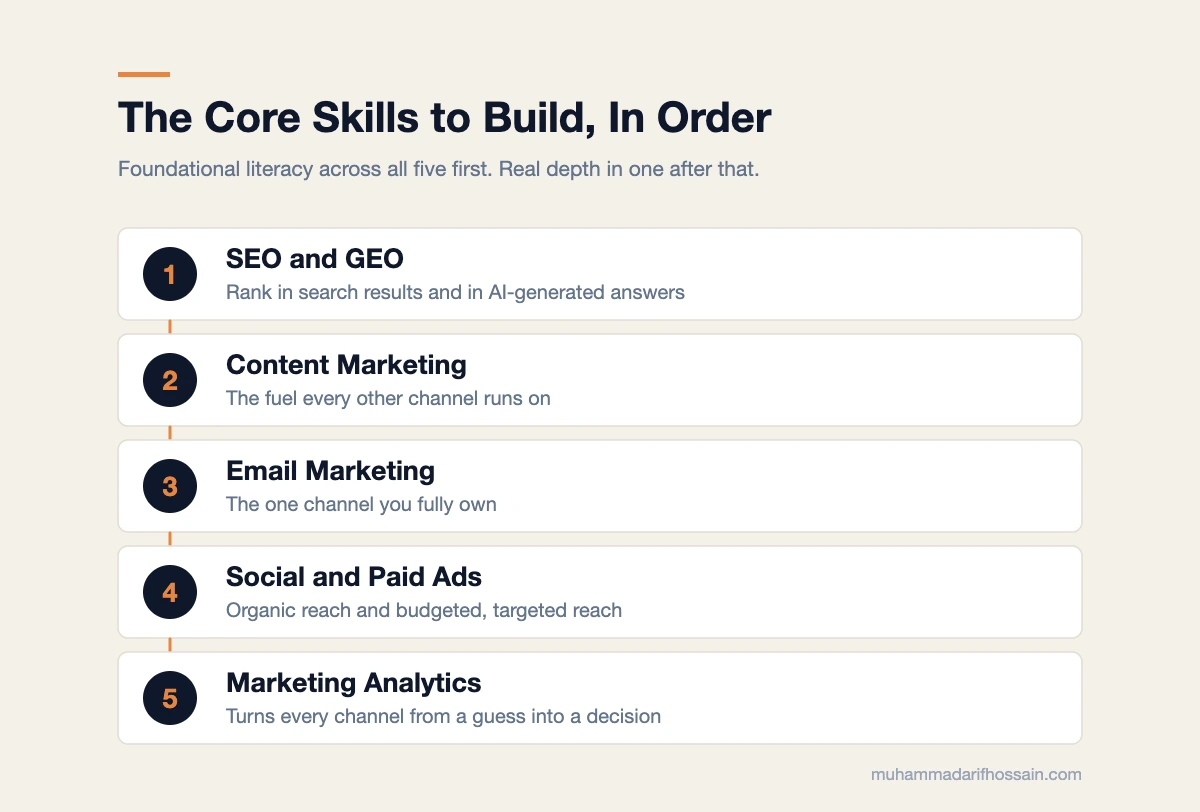
Working out how to become a digital marketer means building several distinct skill areas, and learning them in a deliberate order, rather than all at once, keeps beginners from the overwhelm that causes so many people to quit partway through.
Search Engine Optimization and Generative Engine Optimization
SEO is the practice of improving your content’s visibility in search results without paying for it. Its newer companion, GEO, does the same work for the AI-generated answers now appearing above traditional search results in tools like ChatGPT, Gemini, and Google’s AI Overviews, since this evolution focuses on driving organic traffic from both traditional search and AI response engines, making it one of the more future-relevant skills to learn early rather than as an afterthought.
Off-page work matters here too, and my own link building strategy covers the side of SEO that happens away from your pages. Apply the on-page side directly to your own site: write and optimize a page for one specific keyword, then track its performance in Google Search Console over the following weeks. Watching your own page’s real ranking move, even slightly, teaches more than any course module on the theory alone.
Content Marketing
Content marketing is the practice of creating and distributing material that attracts and holds a defined audience’s attention, and it is the fuel every other channel runs on. Without it, there is nothing to post on social media and nothing to rank in search results.
Practice using established copywriting structures rather than starting from a blank page every time: frameworks like Attention-Interest-Desire-Action or Problem-Agitate-Solution give beginners a repeatable shape to work within while they are still developing their own voice. Write a short, structured series for your own site and track which piece performs best, then ask honestly why.
Email Marketing
Despite frequent claims that email is outdated, it remains one of the highest-return channels available, largely because it is the one channel you fully own, unaffected by a platform algorithm change or a lost search ranking, which makes it uniquely durable compared to social or paid channels.
Build a small welcome sequence for your own site’s list, even before that list has many subscribers. The mechanics of segmentation, automation, and subject-line testing are identical whether your list has ten people or ten thousand, and practicing them now means they are second nature once the list is real.
Social Media and Paid Advertising
Social media marketing splits into organic content, built for free reach and community, and paid social, built for targeted, budgeted reach, and most brands eventually need both working together rather than choosing one exclusively.
Paid advertising, through search engines or social platforms, is the fastest way to generate visibility once organic growth alone is not enough, but it rewards strategy far more than budget. Run a genuinely small test campaign, even five or ten dollars, and spend more time analyzing the results than you spent setting it up. The habit of reading data carefully matters more here than the size of the spend.
Marketing Analytics
Analytics is the skill that turns every other channel from a guess into a measured decision, and it is also, honestly, the skill beginners most often skip, right up until a client or manager asks for a report and they realize they cannot actually read one.
Practice this on your own site’s real traffic in Google Analytics 4, not a course’s sample dataset. Track one page or one small campaign, then summarize what actually happened in a single page, in plain language, as if explaining it to someone who was not watching closely. That single habit, explaining data clearly rather than just collecting it, is the actual skill employers are checking for.
Common mistake to avoid across all of the above: trying to master every skill with equal depth before moving forward. The order above builds foundational literacy in each area. Genuine specialization, covered next, comes after this foundation, not instead of it.
Specialize With Evidence, Not Guesswork
Once you have foundational literacy across the core skills, the next decision, which one to go deep on, deserves more rigor than “whichever felt most fun.” A useful specialization sits at the intersection of genuine interest and genuine, current demand.
The demand side of that equation has shifted noticeably. Roles currently seeing the strongest hiring interest include the AI Marketing Strategist, who designs AI-integrated campaign structures across channels; the Performance Marketing Engineer, who manages automated ad systems and continuously optimizes for return; the Content Strategist, who leads narrative direction across AI-assisted content pipelines; the Marketing Automation Specialist, who builds CRM workflows and campaign automation; and the SEO and AI Analyst, who handles both traditional search optimization and the newer discipline of Generative Engine Optimization.
Notice the pattern across all five: none of them are pure execution roles anymore. Each one pairs a traditional marketing discipline with either automation, AI fluency, or both. This is not a coincidence. It is the direct market response to the entry-level hiring shift covered earlier, employers paying a premium for people who can direct and interpret automated systems, not just operate a single tool manually.
The interest side still matters just as much as the demand side, since a specialization chosen purely for market demand and genuinely disliked rarely sustains the depth needed to actually get good at it. A rough but useful filter: if you love writing, content and SEO tends to fit. If you enjoy numbers, analytics and paid ads tend to fit. If you’re naturally creative, social media and branding tend to fit. If you like building systems, automation and funnels tend to fit.
Common mistake to avoid: specializing too early, before the foundational skills section above has given you enough exposure to actually know which one you enjoy. A specialization chosen in week one, before trying the others hands-on, is a guess. A specialization chosen after real practice across each area is a decision.
Once chosen, go deep rather than broad. The goal from here is becoming what the field calls a T-shaped marketer, broad working knowledge across every core skill, genuine depth in the one you specialize in, which is exactly the profile the current highest-demand roles are actually hiring for.
Use AI as an Amplifier, Not a Shortcut
Given everything covered about AI’s effect on hiring, learning to use AI tools well is not optional in 2026. But there is a specific way to learn this that avoids becoming exactly the kind of shallow, easily-automated skill set employers are now hiring around.
AI genuinely changes what is possible day to day: it enables hyper-personalization by analyzing past behavior to predict what a customer wants next, predictive analytics that forecast trends before they fully arrive, and a real increase in content velocity, drafting and visualizing campaign ideas far faster than doing it entirely by hand. Learning to direct these tools well, through clear, specific prompts and thoughtful research use, is a genuine, valuable skill.
The distinction that actually protects your value in this market is narrower than “know AI tools.” A marketer who can write sophisticated prompts but does not understand customers, positioning, analytics, or underlying strategy will still struggle, since prompt skill without marketing judgment produces confident, well-written work that solves the wrong problem. The fundamentals covered earlier in this guide are not a warm-up before AI. They are the thing that makes your use of AI actually good.
Common mistake to avoid: using AI to skip the thinking rather than accelerate it. If you cannot explain, in your own words, why a piece of AI-generated content or campaign structure works, you have not actually learned the skill AI just performed for you. Always challenge and edit AI output rather than publishing it unreviewed. The final strategy and voice need to stay identifiably yours.
Build a Portfolio That Proves Judgment, Not Just Task Completion
Anyone working out how to become a digital marketer eventually hits the portfolio question, and given the current hiring picture, a portfolio’s job has changed. It used to need to prove you understood the tools. Now it needs to prove you can make a judgment call an automated system could not have made on its own.
Build two or three real pieces rather than a long list of shallow ones. Strong options include a full SEO audit of a real (even small) website, a social media strategy deck built for an actual business, an analysis of a real ad campaign’s results with a clear recommendation attached, or a documented email automation workflow. The website built earlier in this guide is the natural home for most of these, since it gives you real data to analyze instead of a hypothetical scenario.
Each piece should show the same structure: what the situation was, what you decided to do and why, what happened, and what you would do differently next time. That last part matters more than beginners usually assume. The willingness to critique your own results, out loud, is itself evidence of the judgment the current market is specifically hiring for.
Where this matters most: the first real application you submit. A portfolio with genuine reasoning behind each decision, even on small or modest projects, reads as more credible than a portfolio of polished but unexplained outputs, precisely because reasoning is the part AI cannot fake on your behalf without you noticing.
Common mistake to avoid: waiting until the portfolio feels “impressive enough” to show anyone. A portfolio with three honest, well-reasoned small projects beats an empty portfolio waiting for a big one that never quite feels ready. Publish the first version and improve it in public as you learn more.
Getting Hired or Getting Clients
The path to your first opportunity differs depending on the employment-versus-freelance choice made earlier, but both paths run on the same underlying currency: demonstrated, specific proof, not general enthusiasm.
For employment, treat your resume and LinkedIn profile as documents built for the specific role, not a generic summary of everything you have learned. Rewrite your resume using the exact keywords found in the job description, since many applications are screened by software before a person reads them, and optimize your LinkedIn profile with the same specific keywords, like SEO or content strategy, that a recruiter would actually search for. Networking still closes more doors than cold applications: engaging genuinely on LinkedIn, starting a small newsletter, and showing up in relevant communities all build the kind of visibility that gets someone recommended before a role is even posted.
For freelancing, start with a narrow, specific offer rather than a broad one. The strongest early opportunities tend to cluster in a few areas: Facebook and Instagram ad management, SEO consulting, chatbot and customer service setup, sales funnel and landing page design, and PPC campaign management on Google Ads all see consistent demand from small and mid-sized businesses that need help but cannot justify a full-time hire. Offering one of these clearly, rather than “digital marketing services” broadly, makes you easier to hire and easier to refer.
Common mistake to avoid: sending the same generic pitch or resume to every opportunity. Customizing every application and proposal to the specific client or role builds trust and understanding in a way a template never will, even when it takes longer per application. One tailored application usually outperforms five generic ones.
Whichever path you take first, the first paid project, however small, teaches more than the next several courses combined, simply because a real client with real stakes surfaces problems no course scenario replicates. If you want to see what that work looks like written up properly, my case studies show the situation, the decision and the result for each project.
Common Mistakes That Slow People Down
A short, honest list of the patterns that most often cost people learning how to become a digital marketer months of otherwise well-intentioned effort.
- Learning tools before strategy. Running ads or posting content without understanding the funnel stage they serve produces activity without direction, and it is the single most common reason beginners feel busy but stuck.
- Collecting certificates instead of building proof. In a market where entry-level hiring specifically favors demonstrated judgment, a stack of completion certificates with no applied project behind them increasingly under-delivers relative to the time spent earning them.
- Choosing freelance or employment based on preference alone. Both paths work. Choosing one without an honest look at your financial runway and current experience level sets up an avoidable, difficult first few months.
- Trying to master every skill at once. Foundational literacy across all core skills, then real depth in one, consistently outperforms shallow effort spread evenly across everything.
- Treating AI fluency as prompt-writing alone. The market is specifically rewarding marketers who pair AI tools with real strategic judgment, not marketers who can write a clever prompt but cannot explain why the output is actually good.
Reviewing this list honestly every few weeks catches more wasted effort early than any course module will, since most of these patterns are about sequencing and judgment, not missing information.
Related Guides
- How to Build a Content Calendar: 10 Steps and Mistakes to Avoid
- Content Marketing Strategy: 8 Steps That Actually Work
- Link Building Strategy: 57 Links, No Budget, and Traps to Avoid
Frequently Asked Questions
Is digital marketing still a good career to start in 2026?
Yes, though the entry point looks different than it did a few years ago. Overall marketing hiring is still growing, but entry-level hiring specifically has tightened because AI now handles many of the repetitive tasks junior marketers used to learn on. The honest response is building visible, provable skill from day one rather than relying on certificates alone.
Do I need a degree to become a digital marketer?
No specific degree is required, and most working digital marketers are self-taught or certificate-trained rather than degree-holders in the field. What matters far more than credentials is demonstrated ability, through a personal project, real case studies, or freelance work with actual results attached.
How long does it take to become a digital marketer?
Learning the technical fundamentals well enough for entry-level or freelance work typically takes three to six months of consistent, applied effort, not passive course-watching. Developing the strategic judgment that separates a competent marketer from a strong one takes considerably longer and comes primarily from real project experience, not additional coursework.
Should I specialize in digital marketing or stay a generalist?
Start as a generalist long enough to build foundational literacy across search, content, email, social, paid ads, and analytics, then specialize in the one area where your genuine interest and current market demand overlap. Roles that pair a traditional specialty with AI or automation fluency are currently seeing the strongest hiring interest.
How much can a digital marketer earn?
Earnings vary widely by path and experience. Freelance digital marketers in the U.S. report annual revenue roughly between $22,500 and $127,000, averaging around $69,000, with senior specialists charging well above $100 per hour. Employed roles vary by seniority and specialization, with AI-fluent and automation-focused roles currently commanding a noticeable premium over generalist positions.
What is the fastest way to build a digital marketing portfolio with no experience?
Build a real website and use it to apply every skill you learn: run an SEO experiment, write and publish content, build a small email list, and analyze the real traffic data that results. Two or three well-reasoned projects, showing your decisions and results honestly, prove more to a hiring manager than any number of course completion certificates.