Let’s be honest about why you’re here. You’ve either tried cold email and got almost nothing back, or you haven’t started and you’re worried it’s just going to annoy people and land you in spam. Both are fair worries. I’ve felt both of them myself.
Here’s the truth, and I’ll give it to you straight instead of dressing it up. Cold email still works in 2026. Really well, actually. But it works because of a handful of unglamorous things done consistently, not because of some clever subject line trick you found in a listicle. Get the boring parts right, the list, the setup, the follow-ups, and the rest gets a lot easier.
So let’s walk through this together, the way I’d explain it to a friend over coffee. No jargon you have to look up, no vague “just be authentic” advice. Just what actually moves the needle.
TL;DR
- Cold email is a message to someone who’s never heard of you, sent with a real reason and a specific ask. That’s what separates it from spam, not the fact that it’s unsolicited.
- It’s legal in the US and EU if you follow CAN-SPAM and GDPR: accurate sender info, an easy opt-out, and (for the EU) a genuine reason the person would care.
- Before you write a single email, nail down who you’re targeting and get your sending setup right. Most “my cold email doesn’t work” problems are actually list or deliverability problems, not writing problems.
- Keep your first email short, somewhere around 50 to 125 words, and make it almost entirely about the recipient, not you.
- Don’t send just one email and give up. A big chunk of replies come from follow-up two, three, and four, not the first message.
- A 5% reply rate is solid. Above 10% is genuinely excellent. If you’re at 1% or lower, something structural is broken, not just your copy.
What Cold Email Actually Is (and Why It’s Not Spam)
Picture this. You email someone who’s never heard of you, about something specifically relevant to their job or their business, and you tell them exactly who you are and what you want. That’s a cold email.
Now picture the opposite. A message blasted to thousands of random addresses, no personal detail, a fake or hidden sender, and a subject line promising something the email doesn’t deliver. That’s spam.
The difference isn’t whether the person asked for your email. Neither one is invited. The difference is targeting, honesty, and relevance. A cold email is aimed at someone specific, for a real reason, from a real person they could actually look up and verify. Spam is aimed at anyone, hoping something sticks.
Here’s the part that trips people up: your email service provider is watching for the same signals you’d use to tell the two apart. Real sender name, consistent sending pattern, people actually opening and replying instead of deleting on sight. Get those wrong and it doesn’t matter how good your intentions are, you’re getting treated like spam anyway.
Is Cold Email Marketing Legal? Here’s What It Requires
I’m not a lawyer, and this isn’t legal advice, but here’s the practical shape of it.
In the US, the CAN-SPAM Act covers you. You need accurate sender information (no faking who you are), a subject line that matches what’s actually in the email, a real physical address somewhere in the message, and a working way for someone to opt out. Honor that opt-out within ten business days. Violations carry real penalties per email, so this isn’t a “eh, probably fine” situation.
In the EU, GDPR is stricter. You generally need what’s called “legitimate interest,” meaning there’s a real, defensible reason this specific person would care about what you’re offering. Blasting a generic list of European contacts because you found their emails somewhere doesn’t meet that bar. You also need a clear opt-out and to only hold onto the data you actually need.
The practical version of all this: personalize your outreach to people it genuinely makes sense to contact, always give a clean way out, and don’t hide who you are. Follow those three things and you’re on solid ground.
Before You Write Anything, Know Who You’re Emailing
Here’s something that surprised me when I first got into this. Most cold email campaigns that flop aren’t failing because of bad writing. They’re failing because they’re emailing the wrong people, or too many of the wrong people at once.
Build what’s called an Ideal Customer Profile, which is just a fancy way of saying: get specific about who actually benefits from what you’re offering. Not “small businesses.” Something like “marketing managers at 20 to 50 person SaaS companies who just hired their first content person.” The tighter this is, the higher your reply rate climbs, because every email actually feels relevant to the person opening it.
Once you know who you’re after, build your list carefully. Don’t buy a giant list from a shady data broker. Those lists are full of outdated and invalid addresses, and sending to them tanks your reputation before you’ve sent a single good email. Use verified sources, run your list through a verification tool before you send, and keep your bounce rate under 2%. Above that, providers start flagging you, and above 10%, you risk getting throttled or blocked outright.
The Cold Email Setup Work That Decides If Anyone Sees You
I know you want to get to the writing part. We’ll get there. But skip this section and none of the writing will matter, because your emails won’t reach an inbox at all.
Never send cold email from your main business domain. Set up a separate sending domain instead. If that domain’s reputation takes a hit, and it will if you’re doing real volume, your actual business domain stays clean and protected.
Every sending domain needs three technical records set up: SPF, DKIM, and DMARC. I won’t pretend these are exciting, but here’s what they do in plain terms. SPF tells email providers which servers are allowed to send mail as you. DKIM adds a kind of digital signature proving the email wasn’t tampered with. DMARC tells providers what to do if something fails those checks. Skip these and major providers increasingly just won’t deliver your mail at all.
Then there’s warmup. A brand new email address that suddenly sends hundreds of emails a day looks exactly like a spam operation to Gmail and Outlook, even if your intentions are completely legitimate. Start small, something like 5 to 10 emails a day, and build up gradually over two to four weeks before you hit full sending volume. Cap your daily sends per inbox around 30 once you’re up to speed. It feels slow. It’s the difference between landing in the inbox and landing in spam, permanently.
Writing the Cold Email Itself
Okay, now we get to the part you actually came here for.
Keep it short. Somewhere between 50 and 125 words for your first email. I know that feels impossibly short when you have so much to say about what you do. Say less. Research on cold email consistently shows shorter emails get meaningfully higher reply rates than long ones. Nobody’s reading a 300-word email from a stranger.
Make the subject line boring in the best way. Clear beats clever almost every time. Six to ten words, no clickbait, and it should say plainly what the email is actually about. If your subject line promises something the email doesn’t deliver, you’ll get the open and lose all the trust in the same three seconds.
Open with them, not you. Your first line should be entirely about the recipient. Something you noticed about their company, a change they just made, a challenge people in their exact position tend to run into. Don’t open with “My name is” or “I wanted to reach out.” Nobody cares yet. Earn that with relevance first.
Lead with the problem, not your product. Before you explain what you do, name the thing they’re actually dealing with. One sentence on the problem, one sentence on the outcome you help people reach. Save the feature list for later, if it ever comes up at all.
End with one small ask. Not “book a 30 minute demo on my calendar.” That’s a big ask from a total stranger. Try something closer to “worth a quick reply if this is relevant?” Low effort, low commitment, easy to say yes to. One ask only. Multiple asks in the same email just confuses people about what you actually want.
Sign it like a real person. Full name, what you do, and a real way to verify you exist. This isn’t just good manners, it’s also part of staying on the right side of CAN-SPAM.
Don’t Stop After One Email: The Follow-Up Sequence
Here’s something that changes how most people think about cold email once they hear it: a huge share of replies don’t come from the first email at all. They come from your follow-ups.
Think about your own inbox for a second. How many times have you meant to reply to something and then just… didn’t, until a gentle nudge reminded you? Your prospects are doing the exact same thing. They’re not ignoring you out of disinterest. They’re busy, and your first email got buried under twenty other things.
A realistic follow-up rhythm looks something like this:
- Email 1: Day 0
- Email 2: Day 2 to 3
- Email 3: Day 5 to 7
- Email 4: Day 10 to 14
- Email 5: Day 18 to 21
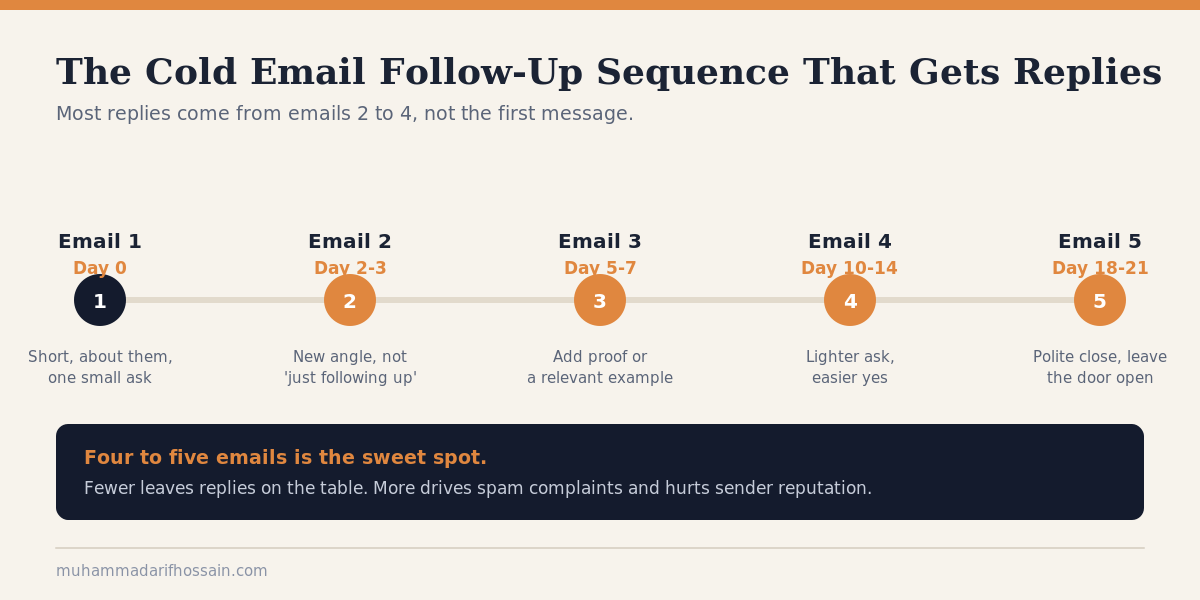
Four to five emails total tends to be the sweet spot. Fewer and you’re leaving replies on the table. More than that and you start annoying people, which shows up as spam complaints and hurts your sender reputation.
Each follow-up should add something new, a different angle, a piece of information, a lighter version of the ask, not just “just following up!” with nothing else added. That phrase alone, with no new value attached, is one of the fastest ways to get ignored a second time.
Cold Email Benchmarks: What Good Actually Looks Like
Numbers help here, so let’s talk real benchmarks instead of vague encouragement.
A reply rate around 5% is solid for B2B cold email. Get above 10% and you’re doing genuinely well. Industry-wide averages tend to sit lower than that, somewhere around 3 to 4%, so don’t panic if your first campaign doesn’t hit 10% out of the gate.
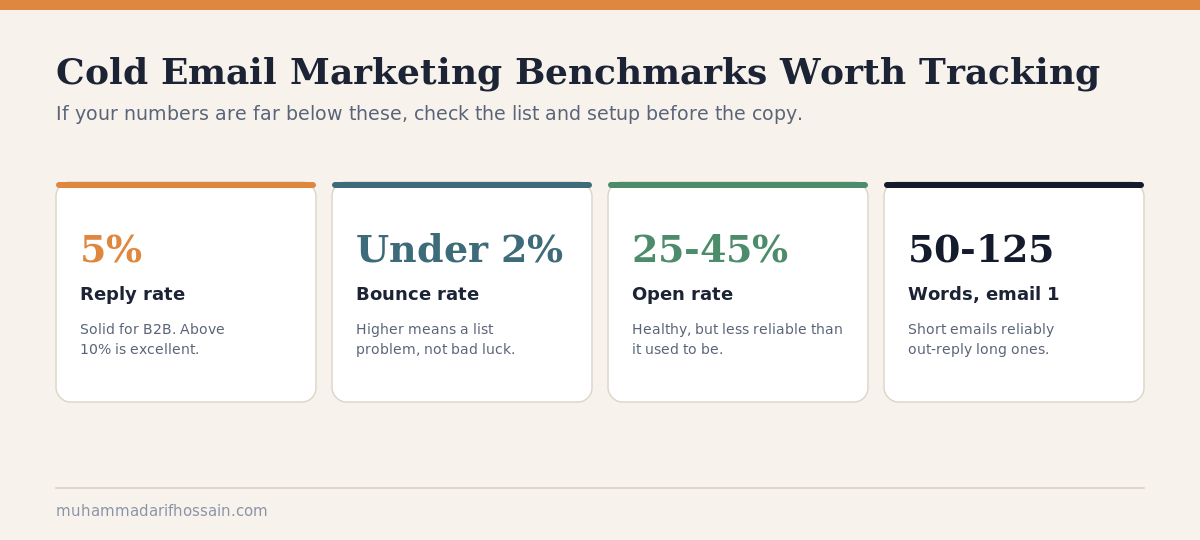
Keep your bounce rate under 2%. Anything higher is a list quality problem, not a bad luck problem, and it’s worth pausing your campaign to clean the list before you keep sending.
Open rates in the 25 to 45% range are healthy, though open rate matters less than it used to, since privacy features on some email clients make opens harder to track accurately. Reply rate and bounce rate tell you a lot more about what’s actually happening.
If your numbers are far below these ranges, don’t jump straight to rewriting your email copy. Check your list quality and your technical setup first. Most underperformance traces back there, not to the words on the page.
Mistakes That Quietly Wreck Cold Email Campaigns
Skipping warmup because you’re impatient. I get it, you want results now. Sending high volume from a brand new address is the single fastest way to end up permanently in spam.
Writing about yourself instead of them. An email packed with “I,” “we,” and “our product” from the first line reads exactly like every other pitch in someone’s inbox. Flip the perspective and watch what happens to your replies.
One email and done. If you’re only sending once, you’re leaving a large chunk of your possible replies on the table before you even start.
Buying a cheap list. It feels like a shortcut. It’s actually a fast way to torch your sender reputation with bounces and spam complaints before you’ve had a real chance.
No clear ask. An email that just introduces you without asking for anything specific usually gets read and forgotten. Give people something small and easy to say yes to.
Related Guides
- Business Growth Strategy: 4 Types and How to Pick the Right One
- Content Marketing Strategy: 8 Steps That Actually Work
- How to Become a Digital Marketer: An Honest Roadmap for 2026
Need Help Getting Your Cold Email Actually Working?
If you’ve read this whole thing and you’re still not sure whether your problem is your list, your setup, or your writing, that’s genuinely common. Cold email has a lot of moving parts, and it’s easy to fix the wrong one first.
I work on marketing systems for SaaS and WordPress products every day, cold outreach included. If you want a second pair of eyes on your campaign, or just want to figure out where things are actually breaking down, reach out here. I read and reply to every message myself.
Frequently Asked Questions
What’s the difference between cold email and spam?
The difference between cold email and spam comes down to targeting, honesty, and relevance, not whether the person asked for it. Cold email goes to a specific, carefully chosen person for a real reason, from a sender who’s honest about who they are. Spam goes out broadly with no personalization and often hides or fakes the sender’s identity.
Is cold email marketing legal?
Cold email marketing is legal in the US and EU as long as you follow the rules that apply. In the US, that means following CAN-SPAM: accurate sender info, an honest subject line, a real address, and a working opt-out. In the EU, GDPR requires a genuine, defensible reason the specific recipient would care, plus an easy way to opt out.
How long should a cold email be?
A cold email should be somewhere between 50 and 125 words for the first message in a sequence. Shorter emails consistently get higher reply rates than long ones, since a stranger’s message competing for attention in a busy inbox doesn’t get the benefit of the doubt a 300-word email needs.
How many follow-up emails should I send?
You should send four to five emails total in a cold email sequence, spaced out over about three weeks. A large share of replies come from these follow-ups rather than the first email, so stopping after one message leaves a meaningful amount of potential responses on the table.
What’s a good reply rate for cold email?
A good reply rate for cold email is around 5%, with anything above 10% considered excellent. If you’re consistently seeing 1% or lower, the issue is usually your list quality or technical setup rather than your writing, so it’s worth checking those first.
Do I need special technical setup before sending cold emails?
Yes, you need a separate sending domain along with SPF, DKIM, and DMARC records configured, plus a gradual warmup period of two to four weeks for any new email account. Skipping this setup is the most common reason cold emails land in spam regardless of how well they’re written.