You search “on-page vs off-page SEO” and end up with ten browser tabs open. One article gives you a list of forty ranking factors. Another tells you to “just build good backlinks.” None of them tell you which one to focus on first, or why it even matters.
Here’s the short version. On-page SEO is everything you control directly on your website. Off-page SEO is everything that happens outside it, mostly other websites and platforms vouching for you. Both affect where you rank. Neither works well alone.
This guide breaks down what each one actually includes, how they’re different in practice, and which one deserves your attention first if you’re starting from scratch.
TL;DR
- On-page SEO is everything you control directly on your website: titles, content, headings, internal links, page speed.
- Off-page SEO is everything outside your website that builds trust and authority: backlinks, reviews, citations, brand mentions.
- On-page SEO shows results in days to weeks. Off-page SEO usually takes a few months, since it depends on other sites choosing to link to or mention you.
- Start with on-page SEO first. It’s fully in your control and it’s what makes your site worth linking to in the first place.
- Off-page SEO becomes the bigger lever once your pages are already well optimized and you’re competing against similarly strong sites.
- Neither works well alone. A great page with no outside authority stalls, and strong backlinks pointing at a weak page waste their value.
On-Page vs Off-Page SEO: The Quick Answer
On-page SEO covers the things you can edit yourself: your titles, your content, your site structure. Off-page SEO covers the things other people and platforms do that reflect on you: linking to you, mentioning your brand, reviewing your business.
Here’s the difference at a glance.
| Factor | On-Page SEO | Off-Page SEO |
|---|---|---|
| Where it happens | On your website | Outside your website |
| Who controls it | You, directly | You, indirectly (through outreach and reputation) |
| Main goal | Help search engines and users understand your page | Prove your site is trustworthy and worth ranking |
| Core activities | Titles, content, headings, internal links, page speed | Backlinks, brand mentions, reviews, social signals |
| Time to see results | Days to a few weeks | Months, sometimes longer |
| Where you start | First, since it’s the foundation | Second, once your pages are worth linking to |
Now let’s go through what actually falls into each category, and why each piece matters more than it looks.
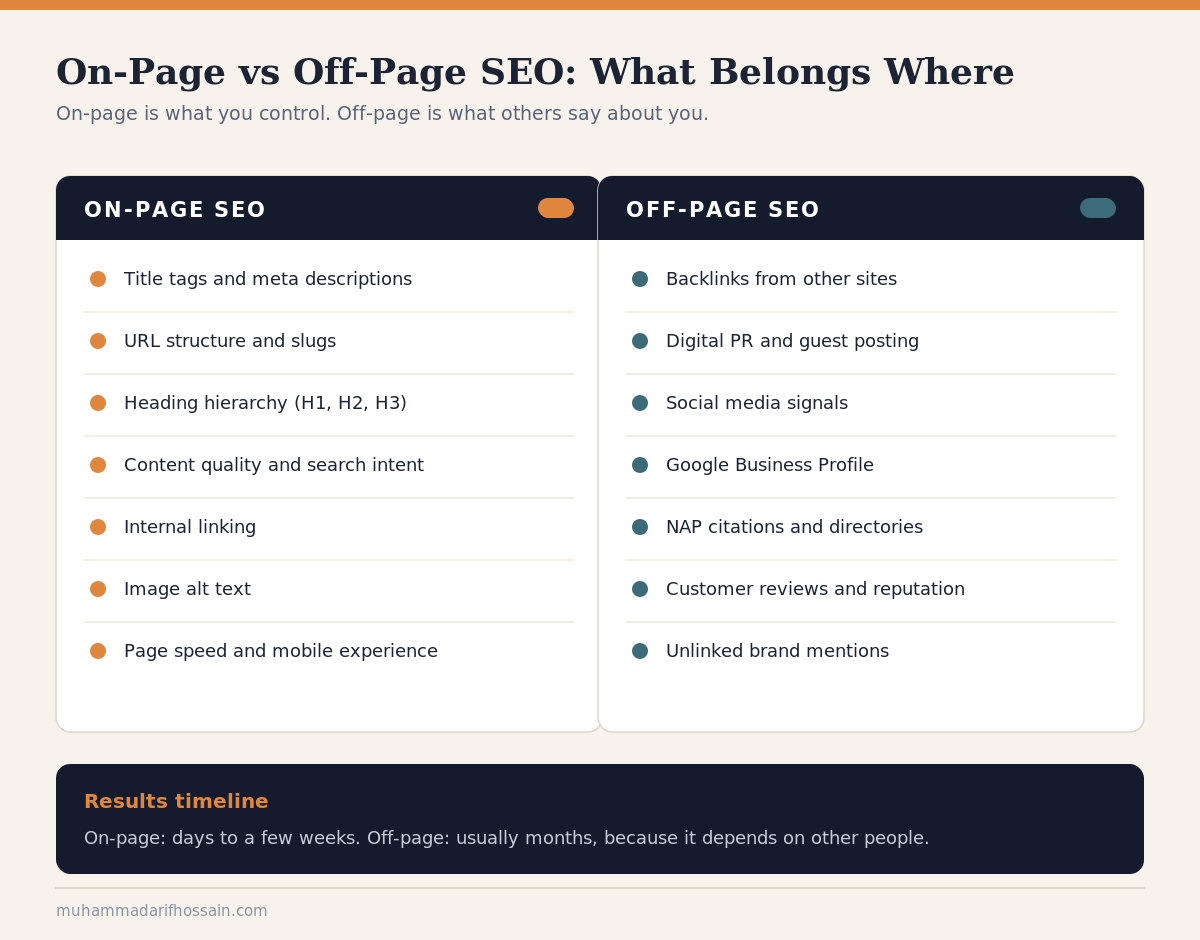
What Is On-Page SEO?
On-page SEO is the practice of optimizing individual pages on your website so they rank higher and match what searchers are actually looking for. It covers your written content, your HTML code, and how your page is structured.
The reason on-page SEO comes first for most people is control. You don’t need anyone else’s permission to fix a title tag or rewrite a paragraph. You open the page, make the change, and it’s done. That makes on-page SEO the fastest place to see improvement, and the safest place to start if you’re new to SEO.
It also does something off-page SEO can’t. It tells Google exactly what your page is about and who it’s for. Without that, even a page with hundreds of backlinks can struggle to rank for the right search terms, because Google isn’t sure what question the page is actually answering.
Let’s walk through the pieces that make up on-page SEO.
Title Tags
A title tag is the headline that shows up in the search results and in the browser tab. It’s one of the first things both Google and a searcher use to decide what your page is about.
A weak title tag is vague or generic, something like “Home” or “Blog Post 12.” A strong one tells the searcher exactly what they’ll get and includes the keyword they searched for, ideally near the front.
Keep your title between 50 and 60 characters. Go longer and Google will likely cut it off or rewrite it themselves, which means you lose control over your first impression in the search results.
Common mistake to avoid: Stuffing the same keyword into the title twice to “make sure Google gets it.” This looks spammy to readers and rarely helps rankings. One clear, natural mention works better than two forced ones.
Meta Descriptions
A meta description is the short summary that appears under your title in search results. It doesn’t directly affect your ranking position, but it directly affects whether someone clicks your result over the one above or below it.
Think of it as your one shot at a sales pitch before the click. If your description just repeats the title, you’ve wasted the space. A good description tells the reader what specific problem this page solves for them, in about 105 characters or less to avoid getting cut off.
Where this matters most: Pages competing in crowded search results, like product pages or popular how-to guides. When five results all promise the same thing, the description is often what tips the click in your favor.
URL Structure
Your URL slug is the part of the address that describes the specific page, like `/blog/on-page-vs-off-page-seo`. It’s a small ranking factor on its own, but it has an outsized effect on user trust and click-through.
A clean, readable URL tells a person exactly where they are and what to expect before they even click. A long string of numbers and folders does the opposite. It makes your site feel disorganized, even if the content behind it is excellent.
Keep URLs short, use hyphens between words (never underscores), and include your target keyword where it fits naturally. Avoid changing URLs after a page has been live for a while, since that can break existing backlinks and search rankings tied to that address.
Heading Structure (H1, H2, H3)
Headings do two jobs at once. They help search engines understand how your content is organized, and they help human readers scan the page and find what they need without reading every word.
Every page should have exactly one H1, and it should closely match your title tag. From there, H2s break the page into main sections, and H3s handle any subpoints under those sections. This creates a hierarchy search engines can parse and readers can skim.
The mistake to avoid is skipping levels or using headings purely for visual styling instead of structure. A page that jumps from H1 straight to H4 formatting, with no H2s or H3s in between, confuses both Google’s crawlers and your reader’s sense of where they are in the page.
Content Quality and Search Intent
This is the factor that matters most, and the one most guides gloss over. Search intent is the actual reason someone typed a query into Google. Someone searching “best coffee maker” wants a comparison. Someone searching “how to clean a coffee maker” wants a step-by-step guide, not a buying list.
Before you write a word, look at what’s already ranking for your target keyword. If every top result is a list-style comparison and you write a single-product review, you’re fighting the intent of the search itself, not just the competition.
Once intent is clear, quality is about depth and originality. Cover the questions a reader would naturally ask next, not just the obvious surface-level answer. Use plain language, back up claims with credible sources when it matters, and make sure the content reflects real experience or research rather than a rehash of what’s already out there.
Common mistake to avoid: Writing to a word count target instead of to the reader’s actual question. A 3,000-word article that pads itself with repeated points will lose to a tighter 1,200-word piece that actually answers what people are searching for.
Internal Linking
Internal links are links from one page on your site to another page on the same site. They help search engines discover your other content and understand which pages are most important to you.
They also guide readers deeper into your site instead of letting them bounce after one page. A blog post about email marketing that links to your related post on subject lines keeps that reader engaged and signals to Google that both pages are connected and relevant to each other.
Use descriptive anchor text that tells the reader what they’ll find on the other end. A link that says “click here” tells Google nothing. A link that says “how to write subject lines that get opened” tells both the reader and the search engine exactly what’s waiting on the other page.
Image Alt Text
Alt text is a short description added to an image’s code, mainly so screen readers can describe the image to visually impaired users. Search engines also read alt text to understand what an image shows, since they can’t actually “see” the picture.
Keep alt text short, specific, and accurate to what’s in the image. Skip generic descriptions like “image1.jpg” and skip keyword stuffing too. Describe the image the way you’d describe it to someone on the phone who can’t see it.
Page Experience and Mobile Friendliness
Page experience covers how fast your page loads, how stable it feels while loading (no elements jumping around as you scroll), and how well it works on a phone screen. Google measures these through a set of metrics called Core Web Vitals.
More than half of web traffic now comes from mobile devices, and Google indexes and ranks based on the mobile version of your site by default. A page that looks great on desktop but forces mobile visitors to pinch and zoom is working against you before they’ve even read a word.
You don’t need to be a developer to check this. Free tools like Google PageSpeed Insights will scan your page and flag exactly what’s slowing it down, from oversized images to unnecessary scripts.
What Is Off-Page SEO?
Off-page SEO covers everything that happens away from your website that still affects how it ranks. Mainly, it’s about other sites, platforms, and people signaling to Google that your website is trustworthy and worth showing to searchers.
This is where SEO gets harder, because you’re no longer in full control. You can write the perfect title tag in five minutes. You can’t force another website to link to you in five minutes. Off-page SEO relies on other people’s decisions, which makes it slower and less predictable than on-page work.
But it’s also where competitive advantage tends to live. If two websites have equally strong on-page content, Google will generally lean toward the one with a stronger reputation across the web. That reputation is built entirely through off-page signals.
Backlinks
A backlink is a link from another website pointing to yours. They function like votes of confidence. The more relevant, high-quality sites that link to you, the more Google tends to trust that your content deserves to rank.
Not all backlinks carry equal weight. A link from a well-known, topically relevant site matters far more than ten links from unrelated, low-quality directories. What actually makes a backlink valuable comes down to a few things: how authoritative the linking site is, how relevant its content is to yours, and whether the link sits naturally within real content rather than a random footer or sidebar.
Earning backlinks usually comes down to creating something worth linking to, like original research, a genuinely useful guide, or a tool other sites want to reference, and then telling relevant publishers it exists. This process is called link building, and it’s slow by nature. It depends on someone else deciding your content is worth citing.
Common mistake to avoid: Chasing link volume over link quality. A hundred low-quality links from unrelated sites can do less for your rankings than five links from sites your actual audience already trusts.
Digital PR and Guest Posting
Digital PR means getting your brand or expertise mentioned in the press, industry blogs, or expert roundups, often by pitching journalists directly or offering original data they can cite. Guest posting means writing content for another site in your industry, usually with a link back to your own site included.
Both work on the same principle. Instead of waiting to be discovered, you’re actively putting your name and expertise in front of the publishers who influence your industry’s conversation. A well-placed guest post on a respected industry blog can bring both a valuable backlink and direct referral traffic from readers who trust that publication.
Social Media Signals
Social shares and engagement aren’t a direct Google ranking factor on their own. But an active, engaged social presence still supports your SEO indirectly, by putting your content in front of more people who might link to it, mention it, or search for your brand by name afterward.
Sharing your content on social platforms, engaging with your audience’s comments, and building a following that already trusts your brand all feed back into the same goal: more people discovering and vouching for your website across the internet, not just inside Google’s search results.
Google Business Profile and Local Citations
If your business serves a specific location, your Google Business Profile is one of the highest-leverage off-page assets you have. It’s what allows you to show up in Google Maps and the local map pack results when someone searches “plumber near me” or “bakery in [city].”
NAP citations, meaning consistent mentions of your business Name, Address, and Phone number across directories like Yelp, Bing Places, and industry-specific listings, help search engines verify that your business is real and located where you say it is. Inconsistent information across these listings, like an old address on one site and a new one on another, actively hurts your local rankings.
Where this matters most: Any business with a physical location or a defined service area. If you’re running a purely online business with no local component, this factor matters far less to you.
Reviews and Reputation
Customer reviews on platforms like Google, Yelp, and industry-specific review sites feed directly into local search rankings, and they shape a searcher’s first impression before they’ve even clicked your website. A steady flow of recent, positive reviews signals to both Google and searchers that real customers trust you.
Responding to reviews, both positive and negative, also matters more than most businesses realize. It shows an active, engaged brand behind the listing, and it gives you a chance to address concerns publicly instead of letting a single bad review sit unanswered for years.
On-Page vs Off-Page SEO: The Full Comparison
Here’s how the two disciplines stack up once you look past the basic definitions.
| On-Page SEO | Off-Page SEO | |
|---|---|---|
| Control | Full control, you make the change directly | Indirect, depends on other sites and platforms |
| Speed of results | Often visible within days to a few weeks | Usually takes months to show measurable impact |
| Cost | Mostly time, your own or a writer’s | Often requires outreach time, PR, or paid link building |
| Risk if ignored | Pages don’t rank because Google can’t understand or trust them | Pages plateau even with great content, since authority is missing |
| Where it lives | Titles, headings, content, internal links, page speed | Backlinks, reviews, citations, brand mentions, social signals |
| Best measured by | Google Search Console, on-page audit tools | Backlink checkers, review monitoring, referral traffic |
Neither column is optional. A page with excellent content and zero external trust signals will often lose to a mediocre page backed by strong authority, especially in competitive niches. And a site with hundreds of backlinks pointing to poorly written, poorly structured pages won’t hold onto those rankings for long either.
On-Page vs Off-Page SEO: Which One Comes First?
If you’re starting from zero, on-page SEO comes first. It’s foundational, it’s fully within your control, and it makes sure Google can actually understand and properly index what you’ve built before you spend any energy trying to earn outside trust for it.
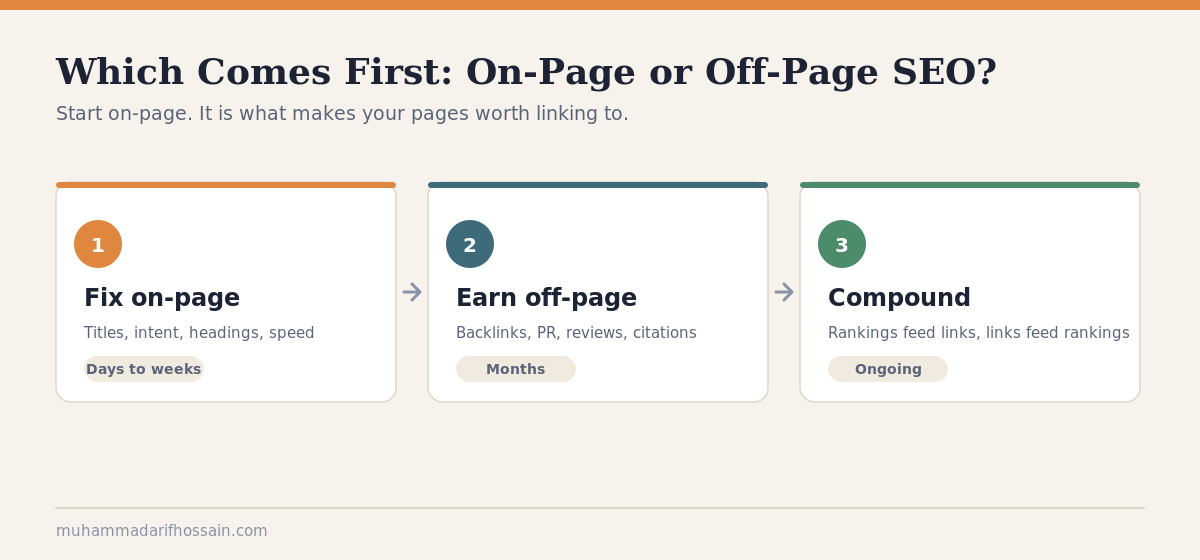
Think of it this way. Off-page SEO is essentially asking other people to vouch for your website. Nobody wants to link to a page that loads slowly, buries its point under vague headlines, or doesn’t clearly answer the question it claims to address. Fix that first, and every backlink you earn afterward works harder for you.
Once your core pages are solid, that’s when off-page work starts paying off faster. A single high-quality backlink to a well-optimized page can move rankings meaningfully. That same backlink pointing at a poorly structured page does far less, because the page itself is still working against you.
How On-Page and Off-Page SEO Work Together
These two aren’t separate campaigns running side by side. They reinforce each other constantly.
Say you publish a genuinely useful guide on your site. Strong on-page work, clear headings, natural keyword use, real depth, gets it ranking respectably on its own. That visibility gets it noticed by a handful of readers who share it and by one industry blogger who links to it as a resource. That backlink, in turn, pushes the page higher, which puts it in front of more readers, some of whom link to it too.
On-page SEO gets you into the race. Off-page SEO is what helps you pull ahead once you’re in it. Skip either one and the flywheel stalls out somewhere along the way.
Common On-Page and Off-Page SEO Mistakes to Avoid
Treating them as either/or. Some site owners obsess over technical on-page tweaks for months while never reaching out for a single backlink, or vice versa, chasing links for a site that isn’t ready to convert the traffic those links bring.
Assuming more content beats better content. Publishing five thin pages targeting slightly different keywords usually performs worse than one genuinely thorough page that fully answers the question, especially once search intent and content quality are properly considered.
Ignoring citation consistency. A local business with three different phone numbers listed across old directories is quietly working against its own local rankings, often without realizing why nearby competitors keep outranking them.
Buying cheap, irrelevant backlinks. Paying for a bulk pack of a hundred backlinks from unrelated, low-quality sites is one of the fastest ways to attract a search engine penalty instead of a ranking boost.
A Simple Starting Checklist
If you’re not sure where to begin, work through this order:
- Audit your top 5 pages for clear titles, meta descriptions, and one properly used H1
- Check that your content actually matches what’s ranking for your target keyword
- Add 2 to 3 relevant internal links to your most important pages
- Run your site through a free page speed tool and fix the biggest flag
- Claim and fully complete your Google Business Profile, if you serve a local audience
- Identify 3 sites in your niche worth pitching for a guest post or a link
- Check your existing reviews and respond to any that are still unanswered
Related Guides
- Link Building Strategy: 57 Links, No Budget, and Traps to Avoid
- How to Build a Content Calendar: 10 Steps That Actually Stick
- Content Marketing Strategy: 8 Steps That Actually Work
Need Help With Your SEO?
If you’ve read this far and you’re still not sure where your own site stands, that’s normal. On-page and off-page SEO both take real time to get right, and it’s easy to spend months on one while the other quietly holds you back.
I work on marketing systems for SaaS and WordPress products every day, SEO included. If you want a second pair of eyes on your site, or just want to talk through where to start, reach out here. I read and reply to every message myself.
Frequently Asked Questions
What’s the difference between on-page and off-page SEO?
The difference between on-page and off-page SEO is where the work happens. On-page SEO is everything you optimize directly on your own website, like titles, content, and internal links. Off-page SEO is everything outside your website that builds its authority and reputation, like backlinks, reviews, and brand mentions.
Which is more important, on-page or off-page SEO?
On-page SEO is more important to start with, though neither one wins outright on its own. It comes first because it’s fully in your control and it’s what makes your site worth linking to in the first place. Off-page SEO becomes more important once your pages are already well optimized.
How long does off-page SEO take to show results?
Off-page SEO takes a few months on average to show results, compared to days or weeks for on-page changes. This is because it depends on outside websites choosing to link to or mention you, which isn’t something you can force on a timeline.
Do social media shares directly affect SEO rankings?
Social media shares do not directly affect SEO rankings as a confirmed Google ranking factor. They still help indirectly by putting your content in front of more people who may end up linking to it, searching for your brand, or becoming customers.
Is technical SEO part of on-page or off-page SEO?
Technical SEO is usually treated as its own third category, though it overlaps closely with on-page SEO. It covers backend factors like crawlability, site speed, and secure HTTPS setup that help search engines access and understand your site properly.
Can I rank well with only on-page SEO and no backlinks?
You can rank well with only on-page SEO and no backlinks in low-competition niches with little existing content, but it gets harder as competition increases. In most competitive markets, some level of off-page authority is needed to outrank established sites with similar on-page quality.