Somewhere along the way, being alone got treated like a problem to solve. A quiet Saturday night gets read as evidence that something is wrong with you, instead of just being a quiet Saturday night.
That framing is backwards, and it makes solitude harder than it needs to be. The people who genuinely enjoy their own company were not simply born that way. They built the skill, usually without realizing that is what they were doing.
If you have been trying to work out how to enjoy being alone rather than simply endure it, this guide is not another list of forty activities to try when you are bored. It covers why solitude feels uncomfortable before it feels good, what actually builds real comfort with yourself, and an honest distinction most articles skip: how to tell the difference between enjoying being alone and quietly using solitude to avoid people you actually need in your life.
TL;DR
- Loneliness and solitude can look identical from the outside but feel completely different on the inside. One says something is missing. The other says nothing needs to be added.
- Being alone feels uncomfortable at first because your nervous system is wired to treat disconnection as a threat, not because something is wrong with you.
- Enjoying your own company is a skill built through repeated, small doses of comfortable alone time, not a trait some people simply have and others don’t.
- Structure helps far more than “just relaxing.” A short, deliberate practice works better than an open-ended evening with nothing planned.
- There is a real difference between healthy solitude and using alone time to avoid the discomfort of real connection. Both can look the same from the outside.
The Difference Between Being Alone and Being Lonely
Two people can be doing the exact same thing, sitting by themselves on a Friday night, and have completely opposite experiences. One feels restored. The other feels like something is wrong. The activity is identical. The internal experience is not.
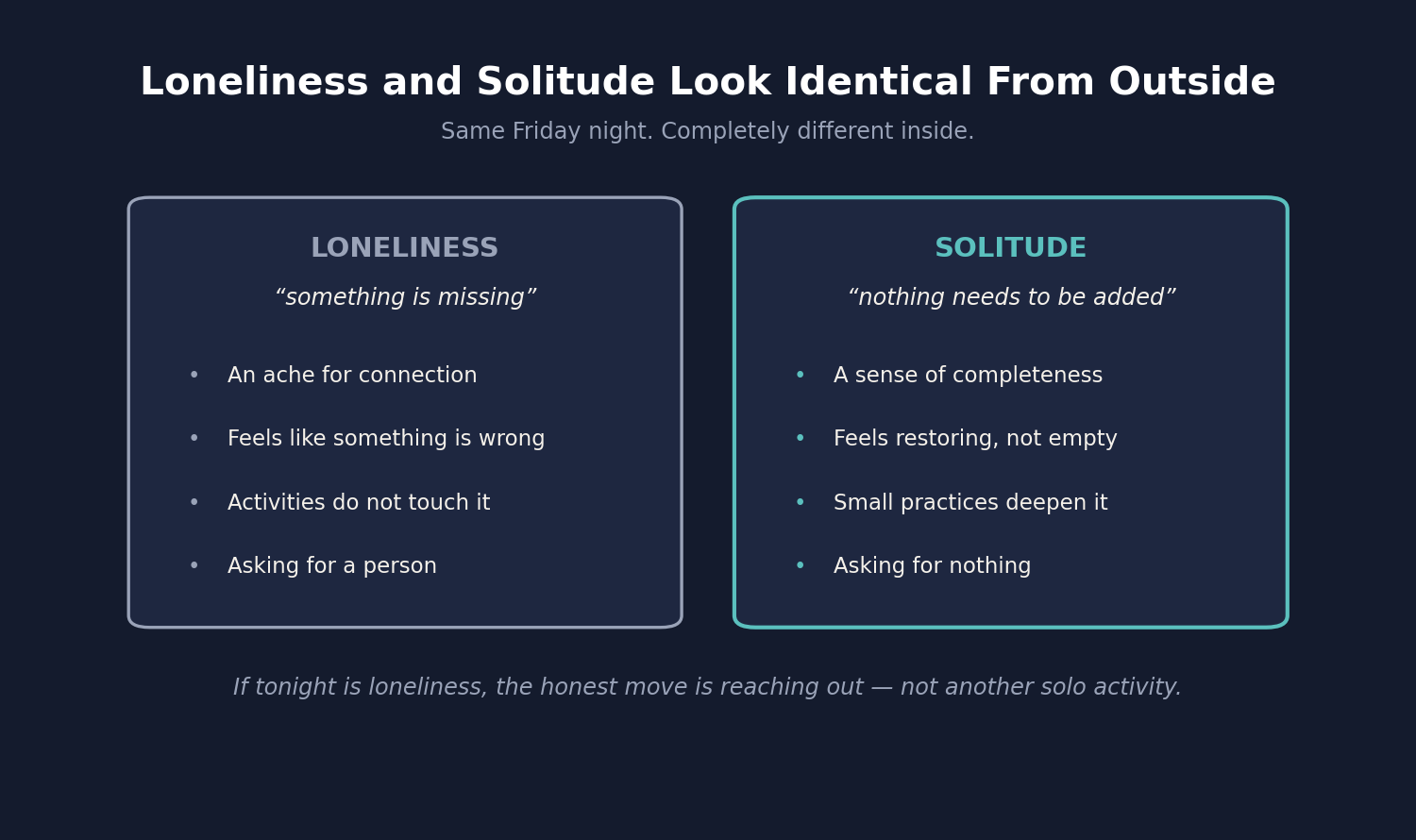
Loneliness is the feeling that something is missing, a specific ache for connection that is not currently there. Solitude is the feeling that nothing needs to be added, a sense of completeness in the moment exactly as it is. The simplest way I can put the difference is this: loneliness says you should not be here and something is wrong, while solitude says you are here and this is enough.
That distinction is not just semantic. The US Surgeon General’s advisory on loneliness and isolation reported that about half of American adults experience loneliness, and that lacking social connection carries a mortality risk comparable to smoking up to 15 cigarettes a day. Solitude carries no such cost. That is exactly why learning how to enjoy being alone is worth real effort.
This distinction matters because most advice about “enjoying being alone” quietly assumes you are already somewhere close to solitude and just need a few activities to fill the time. But if what you are actually feeling is loneliness, no amount of bubble baths or scenic walks will touch the actual ache. That specific feeling is asking for connection, not a hobby.
The honest first step, then, is not a technique. It is noticing which one you are actually in tonight. Solitude and loneliness are not permanent states either. Most people move between them depending on the day, the amount of sleep they got, and how recently they last felt truly seen by another person.
Common mistake to avoid: trying to force solitude when you are actually lonely. That is not growth, it is suppression, and it usually backfires by making the ache quieter but not smaller. If you notice genuine loneliness tonight, the honest move is reaching out to someone, not gritting your teeth through another solo activity.
Once you can tell the two apart, the rest of this guide becomes far more useful, because everything below is built for the moments when you are working with solitude, learning to actually enjoy it, not for the moments when what you need is a phone call to a friend.
Why Being Alone Feels So Uncomfortable at First
If solitude has ever felt oddly unbearable, even when nothing was actually wrong, there is a real, physical reason for that, and it has nothing to do with being broken or unusually needy.
Your nervous system includes what researchers call a social engagement system, a set of circuits built to seek out and maintain connection with other people. When that system senses the absence of connection, especially after a lot of social contact or a recent relationship, it can register the absence the same way it would register actual danger.
The body responds with restlessness, a low hum of anxiety, or a flat, numb feeling. Not because solitude is dangerous, but because your nervous system does not know the difference between choosing to be alone tonight and being abandoned by your group. The full Surgeon General advisory on social connection covers the physiology in detail, including how prolonged disconnection registers as a stressor rather than a neutral state.
This explains something that confuses a lot of people: why a quiet evening alone can feel disproportionately hard compared to what is actually happening. Nothing bad occurred. No one left. But an old survival circuit is doing its job a little too well, treating quiet as a signal to scan for threat.
The good news is that this circuit responds to evidence, not to willpower or positive thinking. Each time you spend a comfortable stretch of time alone without immediately reaching for a distraction, and nothing bad happens, you are giving your nervous system a small piece of proof that solitude is survivable. Repeated enough times, that proof accumulates into something closer to actual comfort.
Where this matters most: the first few weeks after a breakup, a move, or any major change to your usual social routine. That period will almost always feel harder than it “should,” and knowing the mechanism behind that discomfort makes it easier to sit through without concluding something has gone permanently wrong with you.
This is really the core reframe worth holding onto. The discomfort of early solitude is not a signal to avoid being alone forever. It is closer to the soreness after a first workout, a sign that something is being built, not a sign that something is broken.
Solitude Is a Skill, Not a Personality Trait
There is a persistent myth that some people are simply “alone people” and others are not, as if comfort with solitude were assigned at birth alongside eye color. That framing lets everyone else off the hook from actually practicing it.
The more accurate picture is that comfort with being alone is built the same way any other skill is built: through repetition, in doses small enough to actually tolerate, expanded gradually over time. A therapist who works with this exact pattern describes it directly, explaining that the practice of learning to be happy alone is largely the practice of teaching your nervous system that solitude isn’t the same as danger, through repeated, gentle exposure rather than willpower.
This reframe matters because it changes what a bad night alone actually means. If solitude were a fixed trait, one uncomfortable Friday night would be evidence you simply are not an “alone person.” If solitude is a skill, one uncomfortable Friday night is just an early rep, no more meaningful than struggling on your first day at the gym.
Here is how to apply that in practice. Start with a dose of solitude small enough that you can actually get through it without white-knuckling the whole time, even fifteen or twenty minutes, and treat completing it as the entire win. Do not expect enjoyment on day one. Expect tolerance first, and let enjoyment arrive later, once tolerance has had time to settle in.
Common mistake to avoid: treating a single hard evening as proof the whole project is not working. Skill-building always includes reps that go badly. One uncomfortable night says nothing about whether the tenth or the twentieth will feel different, and most people quit exactly one or two reps before it would have started shifting.
If that framing sounds familiar, it is the same logic behind building a habit that actually sticks: small repeatable doses beat one dramatic attempt, and early discomfort is part of the process rather than a verdict on it.
How to Enjoy Being Alone: Start With Structure, Not “Do Nothing”
The advice to “just relax and enjoy your own company” sounds appealing and rarely works in practice. Open, unstructured time is exactly when old anxious habits, reaching for the phone, turning on background noise, tend to take over automatically.
A short, deliberate structure works far better than a wide-open evening with nothing planned. One useful starting exercise: set a timer for five minutes with no television, music, internet, podcasts, or books, find a comfortable place to sit, and let your mind wander without trying to direct it anywhere in particular. That small container makes the exercise feel finite and manageable instead of like staring down an entire unstructured evening.
The same logic applies to phones specifically, since they have quietly changed what “alone” even means. Turning your phone off and putting it away for a full hour lets you actually experience solitude, rather than the diluted version where you’re alone but still one text away from anyone you know. Most people find the first twenty minutes of this uncomfortable and the last twenty surprisingly calm.
Common mistake to avoid: starting with too large a container. An entire unstructured Saturday is a hard place to begin building this skill. A defined ten or twenty minutes is a much more realistic first rep, and it can always be extended once it stops feeling difficult.
Structure is not a permanent crutch here. It is scaffolding, useful early on and less necessary once solitude starts to feel more familiar. Most people find they need less and less structure over time, the same way training wheels come off once balance is no longer the hard part.
Build a Few Solo Rituals You Actually Look Forward To
Most people’s solo time defaults to whatever requires the least effort, usually a screen, simply because effortful planning feels like too much work to do just for yourself. The fix is building a small number of rituals in advance, so there is nothing left to decide once you actually have the time.
A self-date is one of the more effective versions of this. The exercise is straightforward: imagine you were trying to genuinely impress a date, then take yourself exactly there. Go to a movie alone, or a great dinner out by yourself, and treat yourself the same way you would treat someone you were trying to impress. The first one or two times will likely feel a little strange. That feeling fades faster than most people expect.
Meals are worth calling out specifically, since eating alone is one of the moments most likely to default to the lowest-effort option. Preparing a genuinely good meal for one, setting the table properly, even lighting a candle, signals to yourself that you are worth the same effort you would put in for company. Nature works the same way. A walk somewhere with actual greenery or water tends to settle a restless mind faster than staying inside does.
Where this matters most: the specific moments that used to be shared with a partner or a group and now feel like a gap, weekend mornings, dinners, or a regular outing you used to do with someone else. Rebuilding a version of that ritual just for yourself, rather than quietly abandoning it, closes the gap instead of leaving it open.
Pick two or three rituals from this category and treat them as fixed appointments with yourself, not optional extras you’ll get to eventually. A slow, unhurried morning routine is one of the easiest places to start, because the time is already yours before anyone else needs it. The point of a ritual is that it does not require willpower each time. It just happens, the same way brushing your teeth does not require a debate.
Use Alone Time to Create Instead of Just Consume
There is a meaningful difference between filling solitude and using it, and most people default to filling it, mainly because consuming content requires no decisions and creating anything requires several.
The case for creating over consuming is fairly direct: when you’re alone, the only thing stopping you from making the art or the work you’re capable of is yourself, since every excuse about other people’s time or opinions is gone. That is not true of scrolling, watching, or half-listening to something in the background, none of which leave you with anything once the hour is over.
This does not need to mean a serious creative practice. It can be genuinely small: picking up a new instrument badly, writing a page nobody will read, or starting a home project you don’t yet know how to finish. The size of the project matters less than the fact that something exists afterward that did not exist before.
Common mistake to avoid: waiting until you feel motivated or inspired before starting. Motivation for solo creative work tends to show up during the activity, not before it. The honest move is starting anyway, for ten minutes, and letting interest catch up once your hands are already busy.
This same principle extends to reflection, not just making things. Solitude gives you an unusual amount of quiet to actually ask whether you’re happy and fulfilled with the direction your life is on, or whether something needs to change, questions that are almost impossible to answer clearly while constantly filling your attention with other people’s content. Quiet does not automatically produce insight. It just removes some of what usually drowns it out.
Get to Know Your Own Inner Voice
Everyone has a running internal narrator, and when you spend a lot of time with other people, it is easy to never really notice it. Alone, that voice becomes your main company, whether you have consciously chosen to listen to it or not.
This is worth taking seriously, because the way you talk to yourself in solitude shapes the experience of solitude itself far more than any activity does. One useful practice is learning to witness your own internal experience rather than immediately judging it, described by one therapist as the shift from asking “why am I so anxious, what’s wrong with me” to instead noticing “I’m feeling anxious right now, that makes sense given today, I’m going to be with this.” The content of the thought barely changes. The relationship to it changes completely.
This distinction connects to something worth separating clearly: the difference between self-soothing and actual self-regulation. Self-soothing makes an uncomfortable feeling go away for a while, usually through a distraction. Self-regulation is the ability to feel a difficult emotion, name it, and let it move through you without either suppressing it or being overwhelmed by it. Both have a place, but only one of them actually builds comfort with solitude over time.
Common mistake to avoid: treating a harsh internal voice as simply “how you are” rather than something you can actually change. The tone you take with yourself when no one else is listening is a habit, not a fixed trait, and habits respond to deliberate practice the same way any other skill does.
A simple starting practice: the next time you notice your inner voice turning critical during alone time, try rephrasing it once, out loud if that helps, in the observing, compassionate register above. It will feel artificial at first. That is normal for any new habit, not a sign you are doing it wrong.
Don’t Let “Being Fine Alone” Become a Wall
Here is the part most articles about enjoying solitude leave out entirely, and it matters enough to say directly: there is a real difference between solitude that is genuinely restoring you and solitude that has quietly become a way of avoiding people.
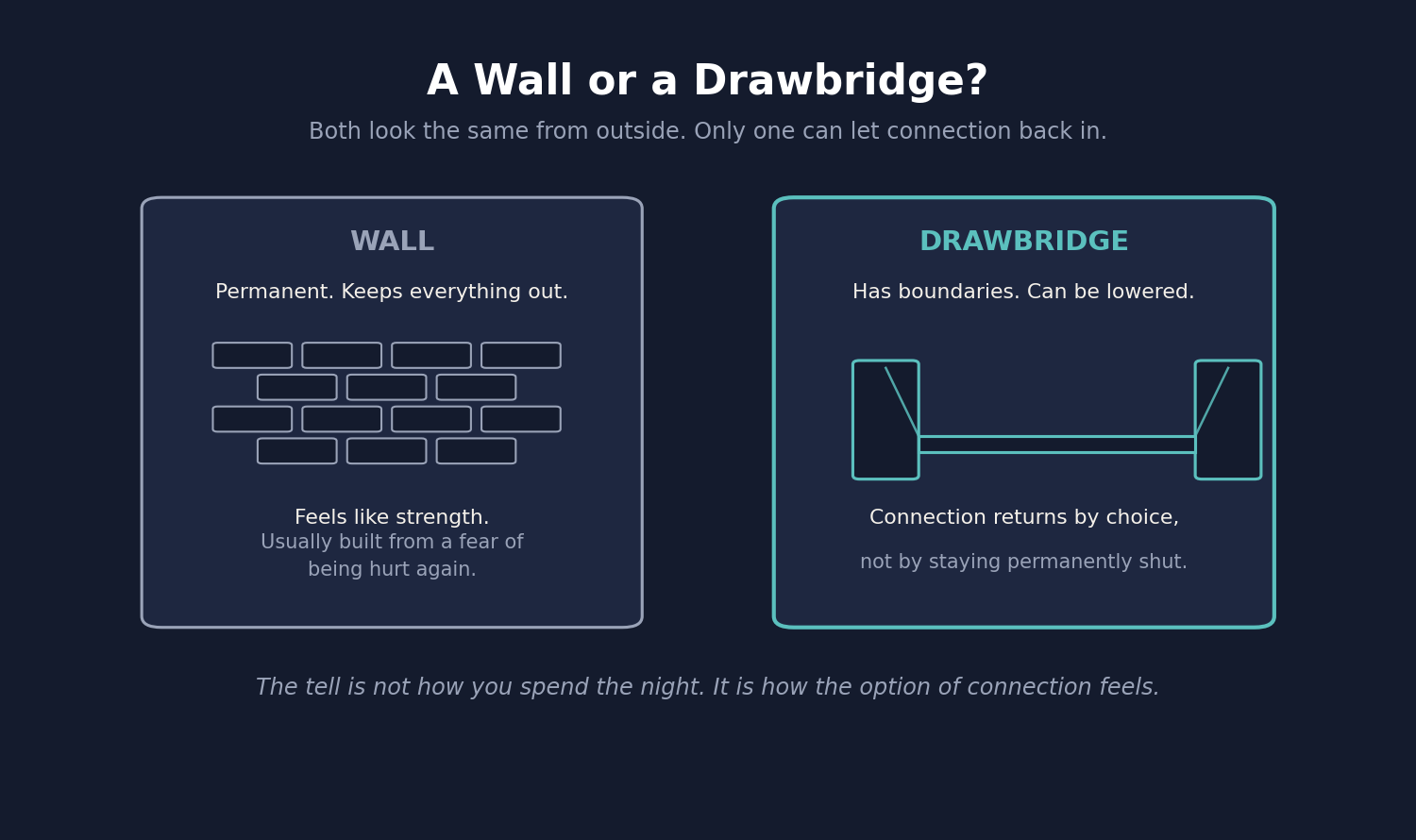
One helpful way to picture this: a wall versus a drawbridge. A wall is permanent and keeps everything out, feeling like strength while actually functioning as a survival strategy built from a fear of being hurt again. A drawbridge has boundaries too, but it can be lowered, letting connection back in by choice rather than staying permanently shut. Both can look identical from the outside. Someone comfortable alone and someone avoiding people can both spend their Friday night exactly the same way.
The tell is usually in how you feel about the option of connection, not in how you spend your actual solo time. If the idea of reaching out to a friend genuinely does not appeal to you tonight but would feel welcome tomorrow, that is likely ordinary solitude. If the idea of letting anyone in consistently produces anxiety or a flat refusal, no matter when it is offered, that pattern deserves an honest look.
Where this matters most: people who have recently gone through a breakup, a loss, or a stretch of being hurt in a relationship. It is common, and understandable, to conclude that needing people less feels like protection. But retreating from connection and calling it independence, or jumping from one relationship to the next hoping someone else will finally fix the discomfort, are both avoidance wearing different costumes.
The goal of everything in this guide was never to need people less. It was to build enough comfort with yourself that when you do choose connection, you are choosing it, not using it to escape a feeling you never learned to sit with.
A Quick Self-Check: Are You Enjoying Solitude, or Avoiding Something?
Given how similar healthy solitude and quiet avoidance can look from the outside, a short, honest check-in is more useful than trying to judge it from the activity alone.
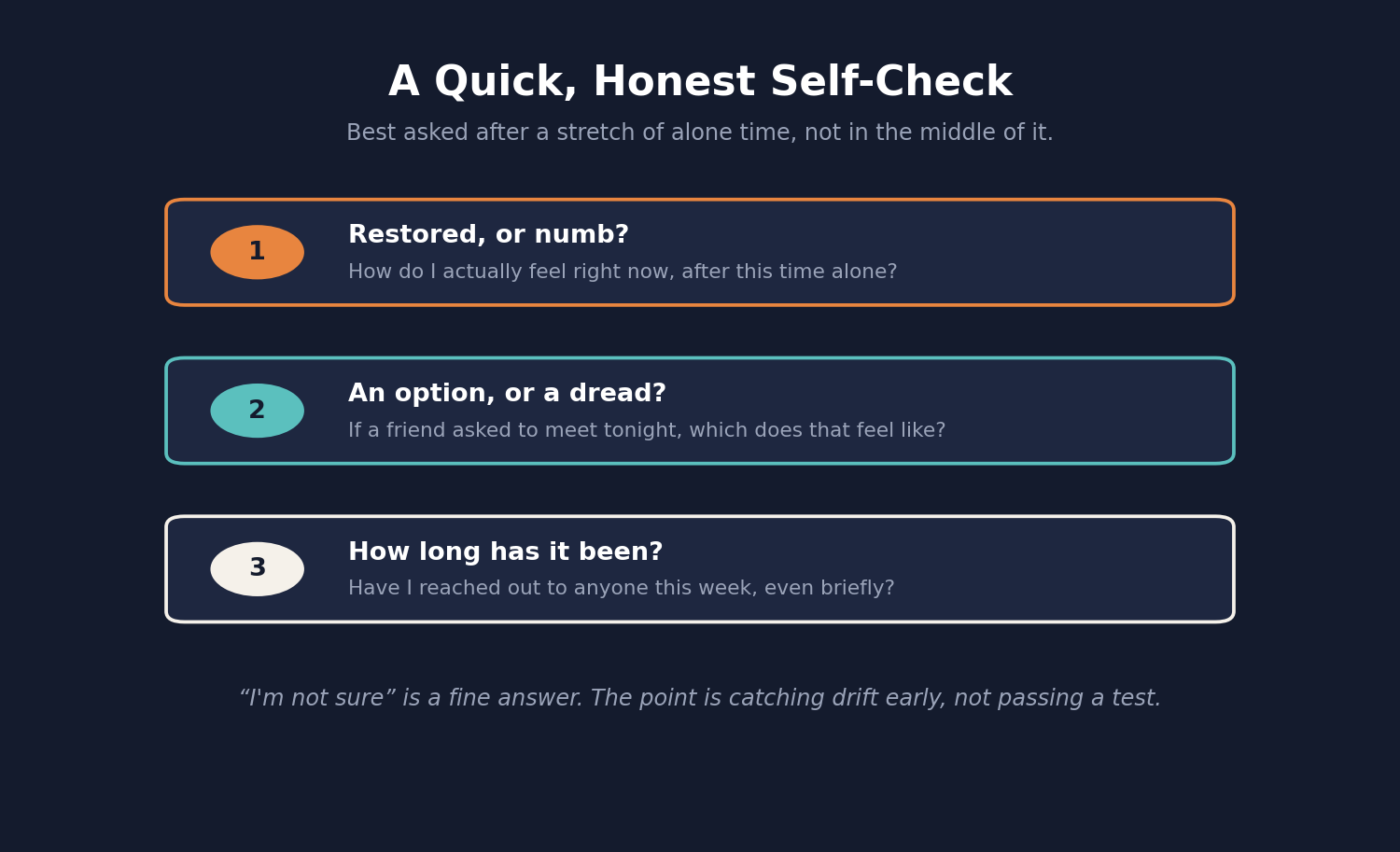
Ask yourself these questions, ideally after a stretch of alone time rather than in the middle of it: Do I feel restored right now, or numb? If a friend called and asked to hang out tonight, would the idea feel like an option, or like something to dread? Have I actually reached out to anyone this week, even briefly, or has it quietly been longer than I would have expected a month ago?
None of these questions have a single right answer, and an honest “I’m not sure” is a completely fine result. The point of the check-in is not to pass a test. It is to catch the drift from solitude into isolation early, while it is still an easy correction, rather than months later when the pattern has hardened into a habit.
Common mistake to avoid: only running this check-in when things already feel wrong. It is far more useful as a light, occasional habit, once every week or two, than as an emergency measure you reach for only once something already feels off.
If the honest answer points toward avoidance more than restoration, the fix is rarely dramatic. It is usually as small as one message to one person you have been meaning to talk to, sent before you have time to talk yourself out of it.
When to Reach Out for More Support
Everything in this guide assumes ordinary solitude, the kind that responds to practice and gets easier with time. It is worth being honest that this is not always the whole picture.
If time alone consistently brings on more than passing discomfort, specifically if you are noticing persistent symptoms of anxiety or depression, or finding it genuinely difficult to cope, that is worth bringing to a therapist, not as a last resort after everything else has failed, but simply because that is what the symptom is asking for. Wanting things to feel better is already a good enough reason to seek support, whether or not things have reached a crisis point.
This is a sensitive area to navigate alone, and if any of this resonates with your own experience right now, reaching out to a therapist or another trusted professional is a reasonable and often very effective next step, alongside anything else you take from this guide.
Frequently Asked Questions
What is the difference between being alone and being lonely?
Being alone is a circumstance, simply not having other people physically present. Loneliness is a feeling, the sense that connection is missing even when you might be surrounded by people. You can be alone without feeling lonely, and you can feel lonely in a crowded room. The distinction is about the internal experience, not the physical situation.
Why does being alone feel so uncomfortable sometimes?
Being alone can feel uncomfortable because your nervous system includes a social engagement system built to seek connection, and it sometimes reads the absence of connection as a threat rather than a neutral circumstance. This is a physical response, not a character flaw, and it fades with repeated, comfortable exposure to solitude rather than through willpower alone.
How long does it take to actually enjoy being alone?
There is no fixed timeline, since it depends on how much practice you have already had and how recently your routine changed. Most people notice a real shift after several weeks of small, repeated doses of comfortable solitude, not from one dramatic attempt. Treat early discomfort as a normal part of the process rather than a sign it isn’t working.
Is it unhealthy to enjoy being alone a lot?
Enjoying solitude is not unhealthy on its own. It becomes worth examining when the comfort with being alone starts to replace, rather than coexist with, real connection with other people. A useful check is whether the option of reaching out to someone still feels available and appealing at least sometimes, or whether it consistently produces dread no matter when it’s offered.
What should I do if being alone makes me anxious?
Start with a short, structured practice rather than an open-ended stretch of unstructured time, since structure gives anxious energy somewhere specific to go. If the anxiety is persistent rather than occasional, or shows up alongside other symptoms of anxiety or low mood, it is worth mentioning to a therapist rather than only managing it on your own.