Cutting sugar started for me with a cup of tea. You know the tea is too sweet, but you drink it anyway. Two spoons in without a second thought, just habit running the show before your brain even shows up. A biscuit with lunch, a cold drink because it is hot outside, a little extra in the payesh because that is how it has always been made. None of it feels like a decision. It just feels like Tuesday. If you want the mechanics behind why that worked, I wrote them up separately in how to build a habit that actually sticks.
I only noticed how deep it went the day I actually tried to stop. Not a diet, not a health scare, just curiosity about whether I could go a few weeks without adding sugar to anything. I figured it would be mildly annoying for a day or two and then fade into the background like most small changes do.
It didn’t fade. Day three brought a headache that sat behind my eyes all afternoon. Day four I nearly gave in over something as small as being offered tea at a relative’s house, where saying no felt ruder than the headache felt bad. I hadn’t expected the hardest part to be a social one instead of a willpower one.
What came after that first rough week is the part worth writing down. Not because the science needs repeating, plenty of sites already cover what sugar does to your body. This is the version with the parts nobody warns you about, the tea, the visits, the four o’clock slump at my desk, and what actually stuck once the first two weeks were over.

TL;DR
- Day three brought a headache, day four nearly broke the whole thing over a cup of tea at a relative’s house
- The hardest part wasn’t willpower, it was saying no to sugar in social and family settings
- Moving the sugar bowl out of easy reach did more than any willpower could
- Energy stopped crashing at my desk around four in the afternoon, and that mattered more than the scale did
- Sleep improved before weight did, which nobody had mentioned to me beforehand
- Skin and digestion quietly improved too, though I only noticed weeks later
- I never fully cut sugar, I cut the added kind and left fruit and natural sugar alone
- None of it required an app, a tracker, or telling anyone I was “on” anything
What Cutting Sugar Actually Means
Before going further, one thing needs to be clear. I didn’t cut sugar completely. That’s nearly impossible anyway, since it’s naturally present in fruit, rice, milk, even the dal we eat every day. What I actually stopped was adding extra sugar on top of food that didn’t need it.
That distinction matters, and it is the one health bodies make too. The World Health Organization guideline on sugars intake targets free sugars, meaning the sugar added by a manufacturer, a cook, or you at the table, plus what is in honey, syrups and fruit juice. It recommends keeping free sugars under 10 percent of daily energy, and says going under 5 percent brings further benefit. The sugar naturally sitting inside whole fruit, milk and rice is not what the guidance is aimed at, which is exactly why cutting sugar did not mean giving those up.
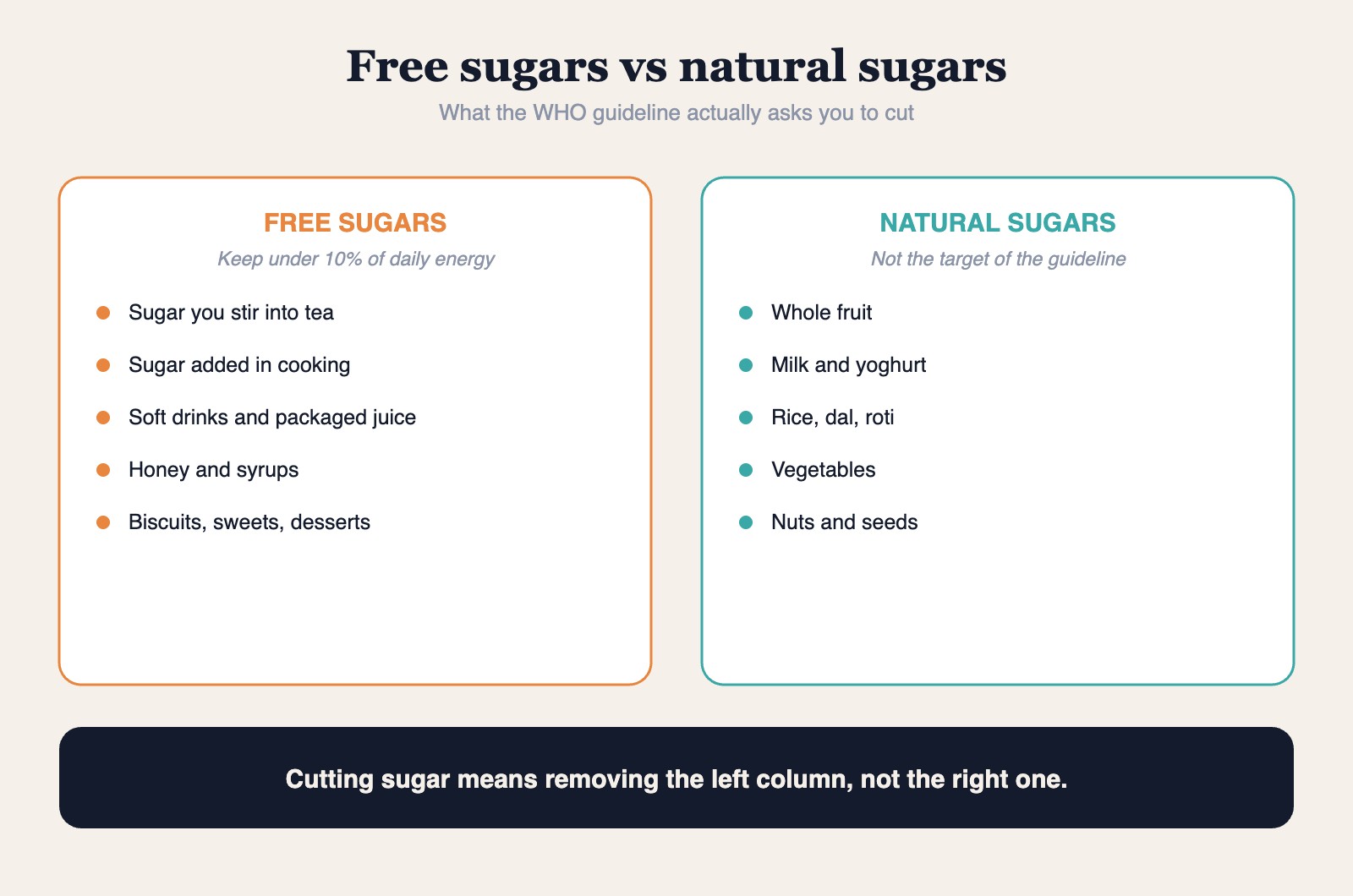
Tea without the two spoons. No sugar stirred into lassi. Skipping the extra spoonful people add to shorbot even when it’s already sweetened. Fruit stayed exactly where it was, so did the natural sugar in things like milk and rice.
This distinction mattered more than I expected. The first few days I caught myself almost avoiding fruit too, thinking sugar was sugar. It isn’t. Added sugar gives you sweetness with nothing else attached. Fruit gives you the same sweetness along with fibre and nutrients that slow down how fast it hits your system. Once I separated the two in my head, the whole thing felt less extreme and a lot easier to actually stick with.
Sugar Withdrawal: What the First Week of Cutting Sugar Feels Like
Nothing happened for the first two days, which almost fooled me into thinking this would be easy. Then day three arrived with a headache that sat behind my eyes from lunch until bedtime. No amount of water made it go away. I hadn’t touched anything unusual, I’d just stopped adding sugar, and my body clearly had opinions about that.
Day four was worse in a different way. I was at a relative’s house, and tea came out the way it always does, already made, already sweet, already poured. Saying no felt bigger than it should have. Not because anyone would have minded. Because turning down tea in that kind of setting reads as turning down the hospitality itself, and that’s a harder thing to do than skip dessert alone in your own kitchen.
I drank the tea that day. Told myself I’d restart tomorrow, and actually did. That one slip taught me something the headache couldn’t. The hardest part of this was never going to be willpower at my own desk. It was going to be every social moment where sugar shows up as a gesture, not just a food.
By day six the headaches had faded and the cravings settled into something quieter, more like a background hum than an urgent pull. Nothing about those first six days felt like progress at the time. It only looked like progress once I could see day ten from where I was standing.
Removing Sugar From Reach: The Habit Change That Made Cutting Sugar Work
The willpower during the day held up fine once the first week passed. What actually made the difference long term wasn’t discipline, it was what was sitting on the counter.
The sugar bowl used to sit right next to the stove, in arm’s reach every time I made tea. I moved it into a cabinet, not hidden exactly, just one extra step away from where my hand automatically went. That one step turned out to matter more than I expected. If sugar isn’t the closest thing to reach, you don’t reach for it out of habit.
Snacks changed too. I stopped keeping biscuits in the kitchen drawer I open first thing in the afternoon, and replaced them with a bowl of nuts and fruit in that exact spot instead. Nothing dramatic, just swapping what’s easiest to grab at the hour I’m most likely to grab something.
None of this required cutting anything out of the house completely. It just meant sugar had to be a decision again, not the default sitting right where my hand landed.
What Happens When You Cut Sugar for a Month
I was watching for weight loss, since that’s what everyone expects from a post like this. Instead, the first real change showed up somewhere else entirely. I started falling asleep faster, and waking up before my alarm instead of fighting it off, which almost never used to happen.
I think the afternoon sugar was doing more to my evenings than I realized. A sweet snack around four used to feel harmless, but it was setting up a crash a few hours later that left me wired and restless right when I should have been winding down. Cut the snack, and the crash never showed up, and neither did the restlessness at night.
The four o’clock slump itself took the longest to notice was gone, mostly because I only clocked it by its absence. For years, four in the afternoon meant heavy eyes and zero focus, the exact hour I’d usually be on a client call or trying to finish a blog draft. Somewhere around week three, four o’clock came and went without the usual wall. I only realized it because I was still waiting for it out of habit.
Weight did shift eventually, but it trailed weeks behind everything else. If the scale is the only thing you’re watching, you’ll likely miss the two signs that show up first and actually mean more day to day.
Other Changes From Cutting Sugar That I Did Not Expect
Sleep and afternoon energy were the two changes I noticed first, but they weren’t the only ones. A few smaller shifts showed up later, and I only connected them to the sugar once I looked back.
My skin cleared up some around week four, less oily by midday than it used to get. I hadn’t changed anything else in my routine, so sugar was the only variable that had moved.
Digestion settled down too. The heavy, bloated feeling after lunch that I’d just accepted as normal mostly disappeared. I didn’t think anything was wrong with it before, I just didn’t notice it was there until it stopped happening.
Mood took the longest to notice, mostly because it’s the hardest one to measure honestly. The irritability from the first week eventually swung the other way. By the second month, small annoyances during the day didn’t spike the way they used to, though I’d hesitate to credit that to sugar alone.
Why I Didn’t Cut Sugar Completely
By week three I’d stopped thinking of this as an all-or-nothing thing. There were still days I had a sweet with tea at someone’s house, still the occasional dessert at a family gathering. What changed wasn’t perfection, it was the default. Sugar stopped being the automatic choice and became something I actually chose on purpose, on the days I wanted it.
Banning it completely never lasted more than a few days at a time in the early stretch. The stricter I tried to be, the more I thought about sugar, which is the opposite of what I wanted. Once I let go of the idea that one sweet ruins the whole effort, the cravings actually got quieter, not louder.
This is closer to how most dietitians actually describe it too, not zero sugar forever, just less of it as the everyday default instead of the exception. Somewhere around 80 percent of my days without added sugar and the rest left alone turned out to be far more sustainable than a hard rule I’d inevitably break and then abandon altogether.
What I’d Tell Someone Starting to Cut Sugar
Expect the first week to feel worse, not better. That’s normal, not a sign to stop. The headache and the irritability are your body adjusting, not a warning that something’s wrong.

Separate added sugar from natural sugar before you start, not after. If you go in thinking all sugar is the enemy, you’ll end up avoiding fruit and milk for no reason, and that makes the whole thing harder than it needs to be.
Plan for the social moments more than the solo ones. Sitting at your own desk and skipping a sweet is the easy part. Turning down tea at someone’s house, or saying no to sweets at a gathering, is where most people actually give up. Decide ahead of time how you’ll handle it, whether that’s accepting a small amount graciously or having a polite way to decline.
Watch your sleep and your afternoon energy before you watch the scale. Those changed first for me, by a wide margin, and they’re easy to miss if weight is the only thing you’re tracking.
Give it past day ten before deciding whether it’s working. The loudest part of the craving fades faster than you’d expect, but only if you get through the first week that makes you want to quit.
Two Months of Cutting Sugar: Where It Settled
Two months in, this isn’t something I think about constantly anymore. Tea without sugar is just tea now, not a small daily negotiation. The relative’s house is still the one place I occasionally say yes, and I’ve made peace with that.
I never set out to quit sugar completely, and I still haven’t. What changed is that it stopped being the automatic answer to every craving, every afternoon slump, every cup of tea. It became something I actually choose now, instead of something that happens to me.
If you’d told me on day four, sitting there with a headache and a cup of tea I didn’t want to refuse, that two months later this would feel unremarkable, I wouldn’t have believed it. But that’s exactly where it landed.
One caveat worth saying plainly: this is one person’s experience over two months, not medical advice. If you take medication for diabetes or blood sugar, or you have a history of disordered eating, talk to a doctor before changing how you eat. The full WHO recommendations on sugar intake are worth reading if you want the evidence rather than one person’s account of cutting sugar.
Cutting sugar turned out to be less about willpower and more about what was within arm’s reach, which is the same lesson I keep running into elsewhere. If that idea is useful to you, my guide to building habits that stick goes deeper on it, and the piece on enjoying your own company covers the quieter side of the same discipline.
What Cutting Sugar Did Not Fix
It would be dishonest to end this without the other half. Cutting sugar did not make me leaner in any way I could measure, because I did not change portions, rice, or how little I walked. It did not fix my sleep on the nights I stayed up working, and it did nothing at all for the afternoon slump that turned out to be about lunch size rather than sweetness.
What it did change was narrower than the internet promised and more useful than I expected. The constant low-level wanting went quiet. I stopped finishing meals with something sweet out of reflex. That is a real result, but it is one habit, not a health transformation, and anyone selling cutting sugar as the latter is overselling it.
Frequently Asked Questions About Cutting Sugar
What happens if I cut out eating sugar?
If you cut out eating sugar, the first few days usually bring cravings and mild headaches as your blood sugar adjusts. Once that passes, energy tends to stabilize, afternoon crashes fade, and sleep often improves before anything visible changes.
What does 21 days without sugar do?
21 days without sugar usually settles cravings into the background rather than removing them completely. By this point most people notice steadier energy through the day and better sleep, while visible changes like skin or weight take longer to show.
Will I lose belly fat if I cut out sugar?
If you cut out sugar, you can lose belly fat as a side effect, mainly because it lowers overall calorie intake and stabilizes the blood sugar swings that drive hunger. It isn’t a targeted fix for belly fat specifically, but it removes a common source of the excess calories that contribute to it.
What are the signs you’re eating too much sugar?
If you’re eating too much sugar, common signs include afternoon energy crashes, frequent cravings for something sweet, trouble sleeping, and feeling hungry again soon after eating. Skin breakouts and low mood are also commonly linked to high sugar intake.
Which fruit has the most sugar?
Fruits with the most sugar include mangoes, grapes, and bananas, which sit higher than fruits like berries or guava. This is natural sugar though, paired with fibre, which behaves very differently in the body than added sugar does.