You rewrite your landing page for the third time this month. New headline, new adjectives, new button color. Conversions stay flat. So you conclude you’re just bad at writing, and you start browsing copywriter rates you can’t afford.
Here’s what’s actually happening. Your words are fine. Your strategy is missing. A copywriting strategy is the thinking you do before writing: who exactly is reading, what they already believe, what one action you want, and what proof will move them. Skip that thinking and no amount of clever wording can save the page.
The good news is that strategy is learnable, and it follows a repeatable process. This guide walks you through building a copywriting strategy in six steps, using the pages where copy earns or loses real money: landing pages, pricing pages, emails, and ads.
TL;DR
- A copywriting strategy is the plan behind the words: one reader, one goal, one big promise, and the proof to back it.
- Start every piece of copy by defining the single action you want, since that decision shapes everything else on the page.
- Steal your copy from your audience. Their reviews, support tickets, and Reddit threads contain better sales language than you’ll ever invent.
- Match your message to the reader’s awareness stage. A stranger and a warm subscriber need completely different opening lines.
- Use a framework like PAS or BAB to structure the draft, then edit out every hype word. Specifics sell, adjectives don’t.
- The biggest mistakes are writing about yourself instead of the reader and burying one strong promise under five weak ones.
What Is a Copywriting Strategy?
A copywriting strategy is a plan that defines what your copy needs to achieve and how it will achieve it, before you write a single line. It answers four questions. Who is the reader? What do they believe right now? What one action should they take? And what will convince them to take it?
Copywriting itself is just the craft of writing words that lead to action: a signup, a purchase, a reply. The strategy is what aims that craft at the right target. Great execution of the wrong message still fails, which is why polished landing pages flop every day.
Strategy is also what separates copy from content. Your blog posts attract and teach, and they belong to your wider content marketing strategy. Your homepage, pricing page, emails, and ads have a harder job: convert. This guide is about that second group.
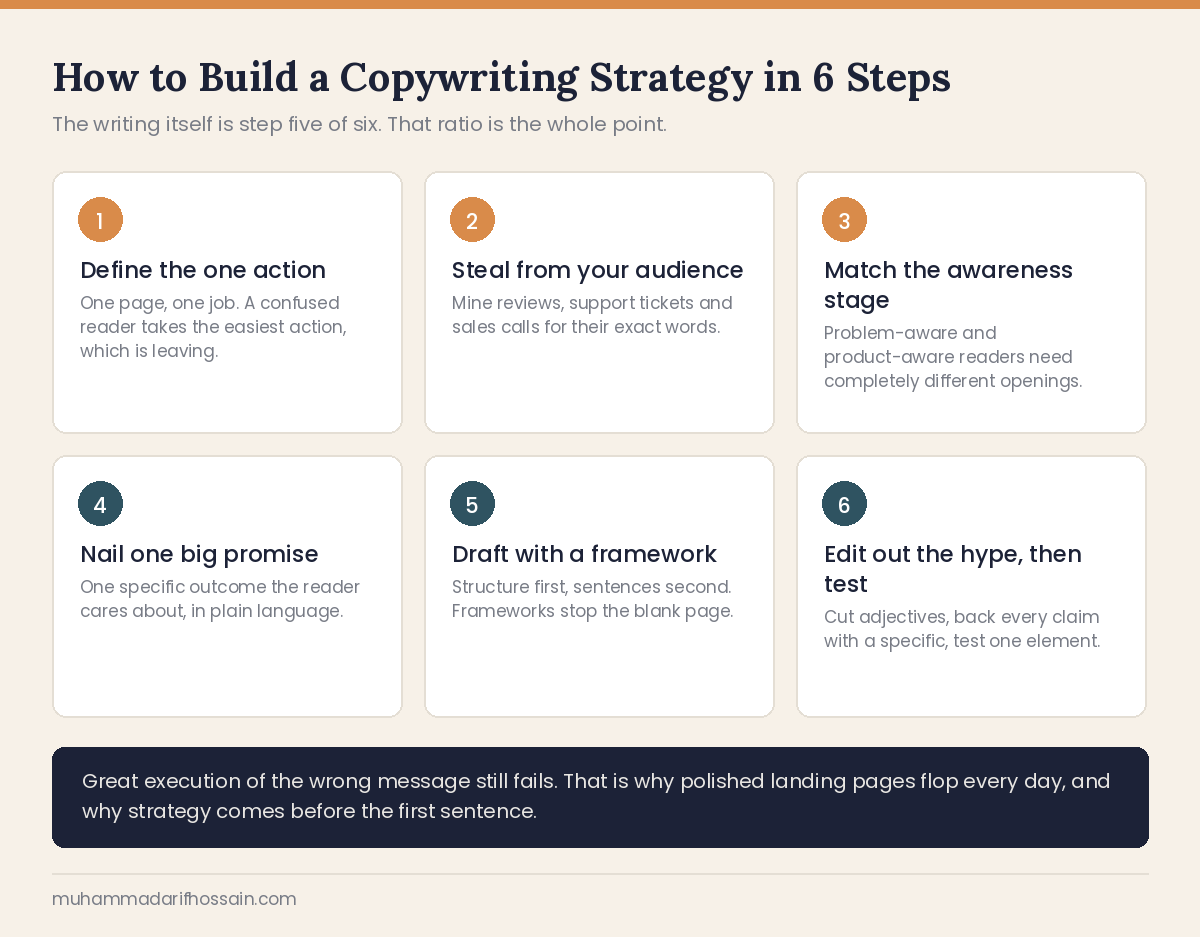
How to Build a Copywriting Strategy in 6 Steps
Here’s the process, in the order that works. The writing itself is step five of six. That ratio is the whole point.
Step 1: Define the One Action You Want
Every piece of copy gets exactly one job. Your signup page exists to collect an email. Your pricing page exists to start a trial. Your cold email exists to get a reply. Decide the job before anything else, because it dictates the length, the tone, and what belongs on the page.
This sounds obvious until you audit your own pages. Most underperforming homepages are trying to start trials, book demos, grow the newsletter, and tell the founder’s story all at once. A confused reader takes the easiest action available, which is leaving.
Common mistake to avoid: Measuring copy by how it sounds instead of what it does. The only grade that matters is the action rate: signups, replies, sales, which is exactly what conversion rate optimization measures. A plain page that converts beats a beautiful page that doesn’t, every single time.
Step 2: Steal Your Copy From Your Audience
The best conversion copy is assembled, never invented. Your buyers are already describing their problem in their own words, in product reviews, support tickets, Reddit threads, and competitor comparison posts. Your job is to collect that language and reflect it back.
Spend an hour mining before you write. Read reviews of your product and your competitors’ on G2, Capterra, or Amazon, and note the exact phrases people use. What they wanted, what frustrated them, what finally made them switch. Sort the phrases into pains, desires, and objections. That document is your copy bank.
The payoff is recognition. When a freelancer reads “I was spending Sunday nights chasing invoices instead of seeing my kids” on your landing page, he doesn’t feel marketed to. He feels understood. Copy in the reader’s own words converts because it removes the translation step.
Where this matters most: Headlines and objection sections. A headline built from a real customer phrase almost always outperforms one you brainstormed, because it passes the reader’s “this is about me” test instantly.
Step 3: Match the Message to the Reader’s Awareness Stage
Legendary copywriter Eugene Schwartz mapped this out in his 1966 book Breakthrough Advertising, and it still decides what your first line should say. Readers arrive at five stages of awareness: unaware of the problem, problem-aware, solution-aware, product-aware, and most-aware, meaning ready to buy.
Each stage needs a different opening. A problem-aware reader responds to copy that names his pain, like “Still building reports by hand every Monday?” A product-aware visitor comparing you against two competitors needs proof and differences, never another definition of the category. Lead with the wrong stage and the reader bounces before your best material.
The mapping usually follows your channels. Cold traffic from ads or cold email is problem-aware at best, so start with the pain. Organic visitors comparing tools are solution-aware or product-aware, so start with what makes you different. Your email list during a launch is most-aware, so lead with the offer and the deadline.
Common mistake to avoid: Writing every page for the most-aware reader. “Start your free trial today” works on people who already want the product. On a stranger, it reads like a demand from a company they’ve never heard of.
Step 4: Nail Your One Big Promise
Before drafting, compress your entire offer into one sentence: who it’s for, what outcome it delivers, and why yours over the alternatives. Something like “The only invoicing tool built for freelancers who bill in three currencies.” That sentence is your positioning, and every headline is a variation of it.
The “why yours” part is where most copy goes vague. Look for the thing you can claim that competitors can’t: your specific mechanism, your niche focus, your data, your results. If ten other products can make your exact promise, the promise needs sharpening, never louder adjectives.
Then attach proof. Customer results, named testimonials, usage numbers, a before-and-after screenshot. Robert Cialdini documented in his book Influence how heavily people rely on social proof when deciding under uncertainty, and buying from an unfamiliar company is exactly that kind of decision. One specific customer story outsells a paragraph of self-praise.
Step 5: Draft With a Framework
A framework is a proven structure for the argument, so you never stare at a blank page wondering what comes after the headline. Three cover almost everything that converts.
PAS (Problem, Agitate, Solution). Name the problem, make its cost vivid, then present your offer as the way out. Best for cold readers: ads, cold outreach, and the top of landing pages. It works because it earns attention with the reader’s pain before asking for anything.
BAB (Before, After, Bridge). Paint life before, paint life after, then position your product as the bridge between them. Best for signup pages and free-to-paid upgrade prompts, where the reader needs to feel the gap between where they are and where they could be.
AIDA (Attention, Interest, Desire, Action). Hook, build interest with specifics, stack desire with proof, then ask. Best for warm emails and launch campaigns, where you have a known reader and a clear offer.
Whichever you use, draft fast and keep one rule from direct-response legend Joe Sugarman: every sentence exists to get the next one read. Short sentences, one idea each, no throat-clearing.
Step 6: Edit Out the Hype, Then Test
Now cut every word that sounds like marketing. “Game-changing,” “world-class,” “incredible value” and their cousins actively hurt you. Nielsen Norman Group usability research found that rewriting web copy in objective language, with the promotional tone stripped out, improved measured usability by 27 percent, because hype forces readers to work out what’s true (source).
Replace every adjective with a specific. “Powerful reporting” becomes “builds your Monday report in 40 seconds.” “Trusted by thousands” becomes “12,400 agencies invoice through us every month.” Specifics do the persuading that adjectives only gesture at.
Then test one thing at a time. Change the headline and watch a week of conversions. Then the CTA text. Then the lead testimonial. This is where copywriting strategy hands off to conversion rate optimization, and every test teaches you something about your reader that feeds the next draft.
Where this matters most: Your landing page headline. It’s the highest-traffic sentence you own, and a headline change moves conversion more than any other single edit on the page.
Common Copywriting Strategy Mistakes to Avoid
Writing about yourself instead of the reader. Count the “we” and “our” versus “you” and “your” on your homepage. If you win, rewrite it. Readers care about their outcome, and your company story only matters as proof that you can deliver it.
Making five promises instead of one. A page that promises speed, savings, security, simplicity, and support convinces the reader of nothing. Pick the one outcome your best customers actually got, and build the whole page around it.
Copying a competitor’s copy. Their strategy was built for their audience, their proof, and their price point. Borrowed copy always reads slightly off, because the thinking behind it doesn’t transfer with the words.
Burying the ask. Plenty of founders feel pushy asking for the sale, so the CTA appears once, at the bottom, in small text. A reader who’s convinced at the midpoint should never have to hunt for the button. Repeat the CTA after every major proof section.
Polishing words before fixing the message. Wordsmithing a page with the wrong promise is rearranging furniture in the wrong house. If a page underperforms, go back to steps two through four before touching a sentence.
A Simple Copywriting Strategy Checklist
Run every landing page, email, and ad through this before it goes live.
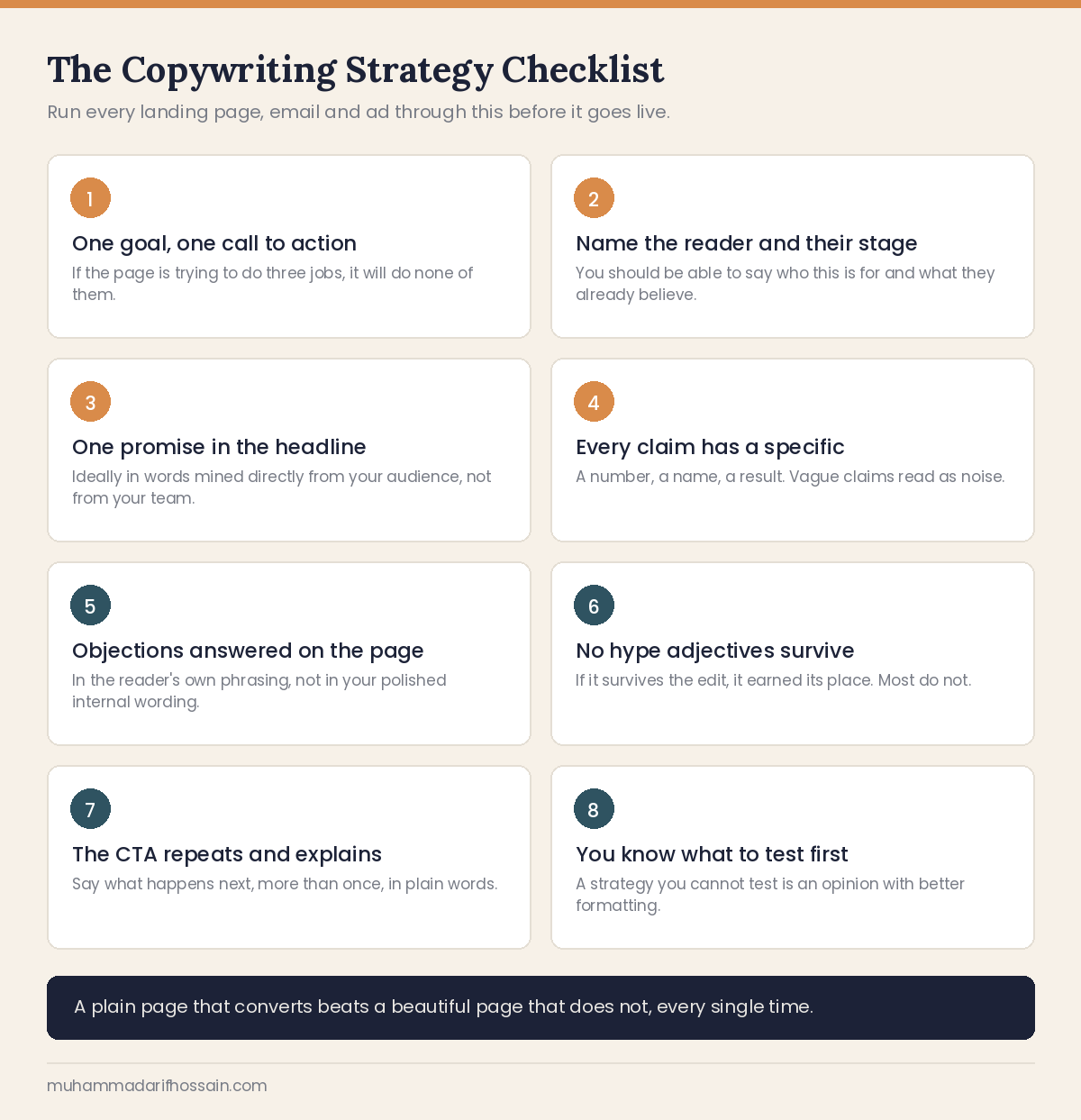
- The page has exactly one goal and one call to action
- You can name the specific reader and their awareness stage
- The headline makes one promise, ideally in words mined from your audience
- Every claim is backed by a specific: a number, a name, a result
- Objections are answered on the page, in the reader’s own phrasing
- No hype adjectives survive the edit
- The CTA appears more than once and says what happens next
- You know which single element you’ll test first
Related Guides
- Conversion Rate Optimization: 6 Steps and Mistakes to Avoid
- Content Marketing Strategy: 8 Steps That Actually Work
- How to Write a Blog Post: 9 Steps and Mistakes to Avoid
- Cold Email Marketing in 2026: What Works and Mistakes to Avoid
- Business Growth Strategy: 4 Types and How to Pick the Right One
Need Help With Your Copy?
If you’ve read this far and you’re still staring at a page that won’t convert, that’s normal. Strategy sounds simple in a list and gets messy on a real product, where the audience research is half-done and three people have opinions about the headline.
I write and test this kind of copy for SaaS and WordPress products every working day. If you want a second pair of eyes on your landing page, or just want to talk through where the message is leaking, reach out here. I read and reply to every message myself.
Frequently Asked Questions
What is the difference between copywriting and content writing?
The difference between copywriting and content writing is the goal of the words. Copywriting exists to drive one action, like a signup or a sale, while content writing exists to teach, build trust, and attract an audience. Your blog is content, and your pricing page is copy. Most businesses need both, working as a relay.
How long should sales copy be?
Sales copy should be as long as the decision is hard, which usually means longer for higher prices and unfamiliar products. A $15 tool can sell with a short page, while a $5,000 service needs room for proof, process, and objections. Length itself never hurts. Boring does, so cut padding, never substance.
Can AI write my copy?
AI can draft your copy, but it can’t do your strategy. The research, the positioning, and the choice of promise all depend on knowing your specific buyers, and generic input produces generic copy. Use AI to speed up drafts and variations, then rewrite with your audience’s real language and your real proof.
Do I need to hire a copywriter?
You don’t need to hire a copywriter for your first pages, and writing your own copy early is usually the better move. Nobody knows your customers’ language better than you, and the process teaches you what resonates. Hire help once revenue justifies it, and you’ll brief that copywriter far better for having done it yourself.
How do I practice copywriting?
You practice copywriting by rewriting real pages and measuring the results, starting with your own signup and landing pages. Copy out strong sales pages by hand to absorb their structure, then test one element at a time on your own site. Ten measured tests will teach you more than any swipe file alone.