
Let’s say you launched a course last year and it went well. Eight thousand dollars in two weeks. Best month you’d had in a while.
Then came the month after that, and the one after that, and you noticed something uncomfortable. Your income only moves when you do. Stop promoting and it stops. Take two weeks off and it stops.
So you start planning the next launch. You don’t have anything new to teach yet. The bills just don’t care about your launch calendar.
That’s usually when someone tells you to add a subscription. Recurring revenue, they say. Predictable income. So you set one up, price it at $29 a month, and point it at the course you already have.
For about three weeks, it looks like it worked.
Then month two arrives and the cancellations start. Your course was fine. Your students had simply finished it, and you’d sold them ongoing access to something that stopped moving.
Here’s what nobody tells you at that stage. Recurring revenue is a structure, and you build it on purpose. It comes down to what you sell at each level of your academy, how a student climbs from one level to the next, and what they get in month six that they couldn’t get in month one.
That’s what this guide is about. You’ll get the four layers, how much content you need before you turn on recurring revenue billing, what to charge for the recurring revenue tier, and what to set up before your first renewal cycle runs.
TL;DR
- Build your academy in four layers: a free lesson that earns you an email, a one-time course that funds your production, a recurring revenue core, and a higher tier for the students who finish everything you make.
- Answer one question before you turn on billing. What does your student get in month six that they cannot get in month one? If you cannot answer it in a sentence, they will cancel on their second charge.
- Stop counting your courses. Add up your total catalog hours and divide by four hours a week. If your material runs out in under three months, your students will finish before you have earned their third payment.
- Choose your recurring revenue model around what you can deliver every month. A library asks you for new courses quarterly, a membership asks for live sessions, a cohort asks for a release schedule, and a certification asks for an annual update.
- Set your recurring price at 10% to 20% of your flagship course. Then divide the launch income you want to replace by that number, and you will know exactly how many active subscribers you need before you commit.
- Push your annual plan harder than your monthly one. Annual plans reduce churn by 51% and annual subscribers are 2.4x more profitable than monthly subscribers, according to Marketing LTB.
- Fix your failed payments before you touch your content. 68% of churn is involuntary, so a grace period of three to five days wins back students who never decided to leave you.
What Recurring Revenue Actually Means for an Online Academy
Recurring revenue for an online academy is money that arrives on a schedule without you making a new sale. The student already decided. The billing runs on its own. Your only job that month is delivery.
That sounds obvious until you compare it to what most academies actually have. A creator who sells three courses to the same student over two years does not have recurring revenue. That was three separate marketing efforts with three separate decisions.
Education businesses generate recurring revenue three ways. Subscriptions bill on a set interval for ongoing access. Renewals charge again when a credential or membership year expires. Contracts bill a company for seats across a term.
The practical difference shows up in planning. If forty students pay you $35 a month, you start the month with $1,400 already committed. You can budget an editor, a course update, or a paid ad test against a number you can see.
There is a real cost attached. Recurring revenue gives you predictability and takes back flexibility. You are now obligated to deliver something every billing cycle, and that obligation does not pause when you are tired or busy.
That trade is worth making only if your academy is built to carry it. Most are not, and the reason is structural.
Why Most Academies Never Get Past the Launch Cycle
Watch what happens when a creator adds a monthly plan to an existing course. Signups look good in week one. Month two is quiet. Month three, the cancellations start and nobody knows why.
The reason is that a finished course has an ending and a subscription does not. Your student paid for continued access to something that stopped moving. Once they finish the last lesson, the charge becomes an unexplained line on a bank statement.
A second failure sits at the front door. Many academies have exactly one price and one offer. A student who is curious about your teaching has no low-risk way to find out if you are any good.
The third failure sits at the top. Your most engaged students, the ones who finish everything and reply to every email, have nowhere to spend more money. That is your highest-margin revenue walking away because you never built a place for it.
Timing makes all three worse. Marketing LTB reports that 44% of subscription cancellations happen within the first 90 days. Your structure has about three billing cycles to prove itself.
Fixing this means designing the academy as a set of connected levels. Each level does a specific job, and each one feeds the next.
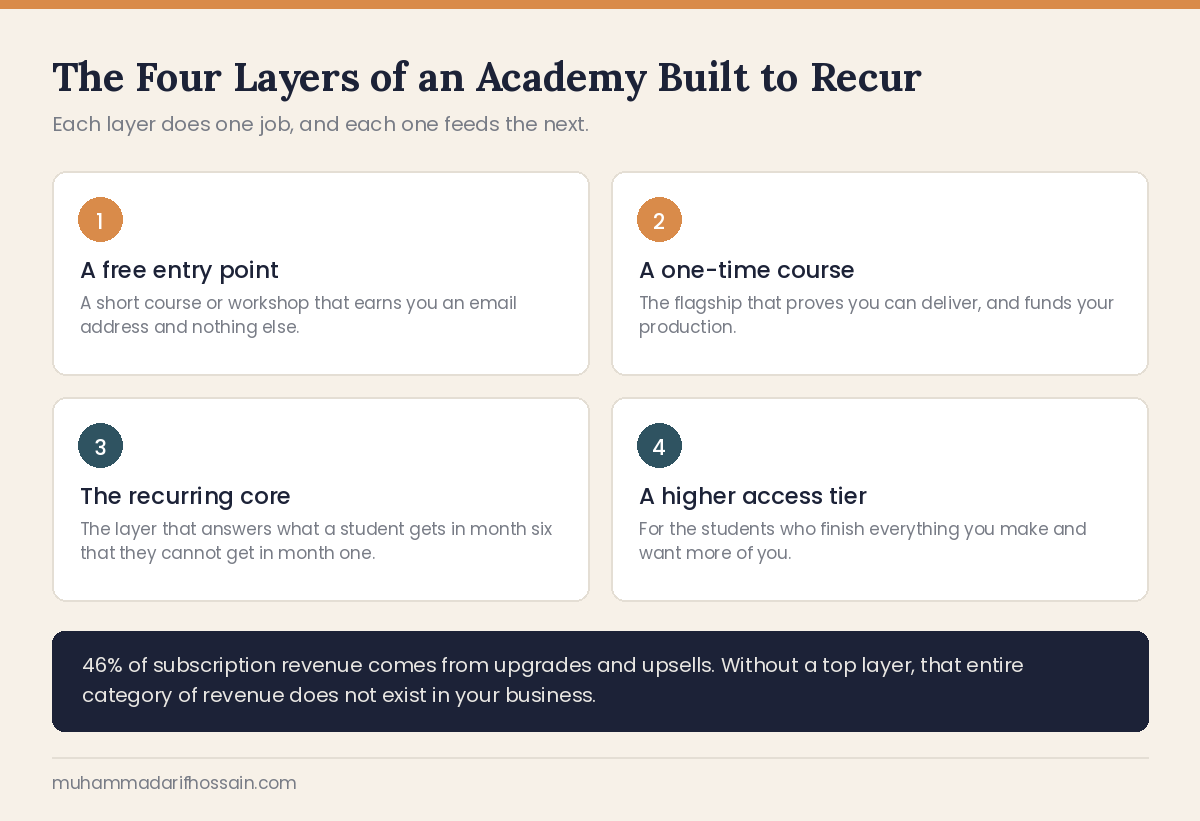
The Four Layers of an Academy Built for Recurring Revenue
Think of your academy as four layers stacked on top of each other. The bottom layer costs nothing and builds an audience. The top layer costs the most and serves the fewest people. The recurring revenue sits in the middle, and it only works when the layers below and above it exist.
You will not build all four in your first year. Most creators build layer two first because it pays immediately, then work outward. The point is knowing where each layer goes before you start.
Layer One: A Free Entry Point That Earns an Email
The free layer exists to turn a stranger into someone you can contact again. A short free course, a workshop recording, or a single problem-solving lesson does this better than a PDF checklist because it shows how you actually teach.
This matters more for recurring revenue than for one-time sales. A subscription asks a student to trust you with an open-ended commitment. That trust is much cheaper to build before you ask for a card.
Build it from material you already have. Pull the strongest 30 minutes out of your paid course and rebuild it as a standalone free lesson with a real outcome. You are proving competence, so pick the piece that produces a visible result.
Where creators go wrong here: giving away something so thin that it proves nothing. A free lesson that solves an actual problem sells your paid layers. A free lesson that lists tips does the opposite.
Skip this layer if you already have a warm audience of a few thousand people who know your work. Build it if you are starting from a cold list.
Layer Two: A One-Time Course That Proves You Can Deliver
Your flagship course is the layer that funds everything else. It has a clear start, a clear finish, and a specific outcome a student can name. Someone pays once and owns it.
This layer does two jobs at the same time. It brings in the cash that lets you build the recurring layer without rushing it. It also converts a buyer into a reference point, which is exactly who joins a subscription later.
Price this one to matter. A $19 course attracts students who will not stay subscribed to anything. A course priced at a level that requires a real decision brings in students who show up and finish, and finishers become subscribers.
Keep selling it after you launch the recurring revenue tier. The two work together, and the case for running both is covered in detail in this guide on subscription vs one-time course sales.
Common mistake: killing the one-time offer the day the subscription goes live. You have just removed your entry point for buyers who will never commit to a monthly charge, and those buyers were funding your content production.
Layer Three: The Recurring Core
This is where predictable revenue actually lives. The recurring layer sells continued access to something that keeps moving: a growing library, a live session calendar, a community, or a program that releases in stages.
The defining test is simple. Ask what a student gets in month six that they could not get in month one. If you cannot answer that in one sentence, you do not have a recurring offer yet.
Content itself is often the smaller part of the value. Access to you, feedback on their work, a group at the same stage, and a reason to show up on a schedule all carry more retention weight than another video.
Set the price below your flagship course so it reads as an easier decision. A student who paid $300 once will look at $39 a month and see a smaller commitment, even though the annual total is higher.
When not to build this yet: if your topic is genuinely finished. Some subjects have a complete answer. Teaching a software tool that ships updates supports a subscription. Teaching a one-time certification exam usually does not.
Layer Four: A Higher Tier for Students Who Want More Access
Your top layer serves the small group who want direct access. Small-group coaching, an annual certification with renewal, a done-with-you program, or licensed seats for a company all sit here.
This layer changes your revenue math more than any other. Ten students at $200 a month equals fifty students at $40 a month, and ten students is a group you can actually serve well.
It also raises retention across the whole academy. A student working toward a credential or sitting in a monthly small-group call has a specific reason to stay that content alone never creates.
Build this layer only after your recurring revenue core is stable. It demands your time directly, and your time is the one input you cannot scale. Selling ten coaching seats before your subscription runs itself leaves you with no hours to fix the subscription.
Expected impact: Marketing LTB reports that 46% of subscription revenue comes from upgrades and upsells. Without a top layer, that entire category of revenue does not exist in your business.
Pick the Recurring Revenue Model That Matches What You Teach
The layer structure stays the same for everyone. What changes is the shape of layer three, and that shape should follow your subject and your capacity rather than your revenue target.
Five models cover almost every academy. Each one asks something different from you every month.
The All-Access Library Model
The library model gives one price for everything you have published. It works when your catalog is deep enough that a student cannot finish it quickly and broad enough that different students want different parts.
Volume is what this model demands. You need new courses arriving often enough that the library feels alive. A quarterly release is the realistic floor for most solo creators.
Its weakness is the completion cliff. A motivated student burns through your catalog and has no reason to renew. Watch your month-four cancellations closely, because that is where this model breaks first.
The Membership Model
A membership sells access to you and to a group, with courses included. The community carries the retention weight, and content becomes the supporting material.
This model suits topics where students get stuck on their own specific situation. Marketing, freelancing, fitness coaching, and language learning all fit because the same lesson lands differently for every person.
The demand here is presence rather than production. Two live sessions a month and consistent replies in the group can outperform four new courses. That trade favors creators who are better on camera than in an editing timeline.
Here is the honest risk. A quiet community actively hurts you. An empty forum tells a new member they made a mistake. Start smaller than you think and only open it when you can guarantee activity.
The Ongoing Cohort or Program Model
A cohort model releases material on a schedule with a group moving through it together. Students pay monthly for the next stage rather than for a finished catalog.
This fits fast-moving topics where a static course goes stale in six months. It also fits skill building that genuinely takes time, where a student needs to practice module three before module four helps them.
Your obligation is a calendar. Miss two scheduled releases and the model loses the thing that made it worth paying for.
The Certification and Renewal Model
Certification generates recurring revenue through the renewal cycle instead of monthly billing. A student earns the credential, and it expires after a set period unless they complete updated requirements.
This only works where the credential carries weight with someone other than you. An employer, a licensing body, a client base, or an industry standard has to recognize it. A certificate you invented last month does not create renewal pressure.
The advantage is a much lighter content load. You update material once a year instead of monthly. The disadvantage is that a renewal charge without new value feels like a toll, and students say so publicly.
The Company Seat Licensing Model
Seat licensing sells access to a business that then assigns it to employees. One agreement can produce more revenue than fifty individual subscribers.
Course topics that map to job performance sell here. Sales training, software skills, compliance, and role-specific onboarding all have a budget attached inside companies.
The cost is a different sales motion entirely. Expect months rather than days, requests for reporting you do not have yet, and procurement steps that individual buyers never ask about. Add this after your individual model works.
How Much Content You Need Before You Turn On Recurring Revenue Billing
This question gets contradictory answers everywhere you look. Some sources say you need twenty or more courses before a subscription feels worth paying for. Others tell you to launch with five subscribers and figure it out. Both are answering the wrong question.
The number that matters is not your course count. It is how long your current material lasts a committed student. If someone can finish everything you have inside one billing cycle, you are not ready regardless of how many courses that represents.
Run the test yourself. Add up the total hours in your catalog and divide by four hours a week, which is a realistic pace for a working adult. Fifty hours of material lasts about three months. Twelve hours lasts three weeks.
Your target is material that outlasts three billing cycles, plus a visible pipeline of what comes next. Three cycles gets a student past the 90-day window where most cancellations happen. The pipeline is what carries them beyond it.
The requirement also shifts by model. A library model needs real depth on day one. A membership model can launch with two courses because the live sessions and the group carry the value. A cohort model can launch with only the first module built, since the schedule is the promise.
What to do if you fall short: launch the recurring revenue tier as a founding-member offer with a lower price and a stated release calendar. You are selling the roadmap honestly instead of overstating the catalog, and early members will tell you what to build next.
Build a Publishing Rhythm That Protects Your Recurring Revenue
Ask any creator who shut down a subscription why it ended. The answer is almost always the same. They promised a pace they could hit for two months and not for twelve.
Cadence is a structural decision, so make it before you set a price. What you can reliably ship every month determines what you can charge and how long people stay.
Start by finding your smallest reliable unit. That might be one lesson, one live call, one teardown, or one written breakdown. Pick the format you can produce on your worst week.
Batch your production. Record four sessions in one day rather than one session a week. A single setup, one lighting check, one editing pass. Most creators cut their production time close to half this way, and it protects your cadence when a bad month arrives.
Use live sessions to carry the calendar. A monthly live Q&A costs you an hour and no editing time. It also produces a recording you can add to the library afterward, which means one hour generates both the cadence and the asset.
Repurpose instead of inventing. Your student questions are a content list you already own. A recurring question becomes a short lesson. A detailed reply becomes a written guide. Nothing here requires a new idea.
Publish the calendar. Tell members what arrives and when. A student who can see next month’s release has a concrete reason to stay through this month’s charge, and you now have a deadline that keeps you honest.
What to do in a slow month: ship something small and say so. A short update with a note about what is coming holds more trust than silence. Members forgive a light month. They do not forgive disappearing.
Price Your Recurring Revenue Tier So the Math Works
Pricing a recurring revenue tier is a different exercise from pricing a course. You are not setting a price for a product. You are setting a number that has to survive a monthly review inside your student’s head.
Start by anchoring to your flagship course. A recurring price somewhere between 10% and 20% of your one-time course price usually reads as reasonable to a buyer who has seen both. A $300 course supports a $30 to $60 monthly tier.
Then check the number against your own capacity. If you can produce four hours of new material a month, price for that. A $99 tier with a $29 output creates cancellations you will spend the next year trying to explain.
Run the replacement math before you commit. Take the launch revenue you want to replace and divide by your monthly price. Replacing $3,000 a month at $39 means 77 active subscribers. At $79, it means 38. That single comparison usually settles the pricing debate faster than any framework.
Do not price at the bottom. A $9 tier needs hundreds of subscribers to matter, and support load grows with headcount while revenue per student stays flat. The volume required is usually larger than the audience you have.
Push the annual option. A monthly subscriber reconsiders twelve times a year. An annual subscriber reconsiders once. Marketing LTB reports that annual plans reduce churn by 51% and that annual subscribers are 2.4x more profitable than monthly subscribers. Offer a discount big enough to change the decision. A token 5% will not move anyone.
If you have not settled your one-time course price yet, do that first. This guide on how to price your online course covers the costing work that your recurring price depends on.
Set Up Access, Billing, and Renewals Before Recurring Revenue Starts
Most creators configure billing rules after something breaks. That is an expensive way to learn, because the first thing that breaks is usually a student’s access to content they paid for.
Decide your billing intervals first. Monthly and annual cover most academies. Quarterly is worth adding if your content ships on a quarterly rhythm, since the billing cycle then matches the delivery cycle and the charge feels earned.
Define what happens when a plan lapses. Access ending the moment a payment fails turns a card problem into a permanent loss. A grace period of three to five days lets a student fix the issue without feeling shut out.
Failed payments deserve real attention. Marketing LTB reports that 68% of churn is involuntary and caused by payment failure. These students did not choose to leave, which makes this the cheapest churn you will ever recover.
Make cancellation clean. A hidden cancel button generates chargebacks and public complaints. A student who leaves easily and respectfully is a student who might come back in six months, and reactivation costs you nothing.
Plan your display before launch too. Your recurring plans need a page where a visitor can compare tiers and see what each one includes. Burying them inside a course page loses buyers who never find them.
Buying implication: check these controls while you are still choosing a platform. Grace periods, custom billing intervals, and lapse behavior are configuration details that decide how much revenue you keep. This roundup of affordable LMS platforms to sell online courses is a useful place to compare what different tools include.
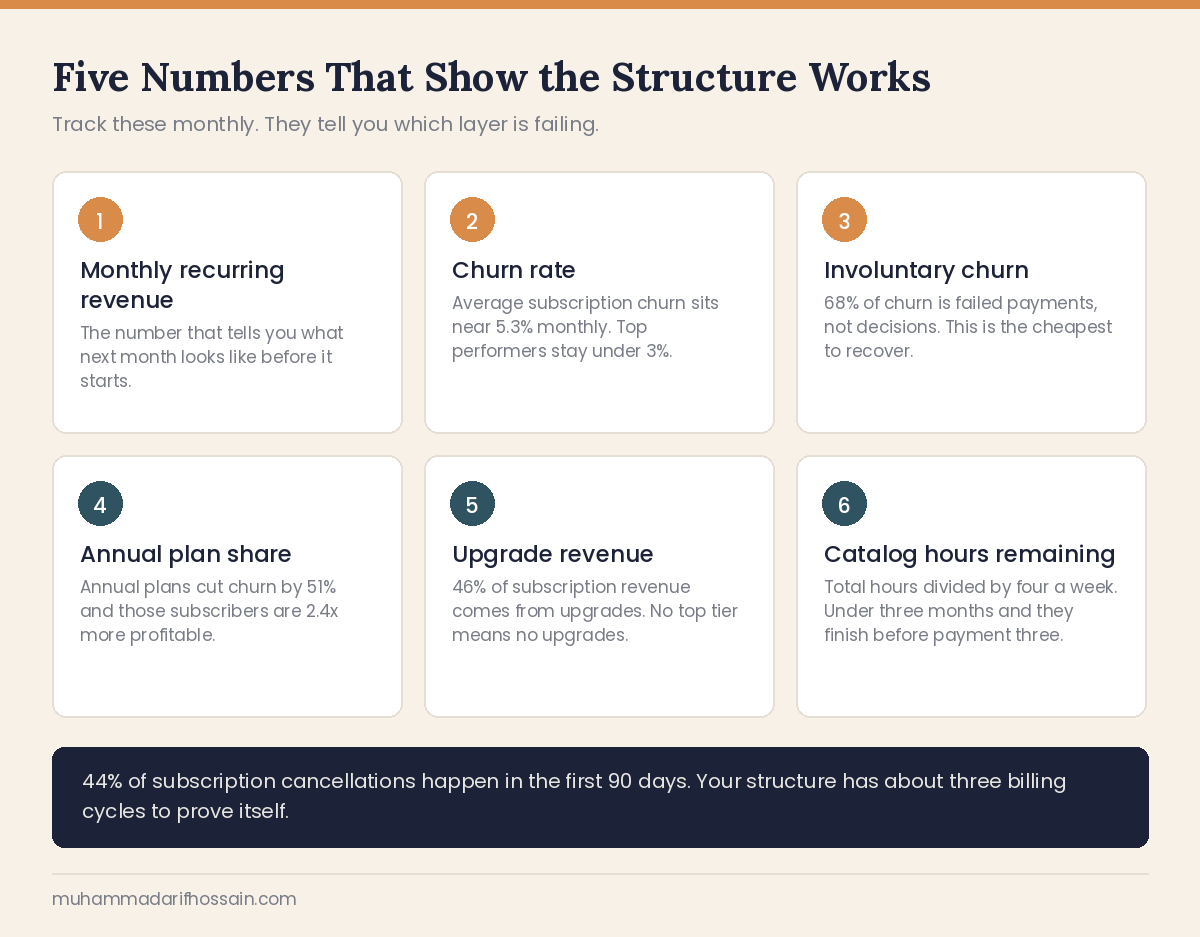
Track Five Numbers That Show Your Recurring Revenue Structure Works
You cannot fix a structure you are not measuring. Five numbers tell you almost everything about how your academy is really performing.
Monthly recurring revenue is your committed income before any new sales. Track it as one line every month. Direction matters more than the figure, and a flat MRR with rising signups means your churn is eating your growth.
Churn rate is subscribers lost divided by subscribers at the start of the period, multiplied by 100. Marketing LTB puts the average subscription churn rate at 5.3% monthly, with top performers below 3%. Use your own previous month as the more useful benchmark.
Customer lifetime value is your average monthly revenue per subscriber divided by your monthly churn rate. A $49 subscriber with 8% monthly churn is worth about $612. If your cost to acquire a student is higher than that, no retention tactic fixes it.
Cohort retention groups students by join month and tracks how many remain at month two, four, and six. Early drop-off points at onboarding. Mid-cycle drop-off points at content freshness. This one number tells you which part of the structure to fix.
Expansion revenue is the share of income generated by upgrades into higher tiers. If it sits near zero, your top layer either does not exist or is not visible to the students most likely to buy it.
Structural Mistakes That Quietly Kill Recurring Revenue
These show up months after launch, which is what makes them expensive. Each one traces back to a decision made during setup.
Launching the recurring revenue tier before you have an audience. A subscription needs a warm list. Selling to strangers takes months of trust building, and you will be paying for content production the entire time with no revenue. Build layer two and sell it first. The guide on how to sell an online course covers the audience work this depends on.
Treating the subscription like a launch. A one-time course needs a launch push. A subscription needs consistent delivery for years. Creators who run a big launch and then go quiet see cancellations arrive in a wave around month three.
Ignoring the first week. A student who logs in once and never returns is already gone. Give new members a specific first step within 24 hours, a check-in around day three, and a progress prompt in week one. That sequence costs you three emails and moves your 90-day retention more than any content addition.
Building the top layer too early. Coaching and small-group programs pay well and consume the hours you need for everything else. If your recurring revenue core still needs weekly firefighting, a tier that demands your calendar will drag both layers down.
Skipping the exit question. When a student cancels, ask why. Four options are enough: too expensive, not enough time, finished what I needed, content was not what I expected. Each answer points at a different fix, and guessing wastes months on the wrong one.
Related Guides
- How to Grow a SaaS Business: 8 Steps and Mistakes to Avoid
- Business Growth Strategy: 4 Types and How to Pick the Right One
- Email Marketing vs Cold Email: What Each Is For and Which to Start First
- Content Marketing Strategy: 8 Steps That Actually Work
- Conversion Rate Optimization: 6 Steps and Mistakes to Avoid
- How to Write a Blog Post: 9 Steps and Mistakes to Avoid
Want Help Structuring Your Online Academy?
Recurring revenue is a structure problem long before it is a marketing problem. Most academies that stall have a great course and no answer to the question of what a student gets in month six.
I build marketing and monetisation systems for SaaS and WordPress products every working day, and the same layer logic applies to an online academy. If you want a second pair of eyes on your structure, your pricing, or why subscribers keep cancelling on the second charge, reach out here. I read and reply to every message myself.
Frequently Asked Questions
How long does it take to build recurring revenue from an online academy?
Building recurring revenue from an online academy usually takes six to twelve months before the income is stable enough to plan around. The first three months go to your free layer and flagship course, which is what builds the audience your recurring revenue tier sells to. Months four through six are typically when you launch the recurring offer to that warm list and learn where students drop off. Real predictability arrives once you have survived two or three full renewal cycles, because that is the point where your retention pattern becomes visible rather than theoretical. Creators with an existing audience compress this considerably, and creators starting from zero should expect the longer end.
Can I run an academy on recurring revenue without a subscription plan?
You can run an academy on recurring revenue without a subscription plan by using renewals or term contracts instead. Certification renewals charge a student again when their credential expires, which produces recurring income on an annual cycle with far less content pressure than monthly billing. Company seat licensing works the same way, since a business renews access for its team on a contract term. Retainer coaching also qualifies, because the client commits to a period rather than a session. These options suit creators who want predictable income without the obligation to publish something new every month.
Should I move my existing one-time students onto a recurring plan?
Moving existing one-time students onto a recurring plan is a bad idea if it means taking away access they already paid for. Those students bought lifetime access, and removing it damages trust in a way that outlasts any revenue you gain. The better approach is to leave their existing purchase untouched and offer the recurring revenue tier as an addition with something new inside it. Past buyers are your warmest possible audience for a subscription because they already know your teaching works. Give them a founding-member rate and they often convert at a much higher rate than cold traffic.
What is a good MRR growth rate for a small online academy?
A good MRR growth rate for a small online academy is anything that keeps net new subscribers ahead of cancellations month over month. In the early stage, percentage growth looks dramatic because the base is small, so a jump from ten subscribers to fifteen reads as 50% growth without meaning much. The more useful check is whether your growth holds steady once the base is larger. Track the net number rather than the percentage, and pay attention to the month your cancellations start matching your signups, because that is your structure telling you which layer needs work.
How do I sell recurring academy access to a company instead of an individual?
Selling recurring academy access to a company starts with reframing your course around a job outcome the business already cares about. A hiring manager buys faster onboarding or fewer compliance gaps. Nobody in that seat is shopping for a course. Package the offer as a number of seats over a fixed term with a single invoice, since procurement handles that far more easily than individual signups. Expect to provide completion reporting, because the buyer needs to show their manager that the spend produced something. The sales cycle runs months rather than days, so treat this as a layer you add once your individual model is already covering costs.
Do I need a community to make a recurring revenue model work?
You need a community for a recurring revenue model only when your students get stuck on situations that content alone cannot solve. Marketing, freelancing, and coaching topics fit that description, because the same lesson applies differently to every person’s business. Technical or reference-heavy topics often retain fine on content depth and regular updates without any group element. The risk is worth naming: an inactive community works against you, since a new member who sees an empty forum reads it as a sign they made a mistake. Launch one only when you can guarantee activity in the first weeks.