So you want to start a business. Ask around and you’ll get chaos. Your uncle says get the LLC first. YouTube says dropshipping. A bank’s blog hands you a 10-step guide that starts with “write a business plan.” A year later, you’re still on step zero.
Let me simplify the whole thing. You need exactly one thing to start a business: proof that someone will pay for what you want to sell. Not a logo. Not a company. Not money. Proof. Everything else is admin, and admin is easy once the proof exists.
That’s how this guide is ordered. Prove people will pay first, do the paperwork second, spend money last. Nine steps, and they work for a freelance service, an online store, or a software product. If your idea is good, you’ll know within a week. If it’s bad, you’ll know within a week too, and that’s the better deal.
TL;DR
- Start with a problem people already pay to solve, never with a product idea you happen to love.
- Validate before you build. Ten real conversations and a handful of pre-sales beat any amount of planning.
- Write a one-page plan: customer, problem, offer, price, channel, and costs. Skip the 40-page document.
- Know your number. Calculate startup costs plus six months of runway before you quit anything.
- Register the business, open a separate bank account, and sort taxes early. Boring, cheap, and it prevents expensive messes.
- Launch the smallest sellable version, get ten customers manually, and let their feedback decide what you build next.
What Do You Actually Need to Start a Business?
You need three things: a problem someone will pay to solve, a way to reach those someones, and enough cash to survive until revenue covers costs. Everything else, the logo, the office, the perfect name, is decoration that can wait.
That’s worth internalizing because the failure numbers are real. According to US Bureau of Labor Statistics data, roughly 20 percent of new businesses fail within the first year and about half within five years (source). And when CB Insights analyzed hundreds of startup post-mortems, the single most common cause of death was building something with no market need (source).
Read those two findings together and the lesson writes itself. The survivors aren’t the ones with the best branding or the cleverest legal setup. They’re the ones who confirmed people would pay before the money ran out.
The nine steps below are ordered around exactly that. The first three cost almost nothing and kill bad ideas cheaply. The rest turn a validated idea into a real, legal, running business.
How to Start a Business in 9 Steps
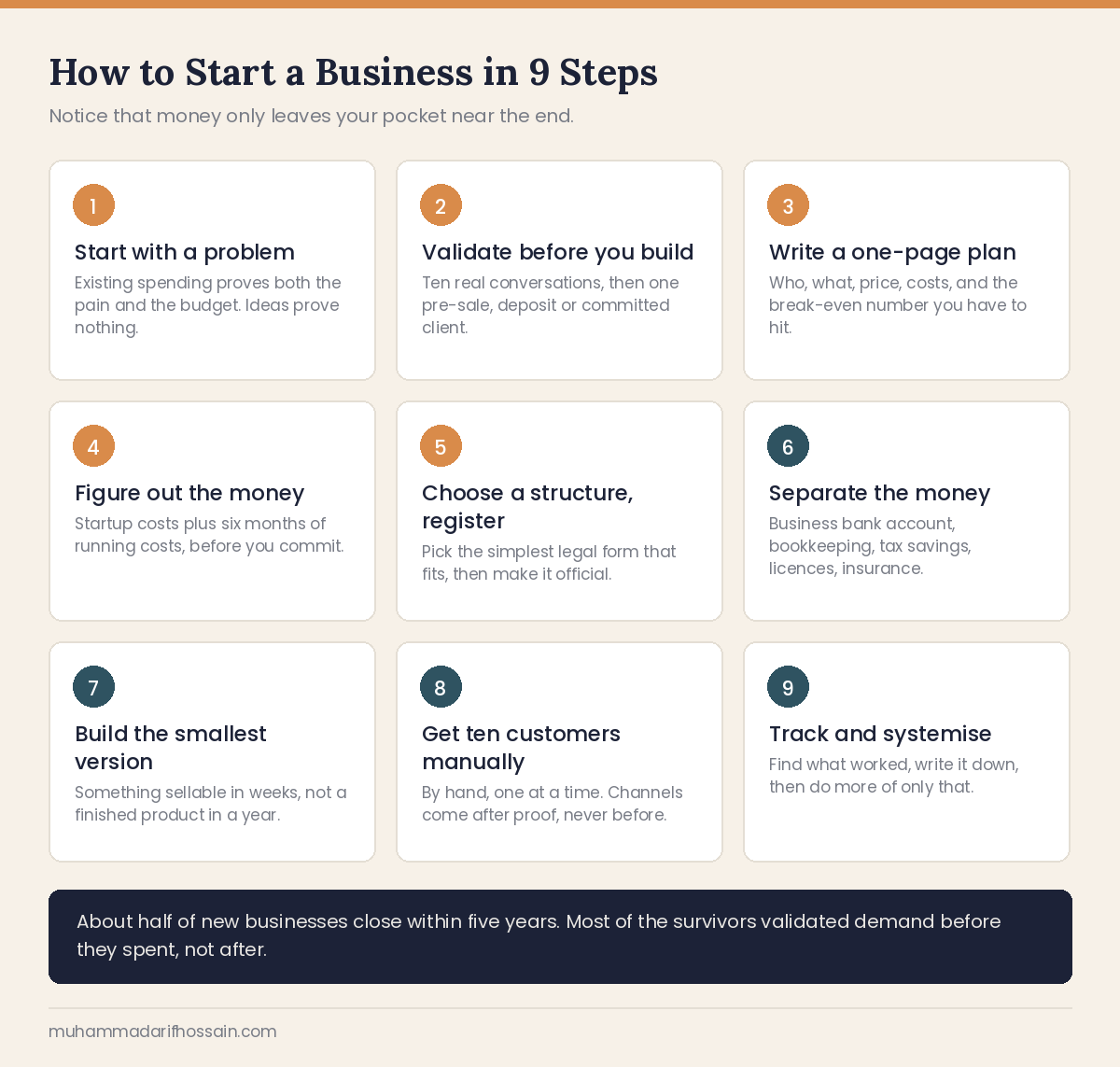
Follow this order to start a business the cheap way. The most expensive beginner mistakes come from doing step seven’s spending with step one’s certainty, and that is exactly how most people start a business badly.
Step 1: Start With a Problem, Not an Idea
The best reason to start a business is a painkiller, not a vitamin. Profitable businesses solve problems people already feel. So instead of asking “what could I build,” ask “what do people around me already struggle with and pay to fix badly?” Existing spending is the strongest signal there is, because it proves both the pain and the budget.
When you start a business, look in three places for that problem. Your own work, where you know the frustrations insiders pay to escape. Your skills, where others already ask for your help. And existing markets with unhappy customers, where one-star reviews of competitors are a printed list of what people want and can’t get.
Common mistake to avoid: Falling in love with an idea nobody asked for. If your pitch starts with the product instead of the person and their problem, you’re already building on hope. Competition, by the way, is a good sign. It means the money exists.
Step 2: Validate Before You Build Anything
Now prove it, cheaply. Find ten people who have the problem and talk to them. Ask what they currently do about it, what that costs them, and what they’ve already tried. You’re listening for pain and existing spending, never for compliments about your idea.
Then push for the only validation that counts: money or real commitment. Pre-sell the service at a founding-customer discount. Put up a simple landing page and see if strangers leave an email. Offer to solve the problem manually for three people this month. Polite interest is worthless, and “I’d totally buy that” from a friend is worth even less.
Where this matters most: Anything that takes months to build. A service business can validate in a week of conversations. A product or software business risks a year of building on a guess, so pre-selling before building is the difference between an experiment and a gamble.
Step 3: Write a One-Page Plan
Skip the 40-page business plan unless a bank demands one. What you need fits on a single page: who the customer is, what problem you solve, what you sell, the price, how customers will find you, what it costs to run, and how many sales cover those costs.
That last number is your break-even, and it turns the dream into arithmetic. “I need 14 clients at $500 a month to replace my salary” is a plan you can act on. “I want to build a successful agency” is a mood.
Revisit the page monthly and change it freely. The plan’s job is clarity today, never prediction of year three. If you can’t fill in the “how customers find me” line, that’s the gap to close before spending anything.
Step 4: Figure Out the Money
Add up two numbers honestly. One-time startup costs: equipment, registration, initial inventory, a basic website. And monthly running costs multiplied by at least six months, because revenue almost always arrives slower than planned. That total is your number.
Then match it to a funding source. Personal savings keeps you in full control and disciplines your spending. Keeping your day job and building nights and weekends is the most underrated funding strategy there is. Loans and outside money make sense only when the model is proven and more cash genuinely means more speed.
Common mistake to avoid: Raising or borrowing to find out whether the idea works. Debt on top of an unvalidated idea turns a cheap lesson into a multi-year hole. Validation is what step two was for, and it should have cost you almost nothing.
Step 5: Choose a Structure and Register
Now the paperwork, and it’s less scary than the forums make it sound. Most small businesses start as either a sole proprietorship, the simplest and cheapest option where you and the business are legally the same, or an LLC or its local equivalent, which separates your personal assets from business debts for a modest fee.
The honest rule of thumb when you start a business: stay simple if you’re testing a low-risk service, and form the company once real money or real liability enters the picture. Rules and costs vary a lot by country and state, so check your government’s official portal. US readers can start at usa.gov/start-business, which links every registration, license, and tax requirement in one place.
While you’re at it, check whether your industry needs licenses or permits, and register the business name. An hour of checking now beats a fine or a forced rebrand later.
Step 6: Separate the Money and Sort the Boring Stuff
Open a business bank account before the first sale, and run every business dollar through it. Mixed personal and business finances make taxes miserable, bookkeeping impossible, and legal protection weaker. This one habit costs nothing and saves you every March.
Set up three more things in the same week. Simple bookkeeping software, or even a spreadsheet, tracking every dollar in and out. A rough tax plan, because in most countries you’ll owe income tax, possibly sales tax or VAT, and self-employment contributions, so put aside a percentage of every payment from day one. And basic insurance if your work carries liability, like anything involving clients’ property, health, or data.
None of this grows the business. All of it prevents the kind of surprise that kills one.
Step 7: Build the Smallest Sellable Version
Launch the minimum thing someone will pay for, not the complete vision. A freelancer needs one service, one price, and one page. A store needs a handful of products, not a catalog. A software founder needs the one feature that solves the core problem, even if parts of it run manually behind the scenes.
Small and live beats big and imaginary for one reason: feedback. Your first ten customers will tell you things no amount of planning could, including which features matter, what the price should be, and what words they use to describe the problem. Those words become your marketing.
Set a launch deadline measured in weeks, then cut scope until the deadline is realistic. Perfectionism at this stage is just fear wearing a work costume.
Step 8: Get Your First Ten Customers Manually
Forget scalable marketing for now. Your first customers come from direct, unscalable effort: your network, communities where your buyers already gather, direct outreach, and asking every early customer who else they know. Ten customers acquired by hand teach you the message and prove the offer.
Once you know what converts, pick one repeatable channel and go deep instead of dabbling in five. Service and B2B businesses often win fastest with direct outreach, and my guide on cold email marketing covers that whole system. Businesses whose customers search for solutions win long-term with content, which is a slower road mapped out in my content marketing strategy guide.
Where this matters most: Pricing your effort. Every hour on logos, business cards, and social media aesthetics is an hour not spent talking to a potential customer. In month one, conversations are the only marketing with a measurable return.
Step 9: Track the Numbers and Systemize What Works
Once money moves, three numbers tell you the truth every month: revenue, profit after all costs, and where each customer actually came from. Review them monthly and let them assign your priorities, because founders who don’t track this end up working hard on the wrong things for years.
Then start turning yourself from doer into designer, which is where you stop working in the business and start working on it. Write down how you deliver the work, template the emails you send twice, and automate or delegate the tasks that don’t need you. Systems are what make the business worth more than your own hours.
From here, growth becomes its own discipline: choosing between selling more to existing customers, reaching new markets, or building new offers. That decision framework is a post of its own, and my guide on business growth strategy picks up exactly where this step ends.
Common Mistakes to Avoid When Starting a Business
Spending months on the wrapper. Name, logo, website, cards, office. None of it validates anything. The businesses that survive spent that energy finding customers, then made things pretty with revenue.
Quitting the day job on day one. A salary is angel investment you never repay. Build to your first paying customers on the side, and let proof, not optimism, set the quit date.
Pricing to be the cheapest. Low prices attract the hardest customers and starve you of the margin that funds everything else. Price against the value of the problem solved, then let early customers negotiate you down, never the other way.
Building in secret. Founders hide their idea for fear of theft, then launch to silence. Ideas are cheap and execution is everything, so talk about it constantly. Every conversation is free validation or free marketing.
Waiting to feel ready. There’s no course, book, or checklist after which the decision to start a business feels safe. Readiness comes from the first sale, not before it.
A Simple Starting Checklist
Work through these in order when you start a business, and notice money only leaves your pocket near the end.
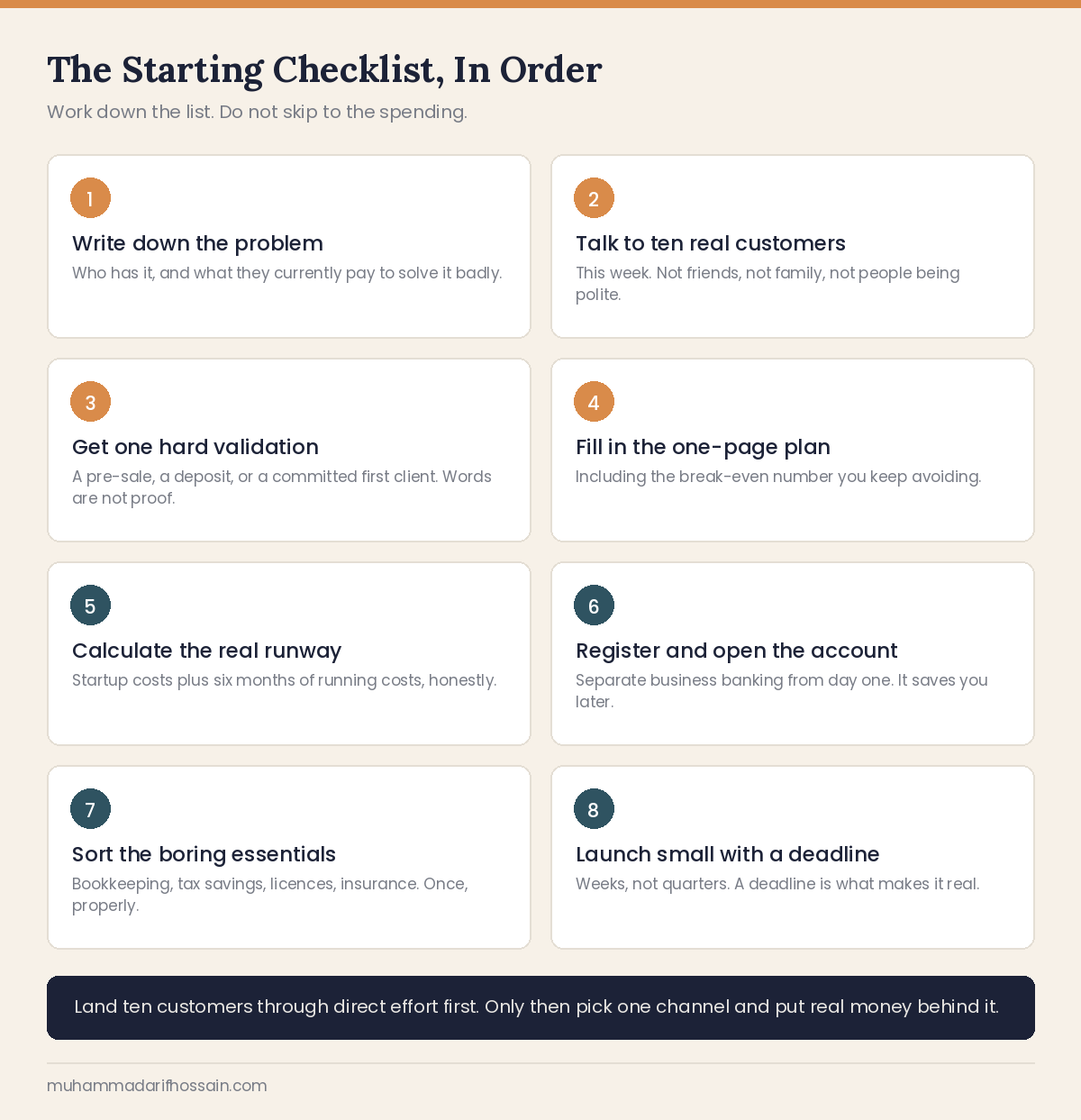
- Write down the problem, who has it, and what they currently pay to solve it
- Talk to ten real potential customers this week, before you start a business on a hunch
- Get one form of hard validation: a pre-sale, a deposit, or a committed first client
- Fill in the one-page plan, including your break-even number
- Calculate startup costs plus six months of running costs
- Register the business and open a separate bank account before you start a business properly
- Set up bookkeeping, tax savings, and any required licenses or insurance
- Launch the smallest sellable version with a deadline in weeks
- Land your first ten customers through direct effort after you start a business, then pick one channel to scale, using a business growth strategy that matches what you sell
Related Guides
- Business Growth Strategy: 4 Types and How to Pick the Right One
- Content Marketing Strategy: 8 Steps That Actually Work
- Conversion Rate Optimization: 6 Steps and Mistakes to Avoid
- Email Marketing vs Cold Email: What Each Is For and Which to Start First
- Copywriting Strategy: 6 Steps and Mistakes to Avoid
Starting Something and Stuck on the Marketing?
If the idea and the paperwork are handled but “how will customers find me” is still a blank line on your one-page plan, that’s the most common place new businesses stall. It’s also the part I do for a living.
I build marketing systems for SaaS and WordPress products every working day, and the same fundamentals apply to almost any business finding its first customers. If you want a second pair of eyes on your launch plan, reach out here. I read and reply to every message myself.
Frequently Asked Questions
How much money do I need to start a business?
You need anywhere from under $100 for a freelance service to several thousand for inventory or product businesses, plus six months of running costs as a cushion. The figure depends entirely on the model, so calculate your own number instead of trusting averages. Service businesses remain the cheapest proven way to start a business.
Can I start a business with no money?
You can start a business with no money by selling a service built on skills you already have, since it needs only time, a free way to reach clients, and an invoice. Freelancing, consulting, and local services all fit. Product and inventory businesses genuinely need capital, so start a business on service revenue and fund the product later.
Do I need an LLC to start a business?
You don’t need an LLC to start a business, and many people begin as sole proprietorships while testing the idea. An LLC or its local equivalent becomes worth the fee once you have real revenue, contracts, or liability to protect your personal assets from. When in doubt, a one-hour consultation with a local accountant settles it cheaply.
How long does it take for a new business to make a profit?
It takes most new businesses one to two years to become reliably profitable, though a lean service business can profit in its first month because costs are near zero. Speed to profit mostly reflects your overhead. The less you spend before revenue arrives, the shorter the road.
What is the easiest business to start?
The easiest business to start is a service business selling a skill you already have, like writing, design, bookkeeping, repairs, or marketing help. There’s nothing to build, no inventory to fund, and your first client can arrive this week through direct outreach. It’s also the fastest way to learn sales, pricing, and delivery before risking bigger bets.