
You launched, you got some users, and now you’re stuck at a number. Maybe it’s $800 MRR, maybe it’s $8,000. You post on social, tweak the homepage, try a week of ads, and the line on the dashboard barely moves. Everyone online says “just get more users,” which is like telling a broke person to just get more money.
Here’s the uncomfortable pattern behind most stalled SaaS businesses. Growth almost never fails at the top of the funnel first. It fails underneath: customers leaving as fast as they arrive, pricing set too low to fund acquisition, or a product nobody activates after signing up. Pouring traffic on top of those problems just burns cash faster.
This guide walks through how to grow a SaaS business in eight steps, in the order that actually compounds. I market SaaS and WordPress products every working day, so this is the sequence I run, along with the mistakes I keep seeing founders repeat.
TL;DR
- Fix retention before acquisition. Growth on top of high churn is a leaky bucket, and more traffic just leaks faster.
- Track five numbers: MRR, churn, CAC, LTV, and activation rate. They tell you exactly which step below needs work.
- Niche down your positioning. “Project management for everyone” loses to “project management for law firms” at every stage of the funnel.
- Pick one or two acquisition channels and go deep for six months. Channel hopping is the most expensive habit in any SaaS business.
- Onboarding is a growth lever, not a UX detail. Users who never reach the product’s first win become next month’s churn.
- Raise your prices. Underpricing is the most common self-inflicted wound in an early SaaS business, and monetization work moves revenue harder than acquisition work.
What Does Growing a SaaS Business Actually Mean?
Growing a SaaS business means increasing monthly recurring revenue, or MRR, faster than you lose it. That’s the whole game. Revenue comes in through new customers, expansion from existing ones, and reactivations. It leaks out through cancellations and downgrades, which together make up churn.
That framing matters because it gives you three levers instead of one. You can add customers, keep customers longer, or earn more per customer. Most founders obsess over the first lever and ignore the other two, which is exactly backwards for an early product, as you’ll see in step one.
Growth strategy also has to match your stage. The playbook below assumes you have a live product and at least a handful of paying customers. If you’re still deciding what kind of growth to pursue at the company level, my guide on business growth strategy covers that bigger picture first.
How to Grow a SaaS Business in 8 Steps
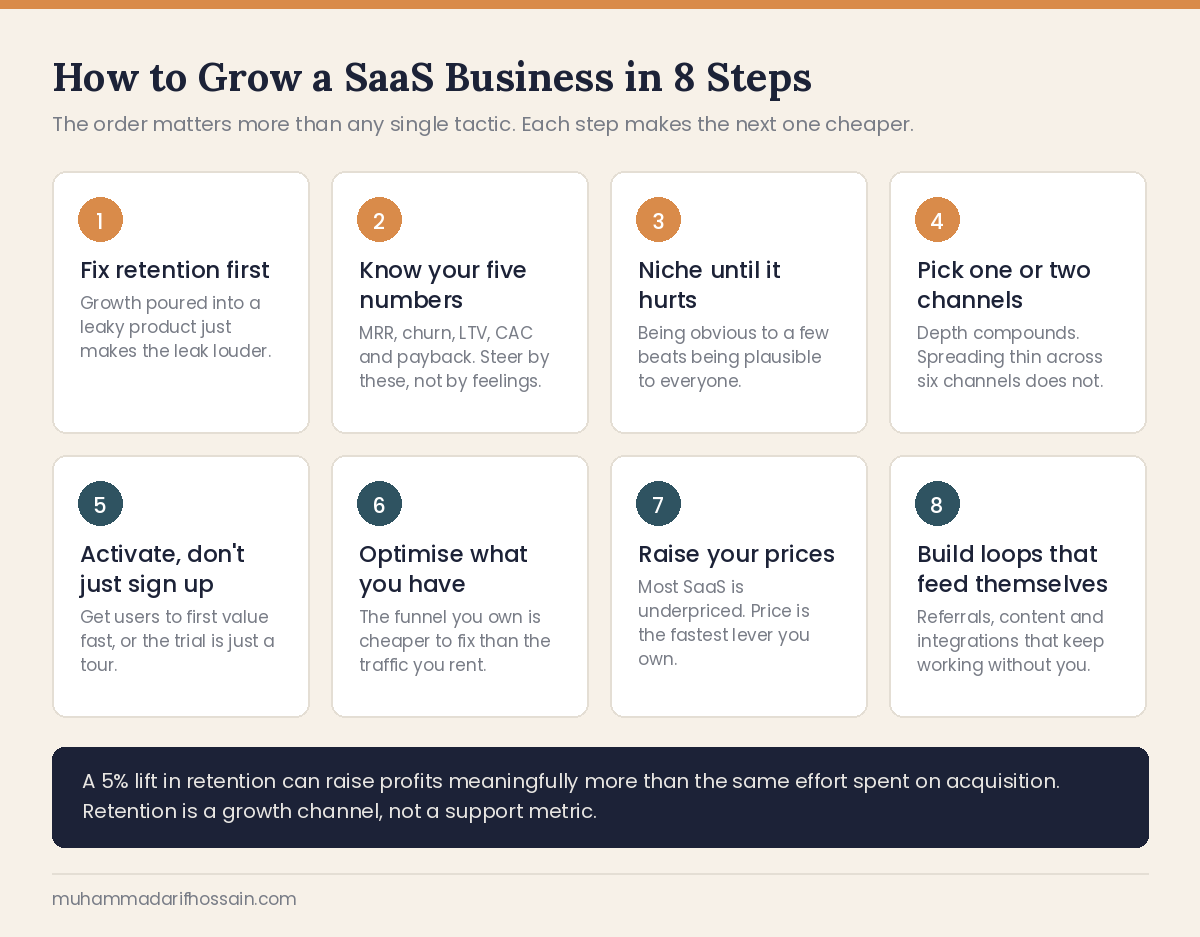
Here’s the sequence. The order matters more than any individual tactic, because each step makes the next one cheaper.
Step 1: Fix Retention Before You Buy Growth
Churn is the first thing to look at and the last thing most founders want to look at. If you’re losing 8 percent of customers every month, you lose over half your customer base in a year, and every dollar spent on acquisition is refilling a bucket with a hole in it.
The financial case for retention is brutal. Bain research by Frederick Reichheld found that “increasing customer retention rates by 5% increases profits by 25% to 95%” (source). Retained customers cost nothing to re-acquire, expand over time, and refer others.
So before spending on growth, interview your churned customers. Not a survey, actual calls. Ask what they were trying to do, where the product fell short, and what they use now. Five honest exit conversations will hand you a sharper roadmap than five months of feature brainstorms.
Common mistake to avoid: Treating churn as a customer success problem when it’s usually a product or targeting problem. If the wrong customers keep signing up, no amount of check-in emails will keep them. That fix lives in step three.
Step 2: Know the Five Numbers That Steer Everything
You can’t grow what you can’t see. Five metrics run a SaaS business: MRR, monthly churn rate, customer acquisition cost (CAC), customer lifetime value (LTV), and activation rate, meaning the share of signups who reach the product’s first moment of value.
Two ratios do most of the steering. LTV to CAC tells you whether growth is profitable, and a healthy SaaS business earns at least three dollars of lifetime value for every dollar spent acquiring a customer. CAC payback tells you how many months until a customer covers their own acquisition cost, and shorter payback means you can reinvest faster.
Set these up this week, even in a spreadsheet. Every step that follows becomes a measurable experiment instead of a guess, and you’ll know within a month whether a channel, a price change, or an onboarding fix actually moved anything.
Where this matters most: Deciding where to work. High churn points to steps one and five. Healthy churn but no signups points to steps four and six. Lots of signups but thin revenue points to step seven. The numbers assign your priorities for you.
Step 3: Niche Your Positioning Until It Hurts
The fastest growth unlock for a small SaaS business is usually a smaller target market. “CRM for everyone” competes with Salesforce and HubSpot on their terms. “CRM for real estate teams” competes with almost nobody, ranks for cheaper keywords, and converts better at every stage because every screenshot, testimonial, and feature speaks to one buyer.
Find the niche inside your existing data. Look at your best customers, the ones who activated fast, stayed, and expanded. What industry, size, and job title keeps repeating? That pattern is your ideal customer profile, and your positioning should name it out loud.
Then rewrite the homepage around one sentence: who it’s for, what outcome it delivers, and why yours over the obvious alternative. Narrowing feels like turning customers away. In practice it does the opposite, because a visitor who feels precisely targeted converts at multiples of one who feels vaguely included.
Step 4: Pick One or Two Channels and Go Deep
Growth in an early SaaS business comes from focus, never coverage. Every channel needs months of compounding before it pays: SEO content needs time to rank, cold outreach needs list and message iteration, ads need creative testing, partnerships need relationship building. Spreading across five channels means mastering none.
Choose based on where your buyers already look and how much your customers are worth. High LTV products, say $200 or more per month, can afford sales-led motions like cold email and LinkedIn outreach. Lower-priced products need scalable inbound, which usually means SEO and a real content marketing strategy aimed at the problems your buyers search for.
Then commit for six months and measure with the step-two numbers. A channel that produces customers at a third of their LTV is a winner you should double down on. A channel that can’t get there after honest iteration gets cut, and you move to the next candidate with everything you learned.
Common mistake to avoid: Copying the channel of a company you admire. Big SaaS businesses run ads, events, and outbound teams because their LTV funds it. Your channel has to fit your price point and your customer’s watering holes, never someone else’s playbook.
Step 5: Turn Signups Into Activated Users
Somewhere in your product is a first win, the moment a user gets real value: the first report generated, the first invoice sent, the first automation that runs. Users who reach it stay. Users who don’t become next month’s churn, no matter how good your marketing was.
So find your activation moment in the data. Compare users who stayed six months against users who cancelled in the first, and look for the action the stayers took early. Then rebuild onboarding to drive every new signup toward that action, and remove everything else from the first session.
Treat the empty first screen as your real competitor. Templates, sample data, a three-step checklist, and one well-timed email nudge routinely lift activation more than any feature launch. Activation improvements also compound, because every acquisition dollar you spend afterward converts at the higher rate.
Step 6: Optimize the Funnel You Already Have
Before buying more traffic, squeeze the traffic you’ve got. A SaaS business funnel has four conversion points: visitor to signup, signup to activated, trial to paid, and paid to retained. A 20 percent improvement at any one of them raises revenue as much as 20 percent more traffic, at a fraction of the cost.
Start where the numbers from step two show the biggest drop. Landing page conversion problems are usually message problems, so revisit the positioning sentence from step three before touching button colors. Trial-to-paid problems usually trace back to activation, pricing clarity, or a trial that ends before the first win.
Run one test at a time and give each a fair sample. My full walkthrough on conversion rate optimization covers the process, but the habit matters more than any tactic: every week, one measured improvement somewhere in the funnel.
Step 7: Raise Your Prices
Underpricing is the most common self-inflicted wound in an early SaaS business. Founders price low out of fear, then discover they can’t afford any acquisition channel because each customer is worth too little. Meanwhile, research from Price Intelligently, the team behind Paddle, found that monetization improvements move revenue several times harder than acquisition improvements, yet get a fraction of the attention (source).
Test upward. Raise prices for new customers, watch conversion, and you’ll usually find revenue rises even when signup rate dips slightly. Value-based pricing beats cost-plus guessing: price against the outcome your niche gets, since the law firm CRM that saves ten billable hours a month is underpriced at $49.
Then build expansion revenue into the model. Usage tiers, per-seat pricing, and annual plans mean your existing customers grow your MRR without any acquisition cost at all. The healthiest SaaS businesses expand existing accounts fast enough to offset churn entirely, a state known as net negative churn.
Where this matters most: The moment a channel starts working. Higher prices raise LTV, which raises what you can afford to spend on CAC, which unlocks channels your cheaper competitors can’t touch. Pricing is an acquisition strategy wearing a finance costume.
Step 8: Build Loops That Feed Themselves
Linear growth comes from what you do. Compounding growth comes from loops, where customers create the next customers. The last step is wiring at least one loop into the business so growth continues while you sleep.
Reviews are the easiest loop for most SaaS businesses. Buyers check G2, Capterra, and Google before trials, so a systematic ask after every success moment builds an asset that converts strangers indefinitely. A referral incentive, even a simple month-free-for-both offer, turns happy customers into a channel.
Content compounds the same way when it earns links and rankings that keep sending traffic years later, which is where link building pays off. And if the product has any natural sharing surface, like invoices, reports, or public pages your users send to others, brand it. Every artifact your customers share is a free impression on exactly the right audience.
Related Guides
- Business Growth Strategy: 4 Types and How to Pick the Right One
- Conversion Rate Optimization: 6 Steps and Mistakes to Avoid
- Content Marketing Strategy: 8 Steps That Actually Work
- Copywriting Strategy: 6 Steps and Mistakes to Avoid
- Email Marketing vs Cold Email: What Each Is For and Which to Start First
Common SaaS Growth Mistakes to Avoid
Scaling acquisition on top of high churn. Ads and outbound multiply whatever funnel they feed. Feed them a leaky one and you multiply losses, usually right after raising money, which is why so many funded startups die faster than bootstrapped ones.
Channel hopping every month. Six weeks of SEO, then a pivot to ads, then a cold email sprint. Every channel looks broken in its first two months, so serial quitters conclude nothing works. Commit long enough for compounding to show up.
Competing on price. Being the cheap option attracts the customers who churn fastest and refer least, while starving you of the margin that funds growth. Compete on niche fit and outcome instead.
Ignoring expansion revenue. If your only path to more MRR is new logos, you’re running uphill forever. Upgrades, seats, and annual plans from existing customers are the cheapest revenue you will ever earn.
Building features instead of talking to customers. Stalled founders often hide in the roadmap because shipping feels like progress. Ten customer conversations will redirect your growth faster than ten new features.
A Simple SaaS Growth Checklist
Work through this in order, and don’t skip ahead.
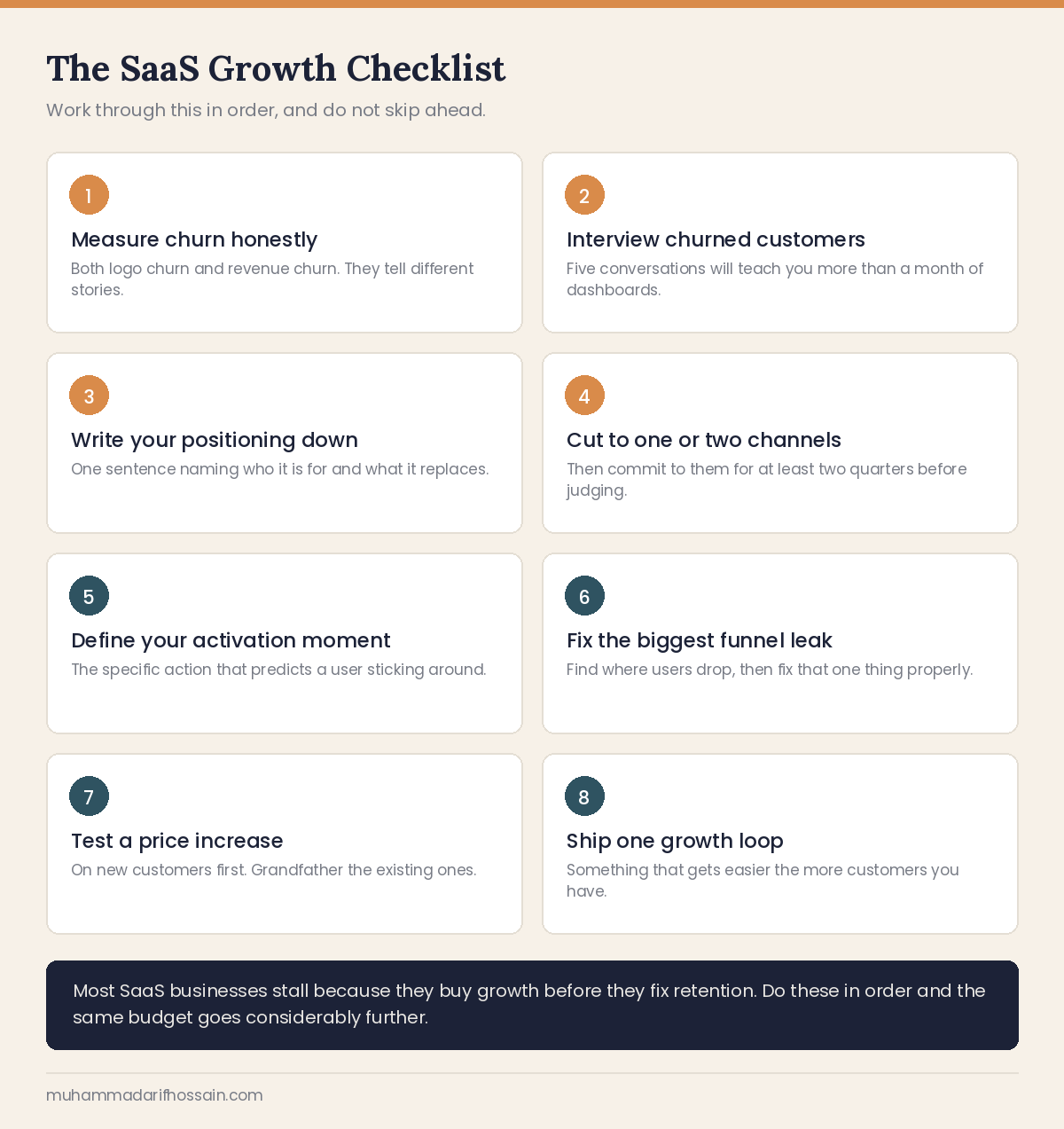
- Calculate your monthly churn, CAC, LTV, and activation rate this week
- Interview five churned customers and five of your best customers
- Write the one-sentence positioning: who, outcome, why you
- Rewrite the homepage and pricing page around that sentence
- Identify your activation moment and rebuild onboarding toward it
- Commit to one or two acquisition channels for the next six months
- Test a price increase on new customers
- Set up one loop: review requests, referrals, or shareable product surfaces
Need Help Growing Your SaaS?
If you’ve read this far and you can already tell which step is your bottleneck, that’s the post doing its job. The harder part is fixing it while running everything else, and that’s where most founders stall.
Growing SaaS and WordPress products is what I do every working day, from positioning and pricing to the channel work itself. If you want a second pair of eyes on your funnel, or just want to talk through where your growth is actually leaking, reach out here. I read and reply to every message myself.
Frequently Asked Questions
What is a good growth rate for a SaaS business?
A good growth rate for an early SaaS business is 10 to 15 percent month over month, though bootstrapped products often grow well at 5 percent. The right benchmark depends on your base, since doubling from $500 MRR means little while 5 percent on $50k is real money. Consistency over many months matters more than any single spike.
What is the Rule of 40 in SaaS?
The Rule of 40 says a healthy SaaS business’s growth rate plus profit margin should total at least 40 percent. A company growing 60 percent can afford to lose 20 percent, while one growing 10 percent should be printing 30 percent margins. It’s mainly a later-stage investor benchmark, so treat it as a horizon rather than an early-stage target.
How much churn is acceptable for SaaS?
Acceptable churn for an early-stage SaaS business selling to small companies is around 3 to 5 percent monthly, and mature or enterprise products should sit near 1 percent or below. Anything above 7 percent monthly means the bucket is leaking faster than most acquisition can fill it. Fix that before spending meaningfully on growth.
Can you grow a SaaS business with no marketing budget?
You can grow a SaaS business with no marketing budget, but you pay in time instead of money. SEO content, cold outreach, communities, and partnerships all work on sweat alone, and plenty of bootstrapped products reached $10k MRR that way. The trade-off is speed, since paid channels compress into months what free channels deliver in a year.
How long does it take to grow a SaaS business?
It takes most SaaS businesses 18 months to 3 years to reach meaningful revenue, and the overnight successes you read about usually had years of quiet iteration behind them. Expect the first $1k MRR to be the slowest stretch. Growth compounds after product, positioning, and one channel start working together.